All posts by running in systems

The Maffetone Method, training the aerobic system, and answers to common frustrations.

For the past few months, I’ve been working in various capacities with Phil Maffetone, who has made many important contributions to exercise science and the endurance sports. He is a proponent that aerobic function—the ability of the aerobic system to utilize fat and oxygen to power the body—is the foundation for all health and athletic achievement.

In a recent article, I discussed this view from an evolutionary perspective: the aerobic system is in charge of the long-term upkeep of the body. Conversely, the functioning of the anaerobic system (which burns sugar in the absence of oxygen) is tied to the autonomic stress response, and necessarily coincides with a high heart rate. The organism primarily uses the anaerobic system to survive an imminent threat to its existence, or (in the case of predators) to capitalize on an opportunity for its survival.

When the anaerobic system stays on for too long—or becomes responsible for the body’s upkeep—chaos ensues. The Maffetone Method (also known as MAF) is all about bringing order to this chaos, and therefore facilitating the body to develop correctly.

A majority of people who try out Phil’s recommendations for the first time—(train at a heart rate that guarantees aerobic function while excluding all anaerobic function)—find that this means running very, very slow. And furthermore, a number of people don’t observe changes to their “aerobic fitness” for some time.

The problem isn’t that the method “doesn’t work.” It’s just that some of our bodies (and in particular, our aerobic engines) are in a state of utter disrepair—and the body is an extremely smart investor. The body will sometimes use the fledgling aerobic system to patch itself up and fill in the cracks before using its newfound potential for anything else.

I often hear that the aerobic system develops slowly. I believe that it develops astonishingly quickly. But while our attention is on the “fitness” we so desperately want—which we want so much that we rarely bother to define it—we miss the fact that the aerobic system is diligently working to achieve it.

Often, the body’s last priority is increasing athletic ability—as it should be. Think about it: if we are succumbing to infections because our aerobic system is struggling to power our immune response, or our bones have insufficient density due to increased acidity (which the aerobic system potently counteracts), then the last thing that we want is to be subjecting this engine to more stress.

This is car engine whose piston rings are rotten. Its valve springs are rusting off and its fuel injection system is all clogged up. Not only do we have no business racing this engine, but the very last thing we should do to it is add a turbocharger. That’s not what this engine needs. But the systems of the human body are so opaque to us, and the cultural narratives around athleticism so damaging, that this is exactly the position that we find ourselves maneuvered into—and outright believing.

ferrari
The human aerobic engine comes from an even better brand. But we need to look under the hood to notice.

Before the body is ready to be challenged with anaerobic exertion, the aerobic system must have achieved 3 benchmarks of competence: (1) as mentioned above, it must provide the overwhelming majority of the energy for the body’s basic upkeep, (2) it must be powerful enough to sustain a high level of brain function—while the muscles are hybrid engines, the brain is exclusively an aerobic animal—and (3) it must be able to adequately absorb the stresses incurred from present lifestyle.

When an underdeveloped aerobic system is being trained, any gains that are made will go towards securing the body’s basic upkeep: if there were chronic issues—such as carbohydrate intolerance, infections, etc—all gains will go first to combat those, and to make sure that they do not reappear. Speed will not increase.

Once that step is complete, any gains in aerobic function will go towards maintaining a high level of stable cognitive function throughout the day: if you had low or fluctuating energy levels, any gains will go towards stabilizing those. Speed will not increase.

And there’s the issue of present anaerobic function: if your your lifestyle or work demands a heightened level of focus, (or hell, you run two blocks with a backpack to catch the bus every day), your aerobic system will have to be that much more robust before it will be able to start contributing anything to your athletic output. Speed will not increase.

Phil Maffetone’s approach to health and athletic achievement does not just require us to develop the aerobic system. When discussing why our aerobic system is so underdeveloped, the Maffetone Method helps us realize that the present fitness culture (and the assumptions and beliefs that surround it) need a major overhaul.

Two people—one with a hugely powerful aerobic system and one without—will find that they have a very different “training response.” One will be able to tolerate a magnificent training volume, and one won’t. Present exercise science—and our own fitness instructors—will often tell us that the issue is genetic, or that we’re not good athletes. But a lot of times, that simply isn’t the case.


Ben Greenfield Fitness on Exercise and The Menstrual Cycle

I just read an excellent blog post over at BenGreenfieldFitness.com, on the topic of the menstrual cycle, how it affects athletic output, and how female athletes should harness it to positively influence training. It’s great stuff. Click on the link if you’re interested.

I’m growing more and more interested in this topic for two reasons: (1) hormones are one of the two main interfaces between the brain and the body (the peripheral nervous system being the other), and (2) there’s very little consideration given in exercise prescription to how hormonal cycles in women differ from men, and how that can affect athletic output, injury rates, and training routines. Although there’s plenty of science on the matter out there, I very rarely see it consciously incorporated into women’s training programs. It’s mostly left to women fitness enthusiasts (and not their coaches) to study this colossally important cycle and then apply the knowledge themselves.

That’s a problem. Why does it exist? I’m sure the reasons are at least as sociopolitical and structural as they are about the science and women’s physiology. Asking why this isn’t in EVERY SINGLE TEXTBOOK AND EVERY SINGLE DISCUSSION on periodization of training is just as important as discussing what is missing.

Ben Greenfield also discussed the topic in this podcast. I haven’t looked at it yet, but I’m sure it’s got some great info. I’ll probably address this topic initially in two blog posts: (1) what the science is and what is being done with it, and (2) where the science should go and what we should do with what we’ve studied.

Cool. Guess that’s it!

High-intensity fitness culture, explained in systems: Physiology, evolution, overtraining in ultrarunners, and what it means for the rest of us.

In the modern approach to training and fitness, the idea that you should (or need to) train at a low intensity is utterly neglected. This neglect is a huge problem. It benefits the few, and harms the many. And even when this philosophy works, it only does so up to a point.

A recent article in Outside Magazine bit into this issue with great abandon. The Outside article discussed the extreme example: Overtraining Syndrome (OTS) in ultrarunners. Many elite ultrarunners have become seriously overtrained, finding that their legendary competitive and running ability evaporates almost overnight. And we see this sort of thing across the board: in crossfitters who get exertional rhabdo; in recreational runners that start too hard. But why does this happen?

Our present fitness culture has an extremely damaging “more is better” and “no pain, no gain” mentality. If your favorite sport is HIIT or CrossFit, you’re prompted to increase the intensity, to “feel the burn,” and to “not feel your legs after leg day.” You name it, it’s out there. If your favorite sport is running, everything around you tells you to collect miles like they were baseball cards—the more the better.

The problem is this: whether you’re an elite ultraunner or someone who is just looking to shed some pounds, the amount (or type) of training that society pushes you towards typically means a lot of stress. It’s not that you won’t get quick results with that high-intensity training program (or by going out and clocking as many miles as you can). It’s that in doing this, a majority of people cross a stress threshold beyond which it’s impossible to keep these gains. It happens to Joe Smith at the gym, and it happens to the ultrarunner.

But in order to understand why it happens (and why you can’t cheat your way around it) we have to discuss a critically important biological system known as the Hypothalamic-Pituitary-Adrenal, or HPA axis.

The HPA axis is the system that creates the autonomic stress response (ASR)—which kicks up the organism’s stress levels (think: alertness) in order to survive a challenge to its existence. Let’s put this in a real-world example: alertness alone isn’t enough for an antelope to escape a lioness. There are two more components to ASR: First, the antelope’s heart rate has to go through the roof in order to bring a high volume of blood to the muscles. Second, the antelope’s anaerobic energy system—which burns sugar without the presence of oxygen, kicks in.

There’s another energy system available to the antelope: the aerobic energy system. It burns a much more plentiful resource—fats—but it takes some time. The fats have to be broken down into sugar, transported through the bloodstream to the muscle fibers, and combined with oxygen inside the mitochondria, before they can be converted into energy. Typically, it takes the aerobic system 15 minutes to get to full burn. But the antelope doesn’t have 15 minutes. It doesn’t even have a few seconds for the initial gulp of oxygen to reach the muscles through the bloodstream. There’s a lioness charging towards it at 40 mph. It needs energy now.

lion hunt
Or towards a water buffalo.

Stress, a high heart rate, and the anaerobic system are hardwired together in every animal. This wiring has to be absolutely reliable. If it wasn’t—if, given certain conditions, you could get a high heart rate and stress but no spike in anaerobic activity—you will die. As far as your body is concerned, in a “real-world scenario” the price for not having these three things occur together every time, with utter certainty, is death.

That’s what your body is thinking—thanks to your HPA axis—every time you get too stressed. Your HPA axis has to assume that there’s an imminent threat to your life, and make all of your internal systems react accordingly. If not, you will die.

The anaerobic system takes over to ensure the immediate survival of the organism. It doesn’t just happen to burn the fuel we use in the short term (sugar). We are wired so that when our bodies are thinking and acting in the short-term (that is, prioritizing escape from a threat over long-term health) we use the anaerobic system.

On the other hand, when our bodies are behaving with the long-term in mind, we use the aerobic system. In the long-term, it doesn’t matter if all the energy isn’t available right now—we’re not running away from anything. On top of that, we have fats, which is a more reliable and plentiful energy source. Sure, it takes a little bit more time to get energy from fats than from sugar, but time is something we have.

But that’s not all: there are reasons to NOT use the anaerobic system in the long-term. Burning sugar without the presence of oxygen wears down the engine: it accumulates protons—hydrogen ions (H+)—which cause the body’s pH to fall, becoming more acidic. (The idea that lactate is the culprit of muscle acidification is a misconception: the presence of lactate predicts, rather than causes, proton-based acidosis in the body).

In the short-term, the antelope’s body doesn’t care about its pH balance. If it doesn’t move, NOW, that lioness will take it down. The temporary acidification of the body is a small price to pay for escape. If everything goes as planned, 45 seconds from now, the antelope will have a chance to calm down. Its stress levels will drop, it’s heart rate will slow down, and a powerful aerobic base will kick in and all the lactate will get churned through the muscle mitochondria and converted into more energy. The proton build-up that happened during the chase will be quickly negated. In that process, a final acidic by-product will come out in a form that the body is designed to quickly and competently expel: CO2.

As soon as the body’s short-term survival has been secured, and it starts thinking in the long-term, it uses its aerobic system.

But if you are under chronic stress, your body never gets a chance to think in the long-term. Remember that stress, an elevated heart rate, and anaerobic function cannot be untied. If you are under stress all the time (even if it’s work stress), you’ll have at least some anaerobic function. Your body will be burning more sugar and less fat. As you use the aerobic system less and less, it will grow less inclined (and less capable) of fueling your daily activities with fat. You’ll have to rely on dietary sugar to keep your energy levels up. You’ll burn even less fat. You’ll slowly and steadily gain weight. But your body will also have a higher proton concentration than it should. It’ll remain more acidic. You’ll wear it down, putting yourself at risk of chronic disease.

Just look at how this snowballs. The media (and your peers) are kind enough to pelt you with exercise programs that promise quick, short-term gains! You can see where this is going. You’re piling acute stress on top of chronic stress. Your problem wasn’t the excess fat itself: it was that your long-term energy system—the aerobic system—was compromised. And those quick, short-term gains that you’re promised? You might get them, but at the cost of keeping them.

Yet again, you’re using the short-term energy system. Yet again, you’re training your body to think in the short-term. The energy system that is responsible for your body’s long-term upkeep is incompetent. By definition, you’ll be unable to maintain that level of activity in the long-term. You’ll lose those short-term gains.

Period.

The problem isn’t that you’re flaky, or that you’re not an athletic person, or that you’re not determined. No amount of discipline or determination will be able to overcome the fundamental problem: that you trained for the short-term instead of the long-term.

No Roads Lead to Wisdom

Great stuff by my brother.

Pessimist Rising's avatarSingle Malt Philosophy

Most people do not know that Bruce Lee studied philosophy at the University of Washington. His project was to bridge Western philosophy with classical Daoism and the traditional Chinese worldview, including yin-yang cosmology and the empty-mind practice we associate with Zen Buddhism. His form of martial expression, Jeet Kune Do, is a manifestation of his philosophy. This is his warning to not try to duplicate the wisdom or insight of others, and to look for your own:

“The founder of a style might have been exposed to some partial truth, but as time passed by, especially after the passing away of the founder, this partial truth became a law or, worse still, a prejudiced faith against the ‘different’ sects. In order to pass along this knowledge from generation to generation, the various responses had to be organized and classified and presented in a logical order. So what might have started…

View original post 553 more words

What do kids need in order to move more? Basic motor skills.

When we see a 7 year old kid running a football down the field like a pro, we say, “wow—what a natural.” And although nobody would argue that genetics and emotional predispositions play a huge role in determining someone’s athletic potential, we often miss the rest of the picture: that the reason this kid is such an outlier has less to do with their athletic ability than with factors that are preventing other kids from expressing themselves athletically with that same ease.

What separates this “natural” football player from the rest of the kids is most likely not VO2 Max or aerobic capacity (which only grows significantly as we get older) but rather that they have a very strong foundation in what researchers call “fundamental motor skills,” or FMS.

The authors of the article in question write that “locomotor skills and object control skills are . . . the equivalent of the ABCs in the world of physical activity.” When a child acquires these skills at an early age, they are far more likely to seek movement opportunities as they get older, meaning that they will have much greater chances to develop the more complex skills necessary to participate in organized sports.

On the other hand, children that did not develop FMS (and consequently did not have these opportunities) tend to become more sedentary. According to the article cited above, not only do they judge themselves as being relatively less skilled than their friends, but they also don’t have the motor skill competence that would allow them to participate in the majority of sports.

The fortunes of the two groups of kids—those with a motor skill foundation and those without—begins to diverge right around here. A recent study showed that the development of aerobic fitness, which helps reduce risk of cardiovascular problems and associated illnesses, is linked to the acquisition of basic motor skills. As we would expect, the opposite is true as well: the lack of foundational motor skills correlates well with sedentary behavior, ultimately leading to obesity. In other words, we can’t just ask someone to go develop aerobic fitness.

Obesity compounds the situation: not only does the increased mass physically make movement difficult, but the roots of obesity and diabetes are is a dysfunction in how the body manages its energy supply—a condition known as “metabolic syndrome.” And since sustained athletic expression is all about correct energy management, it becomes very difficult for someone with obesity to make a lasting change in their health and mobility, particularly if we emphasize that the solution is to “get out more.” That’s not addressing the problem. It is the underlying lack of motor skills that must be changed.

While the genetic and environmental roots of obesity are well documented, these are merely conditions for the proliferation of obesity. They don’t guarantee obesity. Consider why obesity was so well correlated with a lack of foundational motor skills: if someone with every genetic predisposition towards obesity has an extremely strong motor foundation, they would find themselves making the most of every opportunity for athletic expression. The conclusion of the first article cited reads: “the degree of motor skill competence is a critically important, yet underestimated, causal mechanism partially responsible for the health-risk behavior of physical inactivity.” In other words, those predispositions would likely never manifest, much less turn into a full-blown case of metabolic syndrome.

The fundamental solution isn’t to get kids moving more—at least not when they are already in grade school. By that time, those who are getting left behind are already lagging in their foundational motor skills. We’ve all seen the effect that PE class has on certain kids: for those without the requisite skills, every class, every athletic situation, brings nothing but humiliation. That subset of children, along with a significant portion of those who are overweight or obese, won’t—or rather, can’t—benefit from the opportunity provided by PE class: not only is the social importance given to competitiveness and competence toxic to the motivation of someone who has neither, but also, their skills are often subpar in some important way.

Whatever the minimum standard for competence may be in that particular sport, they aren’t capable of meeting it. As a pitcher, they don’t have enough accuracy with the baseball to be confident they won’t hit the batter. As a soccer player, they don’t have enough gross agility or fine motor control of the feet to go after the ball, expect to win it, or know what to do with it if they did. And the problem—the unseen, unacknowledged problem—is not that they don’t have the skill, but instead that they don’t have the foundation they need for that skill to grow in the first place.

The reason this situation is so well-known to us, and why it exists as such a common trope in coming-of-age movies, is that its underlying causes are so damn opaque to the eyes of the typical athletic coach. Most coaches, even the good ones, just don’t understand what is happening: they focus on the lagging students and attempt to teach them the sport, and consequently destroy their motivation on a wall of frustration. All along, their focus should have been on the foundation. And even those who catch on to the fact that it’s the foundation that’s missing often don’t know where to begin.

Sports or physical education in the classical sense just won’t do the trick. Nor will your average coach or gym teacher. We need a more skilled, more inquisitive, and more creative specialist to deal with this situation. Already, the challenges that face most of these kids aren’t personal—they are systemic. It is not a lack of drive, or willpower, or audacity that stops them. It is their relative motor ability, the laughter of society’s persistent superego, and often, the mass of their own bodies. There is no effective way to address this problem, except at its roots.

And the effects of good motor ability reach far beyond the athletic domain. As recent research has shown, the ability to perceive objects as three-dimensional, and being able to manipulate them, grows alongside motor skill competence. In other words, developing a solid motor foundation has untold cognitive benefits. We owe it to these kids, to the very young kids (and to those who are already highly skilled) to make every motor opportunity available.

Enough of telling little kids to sit still and be quiet. Enough of expecting those same kids to know how to move under their own power two or three years down the line. Enough of forgetting (or never realizing) that the least skilled and least competent are often the most focused and driven. We need to be better than that, for everyone’s sake.

Getting to the root of fitness issues: are we doing it right?

It’s a sad business, the way we treat fitness. We well-meaning enthusiasts chide those who’d rather stay on the couch, and tell them they’d be so much better off if they just go for a run. We’ve been taken in by “no pain, no gain” philosophy. We believe that it’s a matter of willpower, because hey, going out for a run is pretty tough.

And we did it ourselves.

But have we really thought about why someone else may still be sitting on that couch?

Let me present you with a possibility, best explained with a metaphor. Suppose that you go free climbing with a friend that’s much better than you. You get to the first pitch and just by eye-balling it, you know you can’t do it—or at least that you’d be much better off in a harness.

I submit to you that a very similar calculation is going on in the head of that person we’ve so dismissively labeled as lazy: faced with the prospect of a two-mile run—that’s just 15 minutes of running!—their brain analyzes their body’s motor and endurance capabilities, but has no words or protracted arguments to explain this calculation. So it acts in the only way it can, in the same way your brain acted faced with that rock wall: it speaks to their subconscious.

And how does this manifest? Your friend the couch potato becomes daunted, queasy, unsure, and discouraged.

This happened for a reason. Professor Tim Noakes, who I believe is a proponent of a solid 30% of today’s sensible nutrition, lifestyle, and exercise prescription ideas, proposed the central governor theory. The central governor is a predictive mechanism in the brain that analyzes the body’s athletic capabilities with regards to the expected performance requirements of the athletic event, in order to produce an optimum output—one which ensures that the event is completed, that the best performance is produced, and that the body is in a condition to perform again.

Your friend’s brain did this very calculation, and gave their subconscious the thumbs-down.

Guilt-tripping them into your chosen activity is doing them a disservice. Through sheer luck they might not get injured, and through even better luck they don’t completely hate running afterwards. But in terms of their health and bodily integrity, you effectively cornered them into rolling the dice.

So what? What now? We’re supposed to just let them sit on the couch for the rest of their life?

No. Absolutely not. Everyone should have a peer or mentor to pull them out of their comfort zone and propel them towards excellence in areas of life they couldn’t have believed possible. Just not that way.

The mentor or coach has to be wiser. They have to be willing to ask the question: Why?

They have to be willing to ask it again and again and again.

This reminds me of that show by Louis C.K., when he describes how his daughter just bombards him with questions that quickly veer towards the existential, until he explodes in frustration. Well, all respect to Mr. C.K.’s reaction, I believe that at the end of that long and agonizing chain of “why’s” is the answer to why someone is still on the couch while you and I have long since gotten up.

And here’s a clue: it wasn’t laziness. When you refuse to stop there, and ask “why” yet again, you’ll find an answer, if you look really hard. And if you’d looked really hard at your friend, you might have seen a frozen right gluteus medius, or a pair of shortened psoas that turns their hips into an unmoving mass of muscle instead of the well-oiled differential you were expecting.

Unfreeze that right gluteus medius. Help them lengthen those psoas. You might just see that their inexplicable reticence vanishes overnight.

Exercise, the fitness industry, and the pursuit of skill.

Most of the people that I know work out to lose weight, to put on muscle, or to get fit. Modern ideas about exercise and athleticism pushes us in that direction. The message is clear: workouts are a means to an end.

There’s a big problem with this. Weightloss and “fitness” are—and have always been—side-effects of more movement.

Just going to work out isn’t enough. Think about this: if you run a few miles, and your skill level (meaning the combination of experience, strength, and endurance) isn’t enough to sustain that distance, you’ll end up breaking your body. “Just doing more exercise” requires something very particular.

It requires developing more skill.

But a lot of the people that are out for a run or at the gym—they just want the weightloss. They’re not in it for the skill. That’s fine, and it’s certainly not their fault: a variety of media, driven by a powerful marketing machine, have impressed upon them that their self-esteem, social acceptance, and their health is subject to whether they exercise or not.

So they expend precious mental capital to get out there and go burn some calories. But what the fitness industry has not told them—what it relies on them to discover alone—is that movement opportunities are created by movement skill.

Think about it: most of our urban areas are an uninteresting environment, and vertical urban environments are impassable (and alien) to the majority. But to the traceur—the parkour practitioner? This is their playground. To the average runner, the highway, with gas stations every ten miles, means nothing. But for the ultrarunner, that same environment is nothing but potential.

The experienced ultrarunner, skilled and knowledgeable in the art of the running gait, can burn five thousand calories, and then go burn some more. Leanness (and fitness) is a by-product of the ultrarunner’s quantity of movement—but their quantity of movement is a direct function of their movement skill.

Movement skill always precedes quantity of movement. This puts the average gymgoer in a catch-22. Remember: they’re not in it for the skill—they’re just in it for the quantity. That’s what they’ve been told is important, and furthermore, here they are, at the gym or on the run, despite their interests and wishes. By focusing on weightloss or fitness (but not movement skill) as a fitness goal, they are quite literally compromising the achievement and maintenance of their stated goals.

Not all fitness goals are created equal—but not because some are worthier than others. In any skill in any domain of human activity, competence is a prerequisite for the achievement of any goal. Some goals are simply more conducive than others for creating the competence required to achieve a broader array of goals in that domain.

As movement expert Gray Cook said, “technique is always the bottleneck of limitation.”

Technique—skill—is the bottleneck goal. Without technique, the achievement of all other exercise goals (fitness, weightloss, or muscle growth) will be compromised.

We athletes and fitness enthusiasts must become ambassadors for this idea. The belief that the pursuit of skill is just one goal of many is flawed, and it militates against the athletic achievement of those whose only mentor is media. Skill, and not shoes, and not gear, makes you fast and powerful. Movement quality drives all sustainable increases in training volume. Until we internalize that, many of us won’t achieve our fitness goals, and we won’t understand why.

I really hope that Alberto Salazar isn’t cheating.

Apparently, Steve Magness, one of my very favorite coaches, thinks that Alberto Salazar is doping his athletes to win a competitive edge. I’ve written before on how I believe that Salazar is a great coach, particularly since (I believe) he learned from the mistakes of his past—overtraining to the breaking point—in order to take better care of his athletes. That’s one of the reasons I’ve admired him for so long, and why I follow the Nike Oregon Project track stars Mo Farah and Galen Rupp.

Please, Alberto. Don’t let us down.

Here’s the link to the article.

Is “being slow” a protective measure for runners with bad form?

We runners—and the scientists that study running—cannot seem to get away from talking about form. Across all sports, we have discussions about “good” or “bad” form. In running we don’t: we argue that all runners are different—that somehow, in running we are all unique. In principle, I think this is a little odd: when we’re trained correctly we all swim alike, golf alike, punch alike, but not run alike?

Maybe there is no right way. Maybe there is.

In recent posts I’ve made the argument that, for all sports, “good form” means “the musculoskeletal configuration that can produce the greatest power output.” I believe that we should adopt the same standard for running. I believe that if we don’t, we are depriving people of the guidance they need to achieve their athletic potential.

There are several reasons for this. As I discussed in earlier posts, the first and most important reason is because across sports (whether they be power or endurance sports), the winner is the one who can generate the most power—technically, who can produce the most work (or energy) in the shortest amount of time. This is obvious in track and field sports, but it holds even for the ultramarathon: the best ultramarathoner is ultimately the one who converted more energy into forward motion in the shortest amount of time.

But there are deeper reasons: For example, a reduction in power output—running slower, that is—can be a protective measure.

The brain has excellent muscular inhibition capabilities. In a well-known lecture, Gray Cook eloquently describes how, when certain shoulder problems exist, the brain reduces the body’s grip strength if and only if the hand rises above the shoulder. When the brain detects that there’s a problem, it inhibits muscular activation that would allow for a behavior that could result in damage: gripping something heavy above the shoulder level is dangerous with an unstable shoulder, and so the brain disallows it.

Running, an activity in which the body incurs an astounding amount of shock and load, should follow the same pattern: if there is an important mechanical or neuromuscular pathology, the brain will limit the energy available to power the running gait.

Yassine-diboun
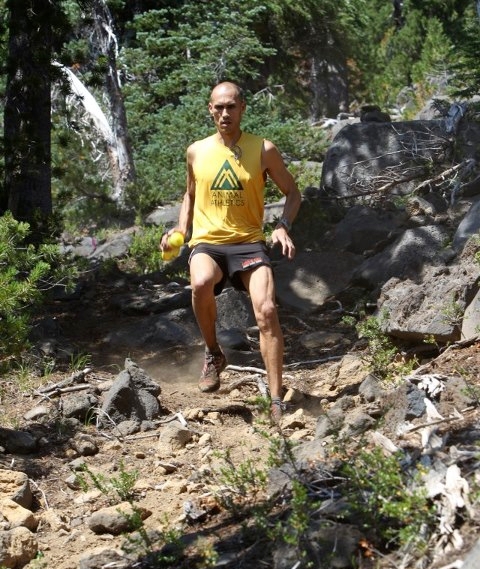
Yassine Diboun, one of the heroes representing the US in the 2015 IAU Trail Championships. (This is NOT a slow runner).

Suppose that someone toes the starting line on a marathon (or a 5k, for that matter) with unstable hips, dumb glutes or abdominal muscles that don’t know how to stabilize the spine in relation to a pelvis (and lower extremities) that are going to be contralaterally loaded with up to three bodyweights per stride. In that situation, it is completely reasonable for the brain to execute a similar calculation to the one that Cook describes in the abovementioned video. However, instead of reducing the power output available to the hand and forearm muscles, the brain inhibits muscles related to gait (whether they be the weak muscles themselves or other muscles up or down the kinetic chain).

Either way, those muscle imbalances are reducing power output, effectively producing a “slow runner.”

But lets think of the implications of this: How many runners are protecting themselves from injury by being slow?

Let’s put this question in a more compelling format: how many runners with a high risk for injury are remaining untreated (meaning that their athletic development is being compromised) because they have been conveniently categorized as “slow runners”?

We shouldn’t just say that the correct running form is what “feels right”: suppose that a golfer has poor sensation in their external and internal obliques. Would the proper golf swing “feel right” for them? Absolutely not! That golfer must go to a health specialist to integrate those muscles functionally into the rest of the body. Then, that musculature must be trained to produce the golfing swing that can generate the most power.

Similarly, establishing the “correct” running form as the one that allows people to produce a greater power output allows us to guide people towards greater athletic performance.

But there’s more: remember that inhibitory reductions in power output are a protective measure. This means that the process of “running the right way” will center around eliminating neurological, muscular, and skeletal imbalances and their resulting gait pathologies. That way, all protective reductions in athletic output will be minimized. More people will be fast, and they’ll be fast because they’re less likely to be injured.