All posts by running in systems

Deconstructing the Plateau: Part 2

When our athletic ability plateaus, and we no longer see the gains in speed, strength, or endurance that we used to see before, we tend to increase our training volume: more hill repeats, more squats, more miles.

Training like this is rarely the right answer. The human body is a phenomenally complicated system—those of us who have been chronically overtrained and injured know that for a fact.

Obvious, straightforward approaches aren’t enough for a system like this. Sure, there are parts that are plainly related to particular abilities: fast-twitch muscle fibers, sugar and ATP to speed, slow-twitch muscle fibers, lungs, fat, and mitochondria to endurance, and muscle size and maximal effort to strength. But ultimately, we need to appreciate the behavior of the system as a whole, and tailor our training to the system as a whole.

If we want to achieve this, there is no idea more important to understand than the systems thinking notion known as emergence.

Emergence addresses the fact that a whole is larger than the sum of its parts: while the parts of a particular system, whether they be atoms, muscles, cars, or people, have properties of their own—atoms are vibrating at certain rates, muscles can be strong or weak, cars can be fast or slow, and people can be skeptical or not—when you put these parts together into a system, you get properties that apply only to the system, and not to the parts.

In other words, these properties emerge from the interaction of the parts, and therefore, of their organization into a system.

These are called emergent properties.

Solidity, for example, is an emergent property. A liquid becomes a solid when the molecules that compose it get colder (and therefore closer together) and move beyond a certain temperature threshold. Nothing happened to the molecules themselves. But the changing nature of their interaction changed a property that expressed itself in the system of molecules: that system went from being a liquid to being a solid.

In the same fashion, speed, strength, and endurance are emergent properties of the human body in the athletic domain. How so? Even if one muscle is strong, fast, and possesses good endurance, it can’t express that speed, strength, or endurance unless the rest of the body’s faculties—opposing muscles and circulatory, endocrine, and nervous system, to name a few—are also functioning properly and interacting correctly with each other.

What does this tell us?

That the particular capabilities of particular muscles or internal bodily systems don’t matter as much as the proper interaction between those systems.

To develop greater endurance, it is not enough, for example, to train simply the aerobic engine (even if you think of the “aerobic engine” as comprising the lungs, blood vessels and capillaries, diaphragm, all the way down to the mitochondria). Bone, tendon, fasciae, and even the fluid sacs around the joint must be developed enough to withstand the added use made possible by a more powerful aerobic system.

Without developing these systems—and others—together with each other, and ensuring that they are equally balanced and capable of interacting with each other at the highest level of performance, we’ll see our increases in athletic ability slowly grind to a halt.

Why?

In a previous post I mentioned how different variables—say, the power of different bodily systems—go from being apparently unrelated to being frustratingly interrelated as we develop the system’s capabilities:

“The perceived set of independent variables changes to a formidable set of interdependent variables. Improvement in one variable would only come at the expense of the others.”

-Jamshid Gharajedaghi

That is essentially what is happening here: as we develop the cardiovascular system, the musculoskeletal system, or the nervous system, we find that further increases in our cardiac output, muscle power, or ability to concentrate lead us down a problematic path. If we develop too much capability in one of these domains, without training others, we’ll end up creating conditions—like running too many miles on untrained calves—that will end up destroying our athletic ability.

But there’s more to this than just training each given component, and more to it than even training them to match each other’s capabilities. As I mentioned above, systems aren’t really built from parts; they’re built from interactions. So we must train the ability of the different parts to interact with each other.

To name one common example of what happens when we don’t, there is the Valsalva manuever, which consists of holding our breath when we exercise. We do this because of a dysfunction of the deep muscles of the hip and the spine, and their inability to work together with the diaphragm. The Valsalva manuever can raise thoracic blood pressure to dangerous levels, and put the athlete’s life at risk.

It is typical to see runners with hip/spine dysfunctions hold their breath every few steps, or time their breath to the landing of a particular leg. This has the potential to exacerbate a whole bunch of gait problems, not to mention the loss of speed, power, and endurance, and the effort implied in having to overwork the lungs to make up for the dysfunction at the hip and the spine.

This, or some form of it, is typically why as runners and athletes we plateau. We can’t move forward with our development: the components themselves are preventing each other’s ability to evolve.

The underlying problems must be resolved, but above all, the functioning of these systems must be synchronized. They must interact; their functioning must assume that the other system is also at play.

When we achieve this with more and more of the body’s components we will observe dramatic increases in the emergent properties of the athletic body: speed, strength, and endurance.

Walking, jogging, running, and how gravity defines them.

What is the difference between walking and running? As runners, particularly runners who often stake their identity on running, this is a question that we should have thought deeply about. But the reality is that in the vast majority of cases, it remains ignored.

Say, the simplest and perhaps most important difference between walking and running—or at least the one with the most consequences—is that running includes a flight phase while walking does not. In other word, walking has a static interaction with gravity, while running has a dynamic one. But upon further consideration, there’s a lot more to be said:

Bounding (by which I mean jumping continuously) also has a flight phase. So does skipping. Of course, these are obviously different from running in that running alternates support, similarly to walking, whereas bounding does not (since both feet land together) and neither does skipping (since each foot repeats its support of the body before alternating to the other).

Running is somehow special when you compare it to bounding and jumping, at least as far as the body is concerned: when we need to travel faster than walking allows, neither bounding or skipping are our go-to methods of travel. Instead, we run. Although this may seem too obvious to be important, it’s important precisely because of that: What is it exactly that running offers us?

All the biomechanics junkies are way ahead of me at this point. Running offers us a way to contralaterally (read: using one leg and its opposing arm) maintain balance and support: when one leg pumps down, the other arm comes up, allowing the body to push on the ground alternately while not compromising balance.

And there’s another requirement: running uses the energy return capabilities of our tendon system (in particular the achilles tendon) to maximize running economy. This means that, by loading the achilles tendon like you would load a spring, the body manages to put the force that it arrives at the ground with into the next step, to make running more “economical” by reducing the amount of energy that the body puts into the next stride cycle: the achilles tendon stretches during the landing and stance phase, and then shortens explosively during pushoff, when the leg and foot, well, push off against the ground to begin the next stride cycle.

Neither bounding nor skipping allow us this increase in economy: to be able to bound successfully, we would have to be counterbalanced in the sagittal plane, (read: front to back) in order to put the hips at the midline of the body. Basically, we’d need a tail. But since we don’t, when we land from a bound (or squat), the hips are behind the center of gravity, and the knees are in front, in order to compress the body properly.

But if we had a tail like a kangaroo, the hips would remain under the center of gravity during the landing phase, because our weight would be more evenly distributed behind and forward of our hips. Without going too far into it, this means that the force put into each bound is primarily generated by muscle power for us, whereas for the kangaroo it is a product of tendon energy return. Skipping doesn’t increase economy either since energy is lost in that second step before alternating legs.

Flying-kangaroo

So, we can begin to lay down the differences between running and walking in this short list:

  1. A flight phase
  2. Contralateral stance and equilibrium
  3. A maximization of running economy

This is where we finally get to why “interaction with gravity” is so important: when running, the human body puts itself at risk of injury by taking off and then accelerating back to the ground, but it is counting on using that acceleration, generated by the force of gravity, to power its next step. This means that an important amount of the energy that is being put into each step is borrowed from the last, and doesn’t come from inside the body at all.

Running diverges from jogging in the following way: Jogging doesn’t really harness the energy return properties of the tendon system. It doesn’t allow for an improvement in running economy. Why not?

In order to create energy return, the relevant tendons (say, the achilles) have to remain taut during the landing phase, in order to stretch. This means that as the foot lands, the extensor muscles along the rear of the leg (hamstrings, gastrocnemius, glutes) begin contracting even as the frontal muscles (quads, tibialis anterior) take the majority of the load.

When the back and front muscles play together like that, a large amount of the energy that the body accelerated towards the ground with goes into the tendon system, and gets released as the foot leaves the ground.

During a jog, the leg muscles are working in a fundamentally different way. Because a jog is slower than a run, the forces being generated are a lot smaller, and so a the rear and the front muscles of the leg can work relatively independently of one another: the front muscles take the body’s load when the foot comes down, and the back muscles push off as the leg goes back. The tendons never become stretched, so they don’t get loaded that much at all.

This means that the jogging cadence is much slower than the running cadence: in order to maximize tendon load, the body is forced to increase the speed and rate at which the legs hit the ground: since the muscles at the back of the leg tense the tendon springs, this drives the leg down at a much greater speed than otherwise, resulting in a faster transition from landing to pushoff, resulting in a much faster stride rate.

However, this also separates jogging from actual running from a power standpoint: in order to run rather than jog, the muscles must be powerful enough that they can hold the tendons taut while the weight of the body comes down. (And of course, the tendons must be resistant enough to support this).

This is the minimum bar in order to run—developing enough leg power (and naturally, the aerobic power necessary to sustain it) that three interrelated capabilities emerge:

  1. The ability to hold the tendons taut throughout the stride cycle.
  2. Increasing the stride rate and successfully maintaining it.
  3. Equipping the body to successfully load tendons instead of absorbing power with muscle and bone tissue.

I believe it is these three capabilities that make someone a runner.

Deconstructing the plateau: part 1

All too often, as runners and athletes we hit a “plateau”—a period of time where we don’t improve, and where increased training seems to shove us into a downward spiral of overtraining and injury. Rinse and repeat. Thanks to our own overactive imagination, or to the whispers of the running superego, we conclude that it’s our genes. Our genes just won’t let us. Continue reading Deconstructing the plateau: part 1

Running 101: Not the same as 102.

For beginners, running—or rather, training to run—means one thing. For skilled runners, it means another. Running 101 is not the same as 102.

In a previous article, I discussed why it was important for beginner runners to consider that the key to begin running safely (and successfully) isn’t just to “wing it,” but rather to understand what running implies in physiological terms, and to adapt the body to interact with those specific stresses.

The problem is that in a supermajority of cases, running is treated in the very same way for the very beginners as it is for the well-versed: everybody just goes out and runs, does the same types of exercises, and periodizes their training in very similar way. Granted, the intensity levels involved are quite different between the beginners and the advanced, but that’s basically where the differences end.

But those differences shouldn’t end there. It is not the same to train a runner whose run since childhood, whose bone, tendon, and muscle are well-adapted to the stresses of the run (and whose form provides the geometry necessary to utilize the forces involved in the most efficient and least injurious way), than to train someone whose body has no more idea of how to move under their own power, at speed, over variable terrain, for an extended period of time (in other words, of how to run), than of how to fly a spaceship.

Roughly speaking, the difference between the beginner and the advanced runner is that the beginner is in a process of explicit development of function and infrastructure. The advanced runner can focus on developing the larger (macro) structures: muscles and organs, because the infrastructure is already in place.

This second process is a process of expansion, where the further development of infrastructure is contingent on the expansion of larger structures, and not the other way around. In other words, the order of development flips: training for beginners develops infrastructure, and developing macro structures is a result of that. Training for advanced runners develops macro structures, and more infrastructure is put in place as a result of that.

In essence, form must be found first. The body must adapt to the stresses of the run, and develop the power to sustain a baseline cadence that is typically (but not necessarily) between 170 and 190 strides per minute.

That cadence allows us to shorten the time we spend in the air accelerating towards the ground by the force of gravity. Once we develop the baseline power necessary to achieve this, and we know that we have our interactions with gravity dialed in, should we begin to do more “traditional” training.

Only then is it prudent to begin developing speed, power and endurance in the earnest. In a nutshell, this constitutes the much-overlooked divide between the beginner and the advanced.

The first and most important component of form is to achieve consistent triple flexion and triple extension during the running stride. “Triple flexion” and “triple extension” refer to concerted flexion and extension of the hip, knee, and ankle joints during the running stride. Achieving this necessitates that the upper body retain a certain geometry (read: form) during the stride cycle: an arched, proud back, a slight forward lean, and arms bent loosely at the sides.

By achieving this, we can ensure that at all times during the run, the body’s geometry is ideally positioned to interact with the force of gravity, and to conduct the generated mechanical energy fluidly throughout the body (rather than having that energy abruptly stop at all the typical places: the ankle, the knee, or the hip).

That, my friends, is what we call “injury.”

So, what are the components involved in training appropriately?

1.    As readers of this blog are probably tired of hearing by now, my favorite way to begin this process is by jumping rope the right way.

But jumping rope does more than develop flexion and extension: it imitates the shocks of running in a much smaller proportion. It provides an excellent way to let the tissues begin adapting to the stresses, to develop a comprehensive mental schematic of how best to absorb shock and return energy, and to develop the power necessary to begin transferring those rehearsed actions to a much more demanding arena: the run.

However, I like using a few other exercises to lubricate this transition:

2.    Squats with minimal weight and high repetitions.

3.    Box Jumps (both single and double-legged).

4.    Various hip mobility/core exercises; (when correctly defined, these are pretty much one and the same).

The box jump is a particularly cool exercise, since it forces us to triple-extend and then to triple-flex in mid-flight, to land on the higher surface. It provides us a great way to neurologically program triple flexion and extension at higher percentages of maximum voluntary muscle contractions (MVC).

(The mechanics of box jumps and their implications to the running stride deserve another post unto themselves).

All of this said, there is another training strategy that I like to use in parallel with these basic components:

5.    The Slow Progression:

The slow progression is exactly what it sounds like: progressing in the time spent running such that gains in performance occur below our threshold of perception. In other words, we want to be increasing so slowly that we barely realize we are exercising.

Why?

The most important reason for the sheer slowness is to account for time. Everyone wants to be a runner TODAY. People want those performance gains now, and those fat losses now, and they want those changes to be sustainable. Well, they can’t have their cake and eat it too—not in the long run (pun very much intended). It takes time to develop extensive capillary networks into the muscles. It takes time to adapt the bone and fasciae to withstand the repetitive shocks of running. It takes time to increase density of tendon tissue to a point in which they are strong enough to take the body’s weight during landing (and returning it to the next stride) without worrying that they’re going to tear a couple thousand steps later.

Remember: when human children run since the day they can stand, their entire young life serves as a slow progression—one that lasts a decade.

What I propose is one that lasts one year: fifty-two weeks.

For the first two weeks you run two minutes, and you keep adding two minutes to your run, every two weeks. (The third week you run four minutes; the fifth week you run six). Although this may not seem like a lot to you—remember: that’s the point—know that at the end of that year you’ll have the potential to be running fifty-two minutes a day, every day.

Contingencies aside, after that year you should be ready to move from Running 101 to Running 102.

Training for training: why we need to get our bodies ready to run.

 The question I hear possibly the most often (about running or otherwise) is this: “I want to start running. How do I begin?”

I have to admit, I often answer this question a bit defensively, almost pre-empting any further questions or comments by saying “whoa, slow down.” Almost invariably, I find, people want to be runners tomorrow—immediately, that is. And for the majority of people who ask me this question, who stopped due to injury—a torn ACL, shin stress fractures, chronic plantar fasciitis—the answer isn’t what they’d like to hear:

 Slowly. Very slowly. Considerations aside, a 5k in a year. A marathon, in ten.

For most, there’s a lot of ground to be covered, a lot of the body’s infrastructure to be built (or rebuilt), before we can legitimately consider that this body is prepared to run: we’d like to believe that all the complex movements that we make every single day—brushing our teeth, getting up from a chair, typing on a computer—are really as simple as they seem to us.

The truth is that they aren’t. Using a single hand in a skilled task takes an enormous amount of the brain’s computing power, to synchronize all the muscles just so. The brain must find a way, then, to counterbalance the movements of the hand with fine-grained activity in the postural muscles in the trunk and hips. If this is done incorrectly, we fall over.

(Likely, this is a major contributor to falls taken by senior citizens: an aging brain is not as capable at navigating these immensely complex tasks as it once was, and once, every ten thousand steps or so, something gives).

When we run, we’re doing the same: we’re using the body for a staggeringly complex task, one which demands that we maintain balance, and all of this occurring when there are enormous forces at play. Although we humans sometimes fancy ourselves weak and delicate beings, our bodies are powerful athletic machines, whose power is tempered by a superior cortex (in the brain) which micromanages our every move to a degree we cannot begin to fathom. And we exert all of our athletic power against the force of gravity, which brings us crashing to the ground at a rate of thirty-two feet per second squared.

We have to prepare our bodies for that, in a way that observes the enormity of the task. To do anything else is folly.

Any successful training program will have to put first things first. For runners, this means the ability to get the entire body, but most importantly the hip, knee, and ankle regions (this includes the foot and lower back) to effectively engage with the force of gravity. (Lower-body plyometrics, but especially jumping rope, do exactly this). Once you do that, the rest of the body’s mechanics basically fall into place. And after that happens, dramatic gains in ability will begin to happen as a matter of course: it is now possible to sustain heavy endurance and speed training, with reasonable confidence that injury will not occur in the regular course of training.

From this discussion, I draw the following principle: in order to become proficient at any athletic enterprise, we first need to prepare our bodies to engage in training.

 You may think that I’m splitting hairs—that training is training, and that’s all there is to it—but I think there is an important distinction to be made here: namely, that any athletic pursuit has at least one overt and at least one covert component.

What do I mean by this?

Take, for example, the case of classical martial arts, say boxing. In order to develop our boxing ability, we need to develop speed, power, footwork, and reaction time. These are all overt components. But there is an objective to all this speed and power: to bring our fists into contact with an adversary’s body.

This is where the covert component comes in: We have to develop the integrity of the bone, muscle, tendon, and fascia in our hands and arms, which translate all of the force we generate into the body of our opponent. Our upper extremities have to be ready for that.

Now notice I didn’t write “strength.” I used a more technical term: “integrity.”

Boxing, like running, is a chaotic enterprise. This means that every step we take is a little different than the last: either the ground is different, or a part of our body is getting more tired, (or, in the case of boxing, our hands are coming into contact with unexpectedly uneven and hard surfaces on our opponent’s body, or our heavy bag).

It is not only important that the muscles in our hand be strong, but also that they be capable of adapting and re-adapting to these changing conditions, and to the massive (and changing) forces that occur. If we look at this problem overtly, and say “we need strength,” we may end up solidifying our forearms (or our calves), and turning them into hard, resistant structures.

But like the parable of the oak and the willow shows us, a term like “strength” cannot be easily defined when the objective is performance. In this parable, an oak and a willow are subjected to hurricane winds. The oak takes the burnt of it: it stands strong, immovable, as the winds pick up and pick up. In this wind, the willow has already begun to bend.

As the winds become inexorably stronger, the willow bends further, but the oak, which does not budge, begins to creak and creak until it is torn out by the roots.

The oak was strong because it was solid. The willow was strong because it was interactive. This should cause us to reminisce in a well-known saying:

“Be water, my friend.”

-Bruce Lee.

Like the willow, and Bruce Lee’s metaphor, our strength ultimately resides in the capability of our bodies to interact with the mechanical energy that we generate, and the forces that surround us.

If we runners make our bodies hard and resistant—or neglect any preparation at all—we’ll find ourselves in a position where we’ll only be able to train our speed, our endurance, or say, our VO2MAX, up until our body gives (which it will).

But if, instead, we train our body’s interactivity, we’ll become increasingly capable to interact with the mechanical energy that we generate, and with the forces that surround us.

Ultimately, integrity doesn’t just mean the integrity of our bodies in an of themselves, but the integration of our bodies within a system: when we box, our bodies and minds form a system with the heavy bag and all of its dynamics. When we run, our bodies form a system with the changing terrain.

Once our bodies are integrated with the relevant systems and forces at a basic level—once they are ready to engage in trainingwe can begin to increase the magnitude of the demands on the system: as boxers, we can begin to increase the speed and power of contact, and as runners we can begin to genuinely extend our endurance, increase our speed, and maximize the level of effort we put into our runs.

Does “strength” really come from the muscle? This is why you should care.

I’ve been reading quite a bit of the time-course of adaptations to exercise, and one aspect has stuck out above all: most of the initial strength gains that we make when we subject a muscle system to exercise is due to neurological adaptations, not muscle growth. In fact, muscle growth only begins to happen in significant measure 4-6 weeks after exercise.

As regards our cultural obsession with musculature, this opens up a huge can of worms. If a big part of getting fit is in the brain—which it is—why do we appraise people as “fit” or “athletes” given their visual muscle tone? Why does our appraisal not typically include the finesse of their biomechanics?

Maybe, when we say we want to get fit, we don’t really know what we’re talking about. (I certainly think that this is the case). And since we don’t know what we’re talking about, our only choice is to center on the obvious: muscle size, and for those budding connoisseurs, muscle tone.

But like most problems with a social component, the buck doesn’t stop there. If we think that the majority of fitness resides in the muscle, when it actually resides in the brain, then our strategies to get fit will reflect our flawed idea of the body, rather than the body itself. Consequently, the only people really getting fit will be those who pierce the social veil—sidestepping the social obsession with musculature—to focus their efforts in training that actually improves the body’s functioning.

And you find yourself in a situation where majority of people at gyms and health clubs, going there to “get fit” only end up spinning their wheels.

Many get discouraged, and only a scant few end up “getting fit” after all.

Those who did, it was likely because they learned something along the way, and their idea of how to exercise changed fundamentally.

Changed into what? You might ask.

Into this philosophy, best condensed by The Gait Guys in this post:

Skill, Endurance, Strength; in that order.

Why? Skill requires the largest diameter afferent (sensory) nerves to accomplish (Ia and Ib afferents from muscle and joint mechanoreceptors); they are the fastest pathways; Endurance comes from larger sized Type I (and sometimes Type IIa) endurance muscle, which are oxygen dependent (aerobic) and are rich in myoglobin, glycogen, mitochondria and capillaries; Strength last, because it comes from smaller, Type IIb fibers, and is largely glycolytic (depends on anaerobic respiration) and is dependent on the other 2 (skill and endurance).

The brain comes first.

If you get skill, you’ll end up with endurance, and then you’ll be prepared to develop strength. The training programs of a wide variety of athletes demonstrate this philosophy, both in the macro and the micro levels. Runners start their training year doing long, slow runs, building skill at a relatively low level of intensity, and getting all the muscles accustomed to moving with each other. Martial artists, throughout their careers, drill first. Focus on form is paramount, and only until the form of a particular movement can be accomplished perfectly does work on speed actually begin.

This is similarly expressed in the layout of a training session: first you do aerobic warm-ups, getting all the muscles up to speed and the brain to a high level of alertness, and then you up the intensity. In martial arts, first you warm up, then you stretch, then you drill, and at the end you apply the training in combat. Not the other way around. Never.

This philosophy works because it observes the realities of the body. Cut back to the gym, where you see a majority with their focus on their strength progression: how fast am I improving my ability to lift?

Now consider that most started out doing bench-presses wrong. They’re lifting more and more, and at a certain point, sooner or later, they’re going to plateau—or they’re going to get hurt. That’s because, instead of working out the skill, which, as stated above, largely resides in the brain and nervous system, they worked out the strength of those muscles which were already skilled.

Had they worked on their form first, their odds of becoming injured would be that much lower.

Runners, consider this: genetics aside, it might be that good runners are good not because they “have good form,” but because they worked on their form first, and their endurance and strength emerged in function of that development of skill.

Leaning forwards to decrease knee pain? What exactly do you mean by that?

According to this research paper, leaning forwards during a run may be a way to reduce frontal knee pain, since it effectively causes the body’s weight to be borne by the hip area rather than the knee area.

Various potential problems with this advice have been discussed here and here.

In the abstract of the abovementioned article, the authors write that “sagittal-plane trunk flexion has a significant influence on hip and knee energetics during running. Increasing forward trunk lean during running may be utilized as a strategy to reduce knee loading…”

Sagittal-plane trunk flexion

The problem I see isn’t with the research article, but with well-meaning people using the phrase “leaning forward” as a shorthand for sagittal-plane trunk flexion. Sagittal-plane trunk flexion isn’t the only way to lean forward: we can also achieve this by lumbar spine flexion. A true sagittal-plane trunk flexion creates forward lean as a function of flexion at the hip, rather than at the spine (think “sitting up straight”).

Lumbar spine flexion

In summary, there are (at least) two possible ways to move the center of gravity forward: at the trunk, and at the hips.

Typically, a runner with lumbar spine flexion is compensating for a weak/badly synchronized gluteus maximus/psoas major system—more on this later—with excessive abdominal flexion, thus putting a lot of strain on the back extensors during late stance and pushoff phase of running gait.

Furthermore, a person can be in a state of chronic sagittal-plane trunk flexion because of a loss of hip extension, meaning that their hip flexors are so tight that their glutes are weakened. A runner who leans forward because of this problem will typically have strained lower back muscles.

The solution isn’t to unilaterally achieve sagittal-plane trunk flexion. The solution is to create it in function of resolving biomechanic problems at the hip.

This problem hides a question: How do we give advice that is tailored in such a way that it promotes people to make the right choice biomechanically speaking (flexing the hip), rather than the wrong one (flexing the back)?

In the comments section of a great article on the topic at runningreform.com, Mike Andersen suggests that using the term “lean” might be a bad way to go, and a better term would be to use the word “angle.”

By changing the angle at which our whole body leans forward, we maintain the same saggital plane trunk flexion while achieving a forward tilt at the hips and ankle simultaneously, because the whole body is in line.

If I could only give a single piece of advice—and I never would, which is why I’d rather give this long explanation—it would be to “sit up straight when you run, and once you can sit up straight, sit up straight and forward.”

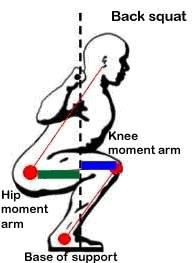
Leaning forward means that the hip moment arm increases: as the weight travels forward in relation to the hips, you need stronger and stronger hips to maintain speed without falling. A similar thing happens with squatting. The deeper the squat, the further forward the weight needs to be:back squat

Therefore, in my opinion, it’s easier (and safer, in terms of the unintended consequences of our advice) to look at this problem in the inverse: we understand a lack of forward lean not as a cause of knee pain but as a result of hip dysfunction. If we have frontal knee pain, it is likely because we’re not leaning forward enough, and we’re not doing that likely because we have weak hips. If, with weak hips, we decide the solution is to lean forwards (rather than strengthening the hips, and having the increase in angle be a function of that), then we’ll force a situation where we have to compensate in order to maintain that angle, and the easiest way of doing that is by flattening the lower back—in other words, by hunching forward.

The most basic solution to this problem is simple: strengthen the hips and develop hip mobility.

(This, however, is not necessarily the whole solution for people who have a more complex gait pathology).

Why is this the basic solution? Let’s look at how the hips are structured.

The two most powerful hip muscles are the psoas major and the gluteus maximus. They work in opposition to each other: the psoas major pulls the femur up and slightly to the inside, and the gluteus maximus pulls the femur down and slightly to the outside. The important part is that the psoas major, which anchors to the lumbar vertebrae, also manages to pull the spine down and towards the femur. (This is why you see forward trunk lean in people with a tight psoas major).

We can see the interaction in full force in this slow-motion video of Dennis Kimetto’s record-breaking marathon run (although we shouldn’t forget that there are many other muscles at play). Ultimately, it is the correct interaction of all the muscles, and not just the two I singled out here, that will lead to a good running gait.

In the video, it is plainly clear how when the gluteus maximus is engaged during the pushoff phase, the erector spinae (along with associated back muscles such as the quadratus lumborum) maintains the curvature of Kimetto’s back. On the opposite side, which is in full flexion, that same curvature is maintained by the psoas major on the front side.

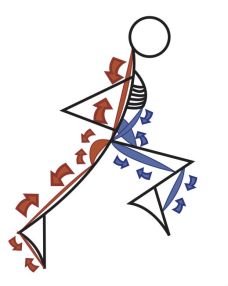
Kimmeto’s forward lean is established by a powerful gluteus maximus and erector spinae on one side pulling the leg back, and by a powerful psoas major on the other side, pulling spine down and forwards.

bow 2

This keeps the pelvis tilted forward at all times during the running stride. 

If Kimmeto’s psoas major wasn’t as effective at maintaining the curvature on the swing side, we would see one of two things happen: he either maintains speed by flexing the lumbar spine, putting immense strain on erector spinae and associates when that leg comes down (and gets hurt at mile 10), or, more likely, his competitor Emmanuel Mutai leaves him in the dust. There is no way that Kimmeto could both (a) not get hurt, and (b) maintain that forward lean without the gluteus maximus and the psoas major working together effectively.

UPDATE: I’m working on a post about good, transferable exercises/drills that develop the interaction of the hip flexors and extensors.

Wisdom in athletic performance

Knowledge is hidden in vaults. Wisdom, in plain sight.

It always pains me when I see broad, juvenile claims being made in the media, such as the one I saw in a recent issue of Men’s Health Magazine, which trumpeted the alleged discovery of the secrets to Bruce Lee’s mastery of speed. No way. The path to competence may be to engage in certain exercises, and certain modes of training. The path to excellence, however, is in how you perform them—and in order to find the right how, you need to find a why.

In other words, you need philosophy.

See, we know this implicitly, even though we don’t like to accept it explicitly. That is why Sun Tzu’s The Art of War will always be a mainstay in military academics. The why behind a particular strategy, or a particular tactic, is intrinsic to its correct application. Philosophy and application cannot be separated: a different philosophy will always yield a different application.

When I pull out some quote from, say, Bruce Lee, I often see people adopt expressions of fitful contemplation—and then proceed to completely ignore the advice. Why? In my opinion, because they are victims of a rampant and damaging view that philosophy is somehow the frill on an otherwise functional garment.

It’s not.

But I’ve discussed Bruce Lee far too often in the past. So let’s go with another example: a famous quote by Muhammad Ali, on the topic of how he fights. Ali once said,

“Float like a butterfly, sting like a bee.”

I credit my brother Aaron for the interpretation that follows.

A lot of us—myself included—look at that sentence and say: “ah, cool,” and pay it no more attention. But it deserves that attention. Perhaps we think that Ali was waxing poetic, or he was appealing to his sensitive side, or he was mad, or perhaps just plain lying, to give himself an edge over those poor idiots that took his advice. My brother (and I), however, think that this advice encapsulates exactly Ali’s defensive style, at least as pertains the phrase “float like a butterfly.”

Why?

It turns out that the flight of butterflies, and Ali’s style of defense, share peculiar similarities. Butterflies tend to fly in an erratic, random pattern, probably in order to make their path unpredictable to predators—say, bats—who want to eat them. If you study how Ali ducks and weaves, you’ll notice that it is quite unsystematic. In fact, he seems to be taking a hint from the random flight of the butterfly in order to make himself inordinately difficult to pin down. No doubt, much of the success of his defensive strategy hinged on the fact that he was floating like a butterfly in particular.

In other words, Ali’s formulation of that piece of advice was born not of some inner muse, but of deep contemplation and study of the natural world, and of how it interfaces with his preferred art form: boxing.

Ali’s success was a result of his fighting style, which was a result of his philosophy. And that philosophy—like Bruce Lee’s philosophy—was hidden in plain sight. He probably hid his strategy in plain sight because of his confidence that it would go unrecognized by his opponents—they would hear that sentence and simply not understand what they were hearing. Secrets aren’t just hidden in plain sight.

To put this in perspective, consider what happens when you look out at the horizon. Given our body of knowledge, and the way that we understand the world, we see the horizon as evidence that the world is round, while people before Pythagoras, given how they understand the world, would take the very same phenomenon as evidence that the world is flat. The difference isn’t in the phenomena that we see, but how our mindset—also known as our paradigm—causes us to take the same phenomenon as evidence of two different things. In essence, for people that didn’t know how to interpret the horizon, the evidence that the world was round was hidden in plain sight.

What makes the masters masters is not their adherence to a particular exercise routine that nobody’s heard about. What makes them masters is a mindset, a particular way in which they understand their art. And when the rest of us think—and insist to ourselves—that the answer must be in some detail we missed,  (rather than considering that we missed the detail because we’re in a frame of mind that is not conducive to asking the right question) then we generate a situation of self-sabotage: in effect, the best remain the best because they understand that the key is in philosophy, while the rest of us remain only competent because we’d rather focus on something that “feels more grounded.”

This differential in ability is created not because the masters have a particular secret that we’ve missed, but because they have a general secret that we’ve missed. Furthermore, this differential in ability becomes cemented when our belief that we’ll develop our abilities by searching for particulars stops us from searching for fundamentals—because fundamentals are the things that drive us to search for particular details, and to neglect others.

Bruce Lee and Muhammad Ali counted on the fact that their training, their preparation, and their fighting was done under the right philosophy, and that their philosophy more accurately described the world than the philosophy of their opponent. (I’ve written about how Bruce Lee’s advice—“The less effort, the faster and more powerful you will be”—can be taken quite literally on all levels of athletic study, from the psychological to the endocrine to the mechanical).

It is this multilayered wisdom that we need to take into account when we think about why we do what we do. As runners, training pure aerobic power, energy return, and muscle resilience is not enough. There must be a philosophy of application, that helps us leverage that biological machinery in the most efficient way. That is why we have to consider—or meditate on—the full array of the implications of a saying such as “the best runner leaves no tracks.” And if we train under such considerations, our athletic (and personal) development will be faster still.

“Fatness”: an insulting, oppressive, and unproductive social construct.

You always hear, these days, people saying that “the question is more important than the answer.” Well, the more I think about it, the more I agree with the sentiment.

Take for example, the case of “fatness.” I’m not talking about obesity, but rather about the vacuous and unfounded social judgment that people of a certain size and shape are bad—and therefore socially worse off because they are allegedly physically worse off.

And I do mean, allegedly. There are very real problems with obesity, problems which strongly detract from quality of life, especially towards elderhood. However, the social judgments that we make about someone’s “fatness” are usually unrelated to whether they have the underlying metabolic syndrome that generates obesity. In other words, “fatness” usually has nothing to do whatsoever with health.

Our social judgments are based on a visual correlate of obesity, a sort of “best fit” analysis that takes in a wide array of indicators—musculoskeletal, morphological (of their body shape) and possibly even socioeconomic, racial, and political—associated with that person, and inducts from that whether they are “fat.” Notice that not one of those indicators is metabolic.

The only indicators that truly matter, that can truly tell us if their “fatness” is not something more than a social mirage—their levels of leptin, their resting levels of blood sugar—are the ones we don’t have access to.

(Granted, it is possible to make an assessment of obesity from the amount of subcutaneous (external) fat. However, even that test has a huge margin of error, is performed by trained, impartial specialists with the right equipment, and cannot be done at a glance, by a layperson who likely has a social stake in the situation).

What I mean to say is that “fatness” is a bullshit way of understanding people. “Fatness” is not, and never has been, about health or exercise—or obesity, for that matter—(and in fact, part of the reason it is so deleterious to its victims and to society in general is because it insists to be about health). “Fatness” has always been about organizing ourselves on yet another social pecking order. It is yet another example of the intersectionality of privilege.

The argument that fatness has anything to do with health is one big lie, and usually only detracts from the capability of those who do suffer from obesity to do something about it. Thanks to the idiotic confusion of fatness with obesity, we have collapsed a socially constructed category that has nothing to do with health—“fatness”—with a medically useful category that is all about health: obesity. By confusing fatness with obesity, we have created a trap: for starters, obesity has lost credibility as a genuine problem.

Consider the understandable, reasonable (and wholly necessary) reaction from those who are categorized as “fat.” They have, rightfully, called bullshit on the whole game. Because “fat” is not unhealthy, they have exposed the construct of “fatness” as nothing more than a construct. Thanks to its illicit association with “fatness,” obesity has lost credibility.

This intricate web of sociopolitical negotiation wreaks havoc on the strategizing of those who do want to, say, “lose weight.”

The first problem, of course, is that the game has been defined around “losing weight.” In other words, one of the main reasons that people exercise is to distance themselves with the indicators of fatness.

But, as with the case of obesity, losing weight—and maintaining that weight loss—is predicated on a variety of factors: the proximal ones are metabolic and physiological, but ultimately, we see that economic, social, and political factors also play a role.

By focusing on the indicators of fatness, and not the systemic causes of obesity, we miss two realities: that our weight gain is a function of our context, and that our “weight” has little to do with our athletic capabilities.

In concrete terms, focusing on weight loss means that we don’t know if we are destroying our body’s capabilities to maintain that weight loss. For example, excessive dieting has been linked to thyroid problems, and excessive running to anemia and chronic injury.

We need to turn our focus away from such superficial indicators and towards the actual roots of the problem. We could say that the problem of “being fat” starts with a lack of someone’s athletic capability. But as I mentioned above, it actually runs much deeper than that. It begins with a society that frames the problem as one of “fatness,” and focuses attention on weight, or apparent levels of subcutaneous fat, or body structure.

This attention to weight distracts us from what really matters all along: proximally, metabolic health, and ultimately, psychological, social, political, and economic environments that are conducive to quality of life.

In a very real way, everyone is at their “ideal weight”—given the internal and external contexts they are subject to. By understanding this, we can ask of ourselves: what is the root of the problem that we want to solve. Whether the problem is weight loss or obesity, “fatness” will always obscure the answer, and limit our ability to solve it.

The right question to ask is, therefore, not “how do I lose weight?” but rather, “how do I cultivate a powerful metabolism?” Only by re-framing the question and making our efforts fundamentally not about weight-loss (or being “not-fat”) will we actually succeed at our athletic endeavors, even if we initially came to them with the naive intention of losing weight. And, if enough of us do that, both “fatness” and obesity may cease to be the overwhelming social phenomena we know them to be.

Muscle strength and running economy — a “chicken or the egg” problem?

Runners are often told that strength training is integral to improving running speed and running economy. But there might be a little bit of a problem with this advice. I recently posted about a body of research that pointed to the idea that, for a variety of biomechanical reasons, weaker muscles in a trained runner correlated with a greater running economy (specifically at the calf region). The consensus was that running economy increased with achilles tendon loading, and decreased with calf muscle (gastrocnemius and soleus) activity.

More muscle means worse economy. A recent article in Runner’s World confirmed this, citing a study that found that running economy was related to the balance of strength between the anterior and posterior muscles (specifically, the quads and hamstrings). It was not, as most of us suspect, a function of pure muscle strength—overall, competent runners had weaker muscles than novice runners.

This brings up several questions. The first is, of course, how can weaker muscles make you run faster? The answer, I believe, is systemic, and our ability to find it hinges on what we mean by “strength training”—and how usefully we’ve defined it for ourselves. In the most basic terms, the strength of an individual muscle has little to no bearing on how the hip-leg-foot mechanical system will function in practice.

The power of this system—when power refers to how much force the leg can put out per unit of time—is much more a function of how well the parts move together, than how strong any individual part (or indeed, all of its parts) are individually. Someone endowed with extremely strong muscles that are all just slightly out of sync will have a completely rigid leg, not a powerful one.

It’s necessary, therefore, to make sure we all mean the same thing by “strength training.” Strictly speaking, the kind of explosive power (plyometric) training that a lot of runners do, which actually does develop hip and leg power, is “strength training”—but of the entire system. We need to be clear on what we mean by this to know if strength training will actually help us become better runners. Do we mean pure strength, or explosive strength?

The second question is more related to a practical matter, and is a consequence of answering the first. What are our reasons to train pure “muscle strength” in the first place? We’d better have them, given the above evidence that muscle strength correlates with low running economy. If we do prescribe a strength training program to runners, are we potentially hurting their running economy?

I don’t have an answer for this. Most of my training is either isometric or plyometric, and the few strength exercises that I do—such as barbell squats—are for balancing my body out, more than anything.

The third question is a matter of causality: why did the novice runners in the Runner’s World article have stronger muscles? To speculate about this, we have to return to the body of research mentioned above. The reason that weaker muscles correlated with greater running economy has to do with the biomechanics of particular bodies. One of the abovementioned studies looked at the ankle region of highly-trained runners, and found that runners who had longer heels (meaning a greater distance between the ankle and the heel) had poorer running economy and greater muscle power.

None of this is surprising, once you think about it. When the hip-leg-foot system pushes against the ground, it exerts force directly into the ground, at a perpendicular angle. To achieve this, the foot works a lot like a lever: the achilles tendon is connected to the end of the lever arm (the heel bone). When it shortens, the heel raises, meaning that the foot rotates downwards around the ankle—the fulcrum—allowing force to be exerted into the ground. Because every action has an equal and opposite reaction, force also travels in the exact opposite direction: into the calf, parallel to the calf bones.

Achilles-tendon-function

Because of the properties of the muscle-tendon system, this results in a trade-off. If you increase the length of the lever arm—the distance from the ankle to the heel—leverage increases, meaning that the calf muscles have an easier time pulling on the lever and causing the foot to point.

However, this also means that the tendons work more like a rope and less like a spring: The elastic fibers that make up the tendon have to be aligned with the direction of force in order to store that mechanical energy. If the lever is longer, the achilles tendon is at a greater angle to the direction of force, and therefore less capable of storing mechanical energy.

In other words: greater leverage = less energy return. When your skeletal structure compels you to use your muscles more (resulting in stronger muscles), you also have less energy return, which is a critical component of running economy.

The reason that the novice runners in the Runner’s World article have stronger muscles may have less to do with the fact that they’re untrained and more with why they’re untrained. Perhaps one of the reasons is that they are not dimensionally prediposed to train running. Supposing this is the case, you might look at their bodies and find that they are built for leverage, not for energy return.

You might. A longitudinal—long-term—study would confirm this (or not). If the untrained runners started training, would their running economy get better? According to the abovementioned study, not really—or at least not completely: the study estimated that 56% of running economy could be accounted for by heel length alone. In addition, the runners they looked at were all highly trained (and had comparable running performance) and their running economy still varied by 20-30%.

(This also means that while longer heels contribute to a lower running economy, they do not necessarily contribute to lower running performance. The human body has many faculties, each of which contribute differently to performance. Energy return is only one of them).

One thing is clear: as a collective, we need to be a lot more careful with the advice that we give runners. As I mentioned above, what does “strength training” mean, and what exactly are we recommending that runners do, if we make such a suggestion? The skeletal mechanics of the body (let alone the possible interpretations of the phrase “strength training”) means that the same advice given to two different runners can have very different ramifications—or worse yet, none at all.