All posts by running in systems

A question of systemic resilience: is it more “efficient” to run shod than barefoot?

The idea that running barefoot offers a metabolic advantage over running shod may be an “appeal to nature” fallacy.

Although some studies have found that running barefoot is actually “more efficient,” there have been a host of other studies that contradict those results.

So we can’t say for sure.

In a 2012 study titled Metabolic Cost of Running Barefoot Versus Shod: Is Lighter Better?, Franz et. al. set out to debunk the claim that barefoot is indeed more efficient. In a nutshell, their results found that not only did barefoot running have no metabolic advantage over running shod, but actually seemed to be more metabolically costly to do so. It has been suggested by several studies that the reason for this added metabolic cost is because of a “cost of cushioning.” According to these studies, the body is making an effort to absorb impact when running barefoot, that it doesn’t make when shod (more on this later).

I largely agree with the research question, experimental design, and results of Franz et. al. But reading this article stirred up several theoretical issues that don’t have much to do with the article in particular, but are important in terms of how the shod/unshod and hindfoot/forefoot striking debates have unfolded, particularly regarding what the terms “efficiency” and “better”—as in the title of the study mentioned above—have come to mean in this debate.

Franz et. al. begin the article by writing that “advocates of barefoot running claim that [barefoot running] is more “efficient” than running in shoes.”

First I’ll address the question of what we mean when we say “efficiency.”

It’s important to be clear that the advocates that Franz et. al. cite (Richards & Hollowell, authors of The Complete Idiot’s Guide to Barefoot Running and Sandler & Lee, authors of Barefoot Running) are using the classical definition of “efficiency” as do Franz et. al.—meaning that they claim there is a lower energetic cost to barefoot running. That claim may well be a fallacy, and Franz et. al. are right to debunk it.

But I want to draw attention to a different use of “efficiency,” which will eventually get us to analyze what we mean when we say that one function (say, shod running) is better than another (say, barefoot running). In order to do this I need to bring in one of my favorite concepts from systems thinking: resilience.

One of the hallmarks of a resilient system is that it is built out of many tightly-coupled feedback loops, which basically mean that there is a lot of movement and interaction between its various parts. And for that movement to exist, the resilient system must be spending larger quantities of energy than the less-resilient system.

(This idea is rooted in thermodynamics: the movement of molecules and atoms correspond to the amount of energy stored in a certain space, i.e. the temperature of that space). The idea that greater movement can only be produced by a greater use of energy is generalizable to basically everything.

Note, however, that the causal relationship between resiliency and increased consumption of energy only goes one way: all other things being equal, a more resilient system must be using more energy than a less resilient one, but a system that uses more energy than another is not necessarily more resilient.

In the classical definition of “efficiency” that Franz et. al. and the barefoot running advocates are using, the resilient system is less efficient—i.e. it is at a metabolic disadvantage, since it uses more energy—than the non-resilient system. It isn’t very useful to speak in terms of “efficiency” when we’re talking about complex behaviors like athletic performance: for example, when the body finds itself in crisis, it will begin shutting down major organs to conserve energy. And for every organ that it shuts down, the less resilient it is: it becomes less and less able to cope with new and unexpected crises. Is this more “efficient” in any reasonable sense of the word but the classical? Not really.

“Efficiency” in the classical sense has never been the goal of human running. In Waterlogged, Tim Noakes explains how running on two legs has a much greater metabolic cost, across the same distance, than running on four legs, and yet, because humans run on two legs, we are capable of running down antelope and other ungulates in the desert. (The advantages that running on two legs offers are thermodynamic, but that’s a story for another time).

Simply stated, if efficiency was what the human body wanted in the first place, we would have never gotten off all fours. Actually, we would never have become runners at all. But we did. So there has to be more to this story. By standing on two feet, there has to be another problem that we were trying to solve beyond “efficiency.” That problem is most likely how to be resilient in the performance of particular function: human endurance running.

The human body—like any system—has other goals beyond pure efficiency. Indeed, one of the primary goals of the human body is redundancy. Studies have shown that even when we exercise at maximal intensity, only a fraction of our sum total muscle fibers are recruited. In the classical sense of “efficiency,” you could say that it is less efficient to be redundant, since more energy and nutrients must be spent building these redundancies instead of using them for athletic performance.

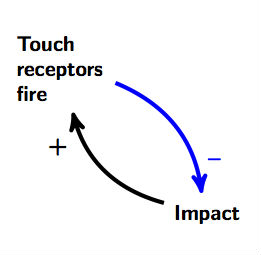
All of this gets us to what we mean when we say “better.” In a very real way, (and for a variety of reasons), it isn’t “better” for the human body to be “more efficient” in the classical sense. It’s better for the body to be more redundant, and more resilient. In theoretical systemic terms, the fact that the number of active “feedback loops” increase when  running barefoot—since the touch receptors on the soles of our feet “feed back” information to our muscular system, which works to decrease impact—is indicative of the likelihood that the unshod system is more resilient than the shod system.
touch rec m

Furthermore, when we blow up the term “efficiency” onto the large scale (divorcing it from its classical meaning), we can ask ourselves: in time and energy, what are the advantages of protecting the system, over not doing so? According to the literature, wearing shoes doesn’t protect the system in its entirety, beyond the skin on the sole of the foot: It has been shown consistently that shoe cushioning doesn’t affect peak impact force, only our perception of that impact. Peak impact force is alleged to be the main cause of repetitive stress injury in runners. While it has also been shown that in hindfoot-striking, shoe cushioning decreases loading on tissues), loading is a very different issue, with different consequences to injury, than impact.

Given that running shod reduces the activity of our cushioning mechanism, it would be extremely informative to do a long-term study on the amount of impact absorbed by the tissue (as opposed to loading), when the cushioning mechanism is deactivated. (Short-term studies already provide evidence that impact forces are indeed reduced when running barefoot as opposed to running shod). In turn, it should be explored how the increased impact translates to tissue damage, recovery time, and ultimately time not spent developing athletically.

In these terms, we may yet discover that it is more “efficient” for the body to run barefoot than shod. Being this the case, we could say that it is “better” for the system to run barefoot than shod.

Whether this is actually the case remains to be seen. What we can do at this point is to observe how our words shape our perception, attention, and inquiry, and what it is that systemic insights can bring to the table, both theoretically and with an eye towards future experimental research.
A functional argument in favor of midfoot striking: putting the research in context.

The human body is a machine with particular characteristics. So is a car. Just like the many different makes and models of cars have slightly different capabilities, human bodies are all different.

But they are not that different. For example, the operational requirements for all cars are very similar: the centrifugal force generated during a turn must not exceed the friction generated by the tires. And they are the same in humans.

But that’s not the way in which much of the medical and sports science literature treats it. Don’t get me wrong: everybody is in agreement on what the individual parts do: the gluteus maximus abducts and extends the hip; the gastrocnemius points the foot, etc. But there is a vast amount of disagreement as to how these parts are supposed to work together. Rather, there seems to be quite a bit of agreement that for the same systemic function (running), the individual parts can be performing wildly varying functions, and yet the system will still be somehow performing correctly.

I am, of course, talking about the footstrike debate. Before I continue, let me be clear that by “heel-striking” I don’t refer to how the foot hits the ground. I refer to the set of gait characteristics that contribute to overstriding by reaching forwards with the leg and striking the ground heel-first. The same goes with the gait characteristics associated with midfoot striking.

I’ve been reading a series of articles that associate different patterns of loading with different stride types. For example, a heel-strike is typically associated with increased loading of the knee, while a forefoot or midfoot strike is typically associated with an increased loading of the ankle and achilles tendon.

Most of the articles that I’ve read tend to conclude that therefore, we should see greater knee injury rates for heel-strikers, and greater achilles injury rates for forefoot/midfoot strikers.

However, that’s a hypothesis. By this I mean that thus far I’ve found no studies that have shown that these hypothesized injury rates actually occur.

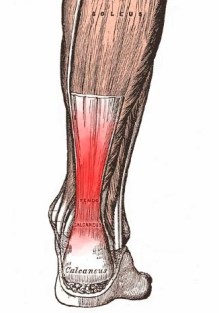
The question is this: are all tissues equally amenable to loading? In principle, absolutely not. Buildings often have central support structures to carry the load. So does the body. The question is whether, say, the presence of the achilles tendon—a dense, springy structure capable of storing massive amounts of potential energy (also the largest tendon in the body)—makes the ankle more amenable to loading than the knee.

In principle, it makes sense that the presence of the achilles allows the ankle to be loaded more than the knee. However, this remains to be ascertained by future studies.

For now, what we can say is that the differences in loading associated with one foot-strike pattern aren’t “equal” to another. Because certain structures are paradigmatically employed by the body to support weight, absorb shock, and store potential energy, a foot-strike pattern that offsets loading to these structures will, in general, be more amenable to the overall health and functional performance of the body. Whether experimental research ascertains that the achilles tendon is such a structure remains to be seen.

However, I certainly agree with the general supposition that a stride type that places more emphasis on loading of the achilles tendon (such as midfoot striking) generates a higher incidence of injury for that structure. Across a population, use of a particular structure will almost necessarily correspond to an increase in injury and overuse rates of that structure.

It remains to be experimentally ascertained whether a stride type which offsets loading onto dynamic structures (muscles) and energy storage structures (tendons and fascia), will, across a population of individuals, create lower overall injury rates despite the likely increase in injury rates due to simple use of those structures.

However, we can still make a systemic analysis.

Let’s use the example of an airplane as an analogy: it is much more efficient for an airplane to use flaps, than to not use them. By increasing the total wing surface, flaps allow landing and takeoff velocity to decrease by a significant amount. An increased use of flaps will no doubt mean that, overall, more flaps will become damaged and broken than if flaps weren’t used at all. But because flaps help reduce the speed at which the aircraft lands, using them contributes to a decrease overall structural stress and damage associated with the impact of landing.

You could even make the argument against using flaps by saying that increasing the wing’s surface area will put more stress on the wing housing and the airplane’s airframe. Even though this is the case, making this argument misses the point. The point of the airframe—and especially of the wing structure—is to absorb the increased stresses associated with increasing the wing surface. Flaps should be used during landing regardless of the fact that both stresses to the wing and incidences of damage to the flaps will increase.

Along similar lines, if we posit that a certain body structure has a certain function, such as the achilles as a structure to store mechanical energy, the gluteus maximus as the main driver of hip extension, etc., then, under optimal conditions, the body should preferentially load the achilles upon landing and put the burden of moving the leg on the gluteus maximus. (All of which seems to agree with the findings of this study):

“When compared to RFS (rearfoot strike) running, FFS (forefoot strike) and BF (barefoot) running conditions both resulted in reduction of total lower extremity (leg) power absorption particularly at the knee and a shift in power absorption from the knee to the ankle.”

All of this said, the systemic analysis of the body is simple: in systems thinking, you look at the functions of different parts, in relation to the whole, to ascertain their function. The achilles tendon seems to be primarily a shock absorber. It certainly works that way when jumping—that’s why it’s almost impossible to land on your heels when you’re jumping straight up and down. So, any stride type that uses the achilles tendon as a shock absorber will likely be more amenable to the body.

Until evidence otherwise settles the matter—and only until then—the most reasonable conclusion to make is that a stride type that uses load-bearing structures to carry weight, offsets torque (rotational force) to joints that can rotate dynamically, uses shock-absorbing structures to absorb shock, and employs energy-return structures to return energy, are “better” than stride types that do not. Given the evidence currently in the literature, everything seems to point to (but not prove) the idea that midfoot striking is an example of the former, and heel-striking is an example of the latter.

AN IMPORTANT CAVEAT: The body is a dynamic system, which means that you can think of it this way this way: if you change one thing, such at the angle at which your foot touches the ground, three other things will change along with it. Perhaps you’ll see a change in your forward lean, a change in your hip extension moment, and therefore a change in the loading of a variety of muscles. In other words, you can never change only one thing. If you oversimplify your understanding or implementation of the changes you need to make in order to be faster, more efficient, or less prone to injury, you will end up being slower, less efficient, and more prone to injury.

This is why it’s important to talk about forefoot striking, midfoot striking and heel striking as “types of gait” and not as “types of footstrike:” the angle at which the foot hits influences (and is influenced by) a variety of other factors. My contention (which I believe is also the contention of proponents of midfoot striking) is that for a supermajority of people, the resolution of all of the biomechanic factors surrounding injury, muscle imbalance, power leaks, and resolvable musculoskeletal asymmetries, will result in the adoption of a midfoot/forefoot strike.

Again, whether this is actually the case has not been borne out by research.

I’d love to read what you have to say about this. Please put your comments, criticisms, and questions in the comments.

An analysis of the paradigmatic features of midfoot-striking and heel-striking.

The term “heel-striking” shouldn’t just refer to which part of the foot hits the ground first. Even in the common parlance, it should refer to the collection of neuromuscular gait features across the body that contribute to a type of overstriding in which the heel lands first, ahead of the center of gravity.

When I write the words “heel-striking,” this is invariably what I mean.

This way, we can neatly sidestep the conversation of whether someone landed on their heel under their center of gravity, or only “appears” to heel-strike. Let’s do away with reductionist analyses: let’s make it about something else than just “the strike.” The most widespread way in which the western runner overstrides is by heel-striking.

In a previous post, I reviewed how there is a paradigmatic body geometry to midfoot-striking, which corresponds to a paradigmatic pattern of muscle use. Heel-striking is no different.

When I say “paradigmatic,” I refer to the core components of the stride; to its most generalizable features. For example, the paradigmatic body geometry of midfoot-striking consists of a full-body arch, which begins at the base of the head and ends at the heel.

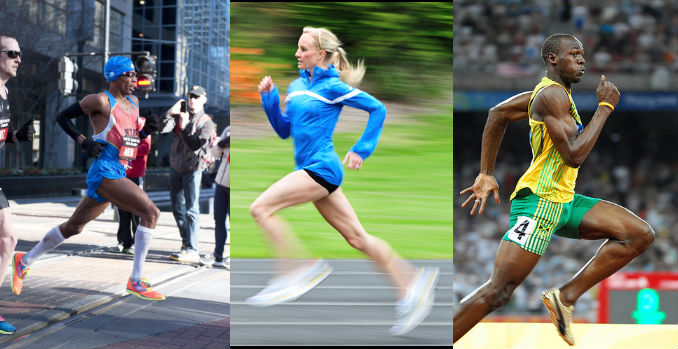
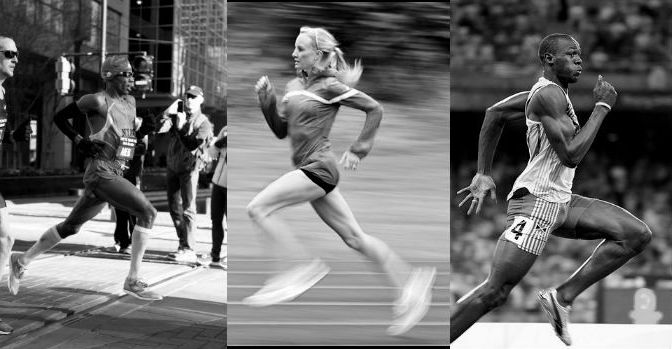
Establishing the paradigmatic features of types of running strides allows us to observe those features and make reasonable predictions about them. If you look at a runner who appears to be heel-striking, and yet is creating a full-body arch starting from the base of the head and ending at the pushoff heel, you can be reasonably certain that if you look closer, you will actually find this runner to be midfoot-striking. In other words, you can know that Meb Keflezighi’s apparent heel-strike (left), is actually a “proprioceptive heel-strike”—rather, a “disguised” midfoot-strike—just by looking at the continuous arch made by his leg and back at pushoff. (This video makes my point rather well). You may notice that other noted forefoot-strikers create very similar arches:

elite arches m

Because every person has a slightly different body geometry, the specifics of their stride will be slightly different. But these specifics are much more similar to each other than it is usually claimed. For example, in the post previously mentioned I reviewed how, necessarily, for all humans, dynamic strength is necessarily achieved by creating a series of consistent and symmetrical arches with the body’s bone structure. The reason this applies to all humans is because it applies to all structures. The integrity of every possible structure—from the Hagia Sophia to the plantar vault—is subject to the symmetry and consistency of its arches.

From this idea, we can extrapolate that no human can be the strongest version of themselves without creating the most consistent and symmetric arches across the body. Therefore, when you look at the differences betwen midfoot-striking and heel-striking, the differences in body geometry stand out starkly: unlike midfoot-striking, heel-striking paradigmatically breaks the full-body arch that makes the midfoot-striking body so resilient.

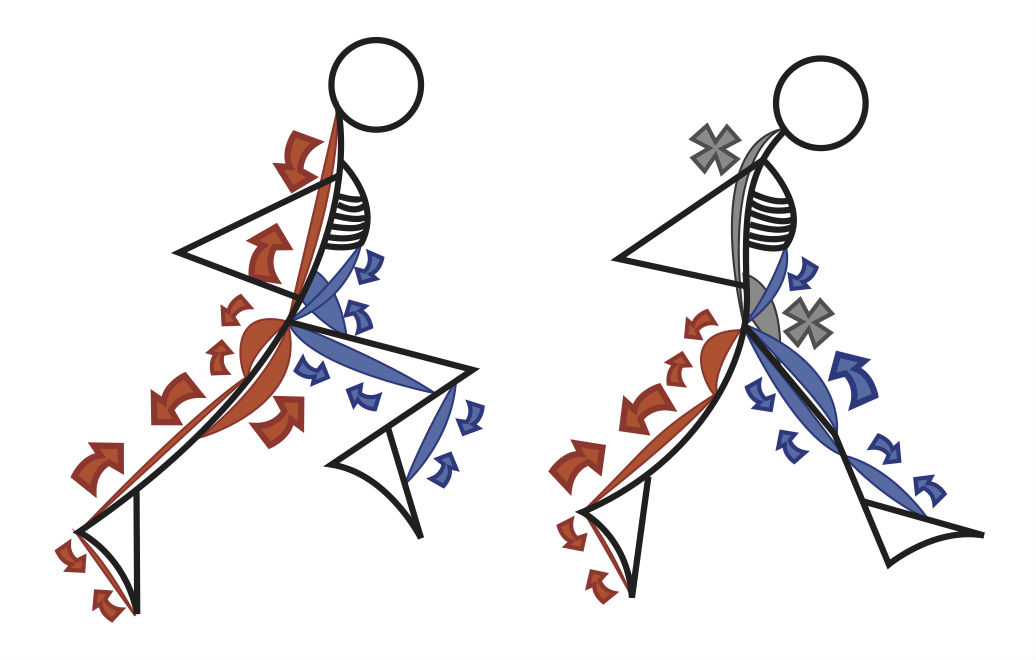
There may be a few runners out there for whom a true heel-strike doesn’t break this full-body arch. There may even be others who can land on their heels, under the center of gravity, without breaking this arch. But paradigmatically, the stride difference between forefoot-strikers (left) and heel-strikers (right) looks like this:

heelforefoot1

As mentioned before, a paradigmatic body geometry corresponds to a particular pattern of muscle use. In the above graphic, you can observe major differences between midfoot-striking and heel-striking in the neuromuscular paradigm of both the extensor muscles used during pushoff (red) and the flexor muscles used during the swing phase (blue). Of course these two types of body geometry load different tissues in different ways. That’s the point.

The most important differences are (1) the reduced iliopsoas function for the heel-striker (depicted by a grayed out X at the hip), (2) the reduced function of the upper back extensors (grayed-out X at the back), and the concentric activation of the quadriceps muscle for the heel-striker (blue arrow at the thigh).

The heel-strikers’s upper leg is in a bit of a predicament: during the swing phase, both the quadriceps (front thigh muscle, blue), and the hamstring (back thigh muscle, blue) are active at the same time. This is a problem because, when the leg is forwards of the hip, the hamstring flexes the knee, while the quadriceps extends it. This means that two muscles of the body which perform opposite functions are active at the same time, pulling in opposite directions. And this is happening as the leg is nearing the ground—during the landing phase—which means that two of the major muscles of the body are fighting each other, and they are doing so at the very moment that the body is about to slam into the ground.

This isn’t a problem for the midfoot-striker: the fact that the front knee is bent, and near the height of the hips, means that the quadriceps is largely inactive at that stage. Full quadriceps activation only occurs towards the end of the pushoff phase (front thigh muscle, red).

Because athletic power is generated through the creation of consistent and symmetric arches, any running body will always be the most powerful version of itself as a midfoot-striker. Furthermore, the body is designed around these principles: because load-bearing structure (the arch) is most consistent when the body is powerfully midfoot-striking, the body is at the peak of structural resilience when midfoot striking. Given that resilience is a hallmark of systemic integrity, this means that a systemic analysis of the body can only basically conclude that the human biomechanical system is operating at its “peak” when it is midfoot striking.

Similarly to the heel-strike, the midfoot-strike doesn’t refer to the part of the foot that hits the ground first. It refers to the constellation of stride components (such as the creation of a full body arch), that allows this part of the foot to hit the ground first.

This post shouldn’t be construed to mean that we should ONLY midfoot-strike. There may be plenty of reasons to heel-strike, such as rapid deceleration, and the opportunity to use the heel bone as a swivel, in order to turn quickly. However, for the purpose of producing safe and sustained forward motion, no type of stride will yield results that are as consistent or as powerful as those allowed by the midfoot-strike.

The human body as a system of suspension bridges: The geometric source of athletic power.

To say “stand up straight” is a bit of a misnomer; the body is made up of a series of curvatures.

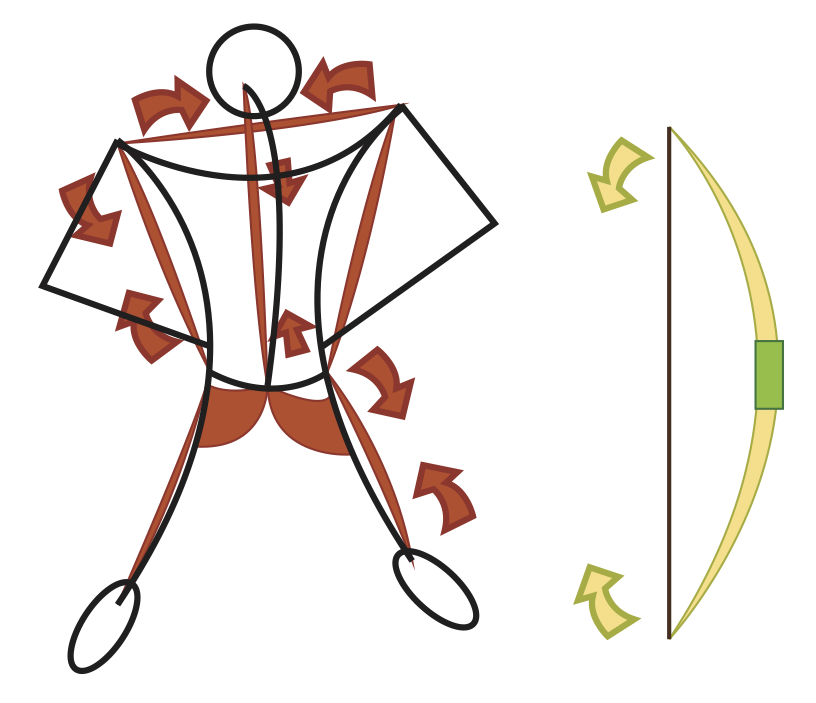
When you look from the side at someone standing up straight, you’ll see that their body actually follows a curve which begins at their heels and ends at the top of their head. Think of a hunting bow: when a bow is strung, the bowstring holds both ends of the bow together, allowing the structure to store a magnificent amount of potential energy, to be released when an arrow is loosed. The extensor muscles of the body (hamstrings, glutes, and back muscles) perform largely the same function as the bowstring:

bow 1

The quintessential proud or dominant posture is achieved by tensing the extensor muscles to align the majority of the bones in the body to create a series of arches, or bows. By maintaining tension in this way, the body creates a firm (yet dynamic) structure. This isn’t a spurious analysis: throughout the history of architecture, arches have been the quintessential support structure. For these same reasons, suspension bridges are built in high-wind and earthquake-prone areas: because using tense cables to support the structure not only maintains the bridge’s shape very well, but does so despite the power that wind or seismic events can exert on it. By contrast, a bridge that is completely rigid through and through would be far less resilient. 

Because the body is a moving system (as opposed to a rigid system), it creates these arches in order to more easily engage with the forces that routinely interact with the body, such as the force of gravity and the kinetic energy generated during exercise.

Continue reading The human body as a system of suspension bridges: The geometric source of athletic power.

My view? Everybody is a runner. Nobody is “a runner.”

Perhaps the most important benefit of systems thinking, as it relates to our way of thinking, is that it lets us grasp the notion that a lot of things in the world that seem immutable actually aren’t immutable—they’re just kept that way.

“By what?” You might ask.

By a systemic structure.

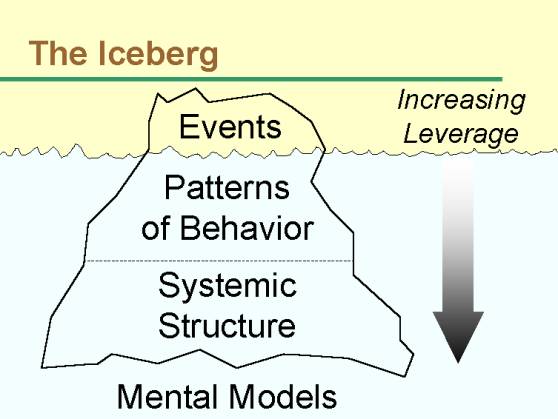
One of the key concepts of systems thinking is that “events” are generated by patterns of behavior, which are in turn generated by a systemic structure. This structure is predicated on certain underlying principles—certain goals and ideas that cause the system to have that particular shape:

iceberg

Our experiences of who is “a runner;” who has “a runner’s body type,” etc., are no exception.

Continue reading My view? Everybody is a runner. Nobody is “a runner.”

Meditation: could it be a running-specific recovery tool?

I meditate as a way to maintain overall mental health, keep my mind clean of obstructions, and to synchronize some of the body’s vital systems like the cardiovascular system and the lungs. In other words, I use meditation for “general maintenance,” if you will. But recently, I made the discovery that meditation has been (at least for me) an amazing postrun activity, especially to let the body wind down after a long run.

Thanks to this discovery, I’ve begun to use meditation (in addition to its generalized, catch-all nature) in a much more surgical fashion. When I meditate after a long run, I find that I have very little muscle soreness, and my recovery from the run begins soon after. I’ve been able to increase my training volume quite noticeably, since my resting heart rate remains consistently low, at 42-47 bpm.

Throughout my experience with meditation, I’ve used different forms of it towards different ends, although most of them come from the discipline and tradition of Zen. Without going into much detail, Zen centers on the ability to perceive the world in a “purer” fashion—in other words, free of the constructs that society creates, and the heuristics that our cognitive machinery uses to allow us to navigate our world.

The type of Zen meditation that I’ve used here is best referred to as “observing the breath.” Its purpose is to observe what the body does—to sit with the body (in its company, if you will)—and just let its processes run its course. Think of it in terms of “observing and allowing.”

By doing that, I realized that something really interesting began to happen.

Usually, I get back from a long run, and my breathing winds down within a minute. I’m tired, and my muscles are tired, and I sit down and rest for a while. For sure, I’ll drink some water. And a couple of hours later, I start feeling the onset of muscle soreness.

But when I started to meditate directly after the long run, regardless of how tired I was—or rather especially if I was extremely tired—I realized that, as soon as I achieved a meditative state, my breathing started to wind back up again. Of its own volition, my body starts taking deep breaths, in which the lungs completely fill and empty. This usually keeps up for like 6-10 minutes, and then my breath gradually starts winding down. Just to let the process run its course completely, I usually remain in a meditative state for about 20 minutes.

So, why did I start breathing harder if I was meditating?

Here’s my hypothesis:

When I get back from a long run and just “go chill,”  my mind isn’t in “observation mode,” it’s in “doing mode” or “thinking mode.” So, once the long run is over, my mind comes up with other ideas of what it should be doing. The processes that were going on during the long run, such as metabolizing a high volume of lactate thanks to accelerated breathing, get overriden by newer processes, and forgotten before they have a chance to fully conclude.

So, when my long run ends, I believe that my body still has a hell of a lot of lactate that needs to be metabolized—but the necessary oxygen flow just … stops.

On the other hand, when I went into meditation—into “observation” mode—after the long run, I removed my mind from the equation. This was about sitting with the body and watching the body intently, and letting it do whatever. And what it chose to do was to increase the respiratory rate and depth of respirations dramatically. Why did this happen? Again, what I have is only conjecture, but I think that what happened is that my body decided that the best thing it could be doing for its own sake was to continue metabolizing the by-products of exercise (such as its heavyweight: lactate). For this, it needs a lot of oxygen—much, much more than I usually give it, in the minutes directly after the conclusion of my long runs.

It seems like that’s why my body decided to increase my rate of breathing.

I’d like to hear your thoughts about this in the comments. I’m convinced that this works on myself. But I’m curious what you use meditation for (if you use it at all). I’m especially interested in your doubts, and in the plausibility of what I discuss in this post. Also, if you think you may have ideas on a possible experimental design to test the correlation between meditation and the opportunity for continued lactate metabolism, do tell.

I’d like to engage with the subject of meditation (and my experiences of it) in a much more academically and experimentally rigorous sense.

From maximalist to minimalist footwear (and back): a lesson in resilience, and in “shifting the burden” systems.

The popularity of the trend of minimalist (zero-drop, low-cushioning) shoes has coincided with a sharp increase in running injuries, according to some sources. This has caused a large amount of community, media, and legal blowback on minimalist shoes, the most salient of which is the recent class-action lawsuit against Vibram, for misleading advertisement.

Misleading advertisement should always be punished. Vibram peddled their five-fingers shoes as the solution to running injuries. They are not. They should never have been advertised that way.

But this blowback has created an unfortunate tendency: blaming the minimalist shoes themselves as the cause of injury.

They aren’t the cause. Although this may seem contradictory, it is the fact that so many people get injured when switching from “maximalist” (shoes that are highly-cushioned; often with an elevated heel) to minimalist shoes—but not vice versa—that suggests that minimalist shoes are better for the biomechanics of human running.

This apparent contradiction can be resolved—but in order to do that we must look at the issue from a systems thinking perspective. And for that, we have to begin with the concept of “resilience.”

Continue reading From maximalist to minimalist footwear (and back): a lesson in resilience, and in “shifting the burden” systems.