All posts by running in systems

Tendinopathy, musculoskeletal characteristics, systemic strategies, and running.

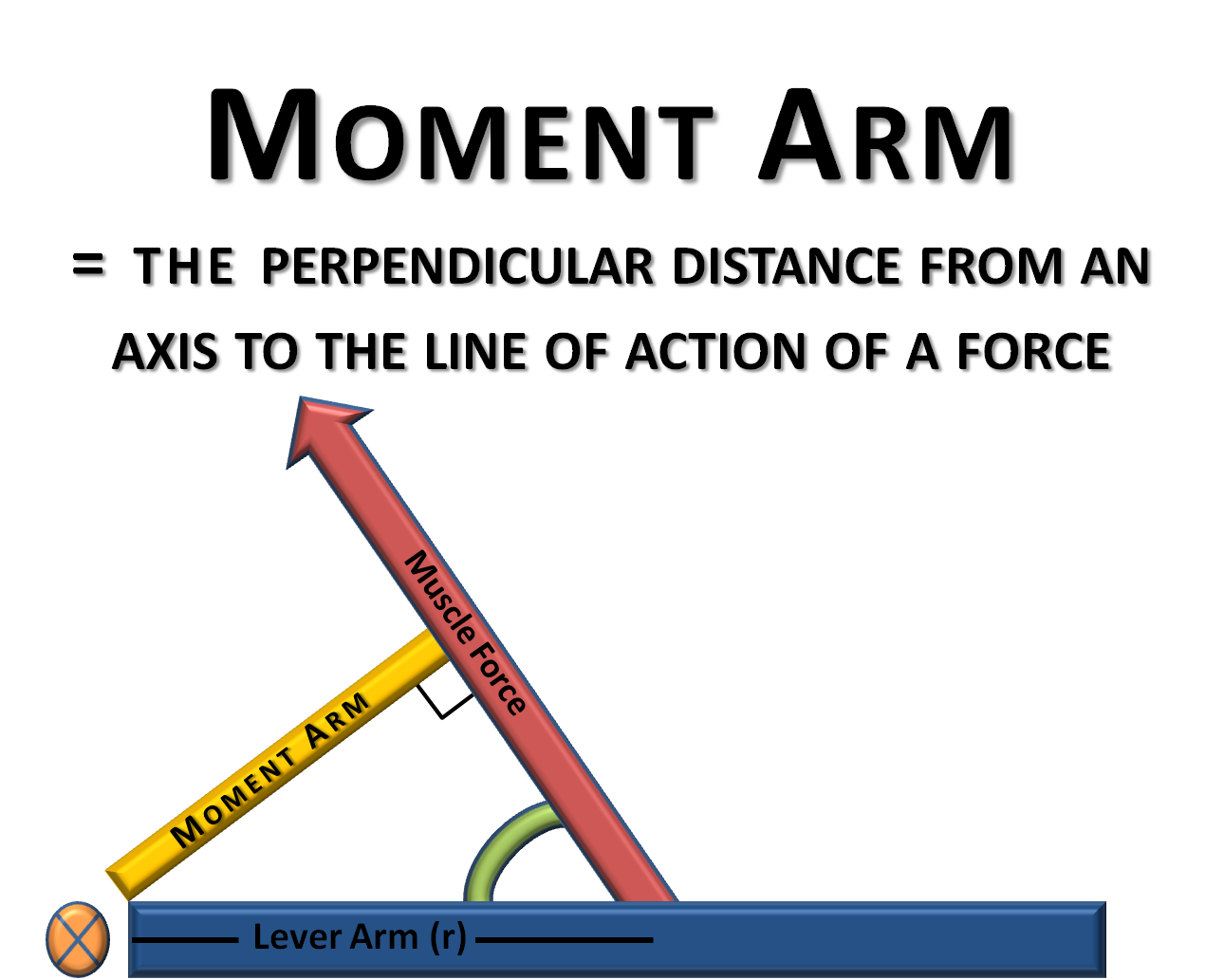
I came across a very interesting research article titled Running Biomechanics: Shorter Heels, Better Economy. Evidence is presented that running economy is determined by supposedly immutable factors in the athlete’s musculoskeletal structure, such as the moment arm of the achilles tendon, which refers to the distance between the achilles tendon and the ankle joint, which serves as the fulcrum of rotation. The evidence presented suggests that greater running economy—the amount of energy stored in the tendons, to be used in the next step—correlates with a shorter moment arm far more strongly than with other factors such as  lower leg volume or VO2 (a given rate of oxygen consumption). This has serious implications for the advice given to runners on how to improve their running economy.
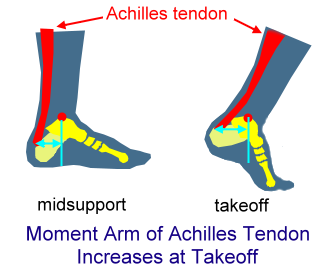
Moment-ArmTakeoffAchillesTendon

The authors conclude that 56% of the variation in running economy between runners could be predicted by the moment arm of the achilles tendon. This is interesting, considering that other studies suggest that there are 20-30% differences in running economy even among elite athletes. The study, which selected highly-trained, competitive male runners as participants, corroborates these findings.

This body of data suggests that, by and large, training does not affect running economy, when running economy is a function of the body’s skeletal configuration. What does this mean? That when it is up to the physical characteristics of someone’s bone structure, changes to running economy cannot be easily made. Because the achilles tendon moment arm (which corresponds to the distance between the ankle joint and the heel bone) is fixed in adults, the abovementioned 56% in variation is also fixed.

However, factors that aren’t skeletal could affect running economy—factors such as poor muscle coordination and imbalance. For example, one of the most common problems in amateur runners is stiffness of the soleus and gastrocnemius (calf) muscles. Often, this contributes to excessive plantarflexion (pointing of the foot) and premature heel rise during the late stage of the stance phase of gait. (Heel rise should occur during pushoff phase).
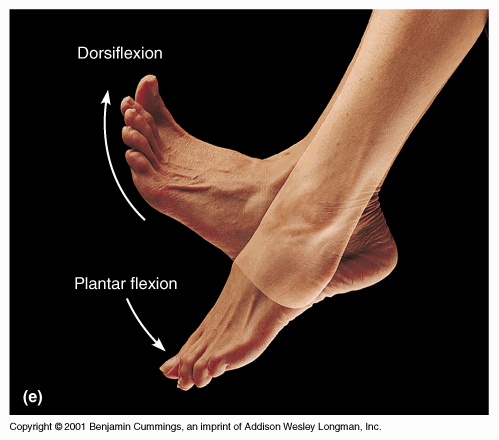
dosiflexion_plantar_flexion (1)

By raising the heel, the achilles tendon moment arm increases, allowing the gastrocnemius to exert more force against the ground. However, as the above-referenced article would suggest, this means that comparatively less energy would be stored in the achilles tendon. Other research on achilles tendinopathy corroborates this, with findings that those who suffer from the condition often have a reduced activation of the tibialis anterior muscle. By and large, those who suffer from achilles tendinopathy will point the foot to decrease loading of the tendon.

It is likely that pointing the foot as a result of achilles tendinopathy is a two-pronged strategy: both the reduction in tendon loading and the increase in achilles moment arm contribute to maintaining a functioning system. In light of the abovementioned research, this increase in moment arm means that force exerted into the ground is achieved through active muscle contractions of the soleus and gastrocnemius, rather than passive energy storage in the achilles tendon. By offsetting the production of power from the tendon to the muscle, the limb can remain useful in a suboptimal state.

This means that there is no single way to improve running performance. In fact, unless you have severely impaired biomechanics—which, granted, is more than commonplace in modern runners—there is nothing much you can do about your running economy. But unless you already use your body perfectly, there is no point in worrying about a large achilles moment arm. And if you already do use your body perfectly, there is no point in worrying about it either: you’ll simply end up developing other faculties, such as the aerobic engine, as your body seeks to achieve greater speed and endurance.

In Running Science, Owen Anderson compares Steve Prefontaine and Frank Shorter, writing that even though both athletes had very similar times in the 10,000 meter race, Prefontaine had a markedly higher VO2max (maximum volume of oxygen consumption per minute) than Shorter.   Anderson’s analysis is that Shorter had superior biomechanics, while Prefontaine had to develop greater aerobic capacity. However, in light of the presented evidence (and a cursory glance over both athletes’ physiology and body type), it is likely that Shorter had musculoskeletal advantages over Prefontaine, such as a reduced achilles tendon moment arm.
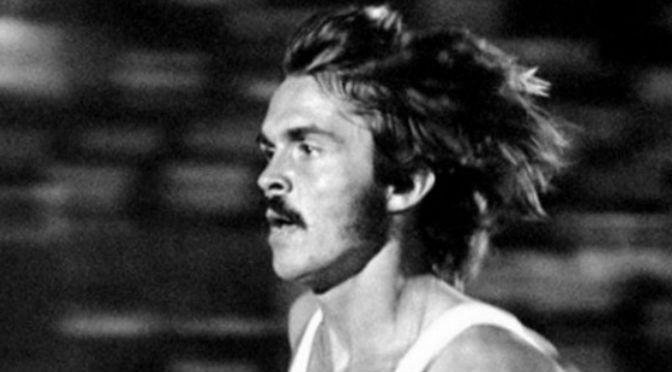
Steve Prefontaine
                   Steve Prefontaine

Concretely, this means that faulty biomechanics aside, certain runners will benefit more from particular kinds of training than others. For example, a runner with a huge achilles tendon moment arm may benefit more from weightlifting and muscle power exercises, particularly those that develop the tibialis anterior, allowing for ankle stabilization during the landing phase at greater ankle dorsiflexion than runners with a smaller achilles tendon moment arm: as mentioned above, dorsiflexing the foot reduces the achilles moment arm and increases loading (which is why those with achilles tendinopathy avoid it).

Runners who have to increase dorsiflexion to a greater extent for a given running economy will still be relying on more muscle power than those who don’t, at least in some fashion: the moment arm of the tibialis anterior (which dorsiflexes the foot) increases throughout dorsiflexion. In other words, this will offset the need for muscle power from the rear muscles to the front muscles, at least in the calf region.

It’s likely that the same biomechanic advice—advice on how to develop running economy—won’t be equally useful for two different runners. Although running economy will be largely a function of achilles tendon moment arm, running speed, endurance, and overall performance is not. Runners should study their bodies (or get studied by an expert) to see what kinds of training will help them develop their race performance.

Keep in mind that running economy is not the same thing as running performance. Prefontaine and Shorter’s comparison should tell you that. However, certain people have attributes that favor specific skillsets. Some people have great muscle power, others have great economy. Lately, running trends have been focusing too much on the energy-return properties of the body—so much so that runners are either alienated or forget that the body has other properties. The body is always more complex than the latest trend says so. And even if the latest trend does not validate the attributes that we should develop to make us better runners, it doesn’t mean those attributes aren’t there, or are somehow less important. The human body is an extremely complex machine, capable of achieving great performance through many different avenues. With a bit of study, we can figure out what those are.
A great, great article on reactive sports rehab: the “foam roller” paradox.

A great article by Robert Camacho, titled Your IT Band is Not the Enemy (But Maybe Your Foam Roller Is), neatly summarizes one of the many shifting-the-burden systems that we encounter in mainstream sports rehab: the use of the foam roller. When we apply the foam roller to our IT bands, it alleviates pain, and allows (most of) us to forget that the ultimate solution to the problem is actually resolving muscle imbalances.

The article neatly points out that by not resolving those imbalances,

you aren’t really doing anything to affect any kind of permanent change and in some cases you may be pushing the issue further.

The issue here is that the two muscles that are most directly connected to IT band function, the tensor fasciae latae and the gluteus medius, aren’t being developed properly, and aren’t being taught to interact with the rest of the hip musculature. As mentioned above, this is an excellent example of a shifting the burden system, which is characterized by how the “symptomatic,” short-term solution itself reduces the ability of the system to solve the fundamental problem:

The problem with this is that you’re now statically using a structure to achieve dynamic stabilization. That’s kind of like responding to the shocks on your car being too loose by tightening them up so much that they can’t move.

In systems thinking terms, this is known as a loss of resilience. By tightening up like this, the leg cannot adapt to changing conditions, such as variations in terrain, and the progression of muscle fatigue. In other words, this is a guaranteed recipe for constant, chronic injury.

The one caveat that I would add to the article’s message (although it is far from a counterargument) is that the foam roller may be a useful tool while also engaging in rehab that solves the fundamental problem. Because the foam roller does loosen up the muscles, when the hip is too tight to move well, the foam roller can be used before doing the relevant hip workouts, in order to make them more effective. As with other shifting the burden systems such as anaphylaxis, (which I discuss halfway through this article) sometimes you need the symptomatic solution to keep the system afloat, but only while diligently implementing the fundamental solution to solve the underlying problem.

A culture of injury

The endurance running hypothesis submits that humans evolved as desert persistence hunters—fast, long-distance running machines. Contemporary research has found no relationship between running and knee osteoarthritis. And the Tarahumara—the Mexican tribe of running people also known as rarámurihabitually run hundreds of miles per week while sustaining only a modicum of injuries. All of this raises the following question:

Why do we continue to insist that running is bad for the knees?

The most immediate answer is that, for a critical mass of westerners, running has actually created a variety of musculoskeletal and metabolic problems, enough so that it’s gotten a bad rap. However, especially in light of the above data, this doesn’t mean that running is bad. What it does mean is that we’re doing something fundamentally wrong.

Like most systemic problems, it has more than one source. Consider this: not only do we run in biomechanically disadvantageous ways, but we’ve done that for so long that the cultural consciousness has internalized this as the notion that running is somehow inherently injurious. Once this idea has been internalized, we lose any incentive, and any reason, to change incorrect patterns of motion. Because we’ve operated for so long under this conclusion, chronic injury and dysfunction becomes not only the standard, but also the norm.

However, it does more than that: chronic injury becomes the badge of the runner—a badge worn with pride. It is at this point that the culture of injury becomes fully cemented. If you aren’t injured, you’re not a “real” runner; you don’t share the burdens that we all share. You don’t go through the constant rite of passage that we all go through. You’re an anomaly, an exception. You’re special. Good for you.

With most runners, injury is the way of the world. Injury is a self-fulfilling prophecy that has everyone singing its virtues. If you aren’t injured yet, you keep training. It’s almost as if you look for injury. Why? Well, because if running is inherently injurious, if you’re not injured, you’re not doing it right. If you don’t have to constantly stretch and rehabilitate and ice and elevate, maybe it’s time to train a little harder.

So, what do we have here? A self-fulfilling prophecy, one which for the majority usually removes the possibility of running completely pain and injury free. The world in which we don’t have to RICE it up all the time, and foam roll our IT band isn’t one we’re used to considering.

Think that this world is a fantasy? Return to the evidence above. You’ll likely find that your skepticism is far more a function of the story we’ve been telling ourselves (and the socio-athletic system that’s emerged from it) than a function of the actual capabilities of your particular human body.

The first step to change this feedback loop is not, of course, to just go out and try to run like the rarámuri. That would be silly. Mere wishful thinking cannot ever replace good biomechanics and great training volume over the course of a lifetime, not to mention the benefits of being steeped in a culture of running. Most of us don’t have that, and never will.

But what we could do is to believe that it can somehow be different. We can believe that, given the evidence above, it makes sense to try and create the world in which we’re not plagued by injury, and beset by the notion that it is somehow an inevitability. Once we believe that, we can realize how antiquated the notion of “pushing through the pain” actually is.

If the plantar fascia begins to hurt, why not change something in our stride so that it stops? Change what? Go figure it out. But the injury is not inevitable. Only the notion of pushing through it—that useless phrase that our athletic culture has given us—makes it a certainty.

The systemic nature of obesity, and a few of its socio-economic feedback loops.

As part of the systemic explorations of athleticism on this blog, it’s time to begin addressing the topic of obesity. Let me begin by stating that obesity is not, as many believe, a reflection of someone’s character, or caused (and maintained) by a lack of willpower. It is largely a systemic issue, meaning that in our current socioeconomic structure, there are a multitude of processes that contribute to the creation and proliferation of obesity in particular populations.

In fact, the evidence that obesity is systemic begins with the fact that it is much rarer in affluent (white) populations than it is in minorities, the disenfranchised, and the oppressed. If it was an issue of willpower, then we’d see no such social, ethnic, and economic disparity between populations.

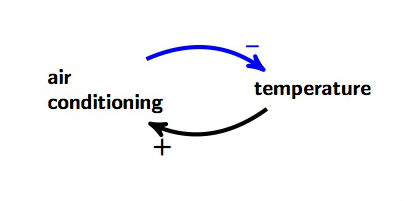
As with all systems, society and the body both work in terms of feedback loops—processes that link with other processes in order to achieve a particular function. A typical example of a feedback loop is a thermostat: when the temperature in the room rises, the air conditioning kicks in. Once the temperature drops, the thermostat shuts down, allowing the temperature to rise again. One process (the rising temperature) “feeds back” into the other process (the thermostat/air conditioning), creating a loop.

thermo 1

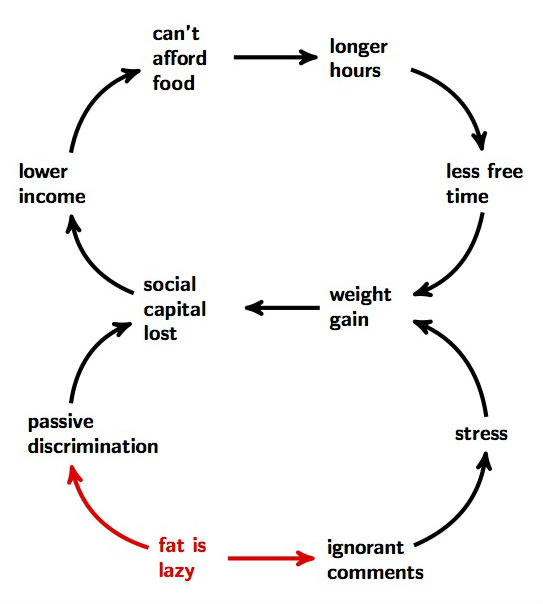
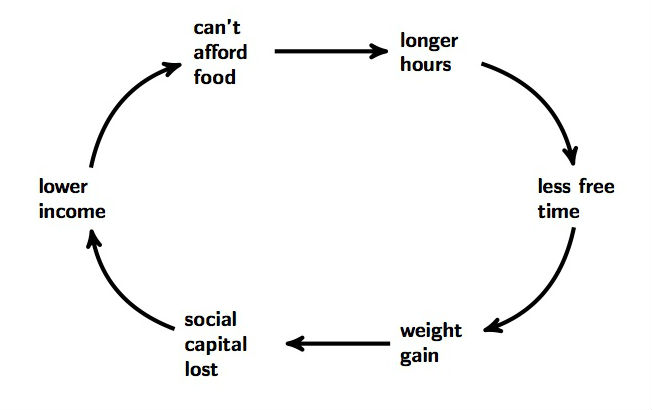
In order to diminish the expression of obesity in a population, the relevant feedback loops have to be understood. One such loop is created by the following factors. The high prices of unprocessed foods often make them prohibitively expensive to the poorest populations, who often have to work longer hours in order to make ends meet. With no time for visiting family, let alone constant, rigorous physical activity, people develop metabolic problems and gain weight. However, because obesity is perceived to be a product of laziness or poor character, the person often loses social capital. With this loss of social capital, the person loses job opportunities to slimmer, fitter individuals of “better character,” solidifying their poverty and destroying any possibility of change.

ob loop 1

There are other biological factors to be taken into account: because stress itself often leads to weight gain, the lack of free time for most working adults can also contribute to the expression of obesity. Social stresses, such as the pressure to exercise or diet, created by well-meaning yet ignorant people that are sure that all these people have to do is “go work out,” can not only destroy motivation but also directly increase someone’s weight gain.

ob loop 2

Try getting out of that system. And it’s only part of the story.

Of course, none of this means that conceivably, obesity cannot be caused by a loss of willpower or poverty or character. But what the systemic analysis does is illustrate that overwhelmingly, the most powerful contributors to the obesity epidemic are not inside the person (whether they be genetic or psychological). They are outside, in the socioeconomic system, or created by outside forces inside the person.

The last thing we should do to someone struggling with obesity—or someone who isn’t struggling and just wants us to get the hell off their back because they’re okay with themselves, or someone who in fact isn’t obese (or otherwise unhealthy) and just looks fat to our untrained eye—is suggest them to change or expect them to change.

Perhaps the biggest social contributor to obesity is ignorance of systemic factors, and of systems in general. And it isn’t the ignorance of those who suffer from obesity, but the ignorance of those who don’t. For example, even though obesity is characterized by an increase in body fat, body fat alone does not signal obesity. This is a condition in which the person’s metabolism is working against itself, putting on too much fat to maintain health and mobility. Unless those conditions are met, body fat is just body fat.

Unless we know that this “added” body fat is impinging on someone’s health to a certain degree, we can’t know that they are obese. Most of the time, people who look chubby are completely healthy. However, to those of us who have associated fat with obesity—and to those others who use a lack of body fat to gain social capital—this is a disagreeable state.

But some differences really are only cosmetic. Ignorant, yet well-intentioned comments or suggestions will do a majority of people very little good. Often, all they really do is entrench our own ignorance (since we leave the interaction so smugly sure of our knowledge) and distance ourselves socially from the person we commented on.

Casting attention on a feature that is socially disadvantageous (but not disadvantageous in terms of health) shines a light on how we don’t have that “problem,” whether we want to or not. Our social capital increases, whether we see this or not, and that benefits us, whether we understand that or not. Those actions only solidify the argument that because obesity creates body fat, body fat is obesity, and therefore fat is bad.

Unsolicited advice has systemic repercussions. By itself, even if it’s accurate—or rather, especially if it’s accurate—unoslicited advice can worsen the problem.

Something we could do is help remove the systemic factors contributing to obesity, including the social pressures to be thin. This is not to say that obesity is okay.  Obesity is a metabolic disorder whose effects seriously encroach on people’s quality of life, particularly towards their senior years. We’ll never get around this fact. But just trying to help isn’t enough. The ignorance that leads to “helpful” comments and suggestions really only exacerbates the problem. The road to hell is paved with good intentions. Only in the case of obesity, it’s usually us paving the road, and it usually leads to somebody else’s hell.

Tales of Forgotten Subsystems, Part IV: The Sweating Mechanism.

The sweating mechanism is truly one of the most forgotten parts of the human body. Its influence in our athletic performance is so great that it’s really a mystery to me why more emphasis isn’t placed on training and developing it.

In a big way, our sweating mechanism is one of the things that sets us humans apart from the rest of the animal world. (The second sweatiest animal, the horse, only has about one-fifth of the sweat glands, per unit of skin, that we do). There must be a good reason we have a five-hundred percent sweating advantage over the next-best sweater in the animal world.

And yet, not only do we gloss over this massive mechanism to focus on sexier components of athletic training, but we actively shun it in society. We deride people who sweat a lot, and turn the very act of sweating into a social faux-pas.

Discussing that irony is an essay in itself.

Sweating is one of the things that makes us human. It is intricately tied to a multitude of other traits that identify us among animals: why we have little to no hair covering our bodies, why we have big brains, and even why we stand erect.

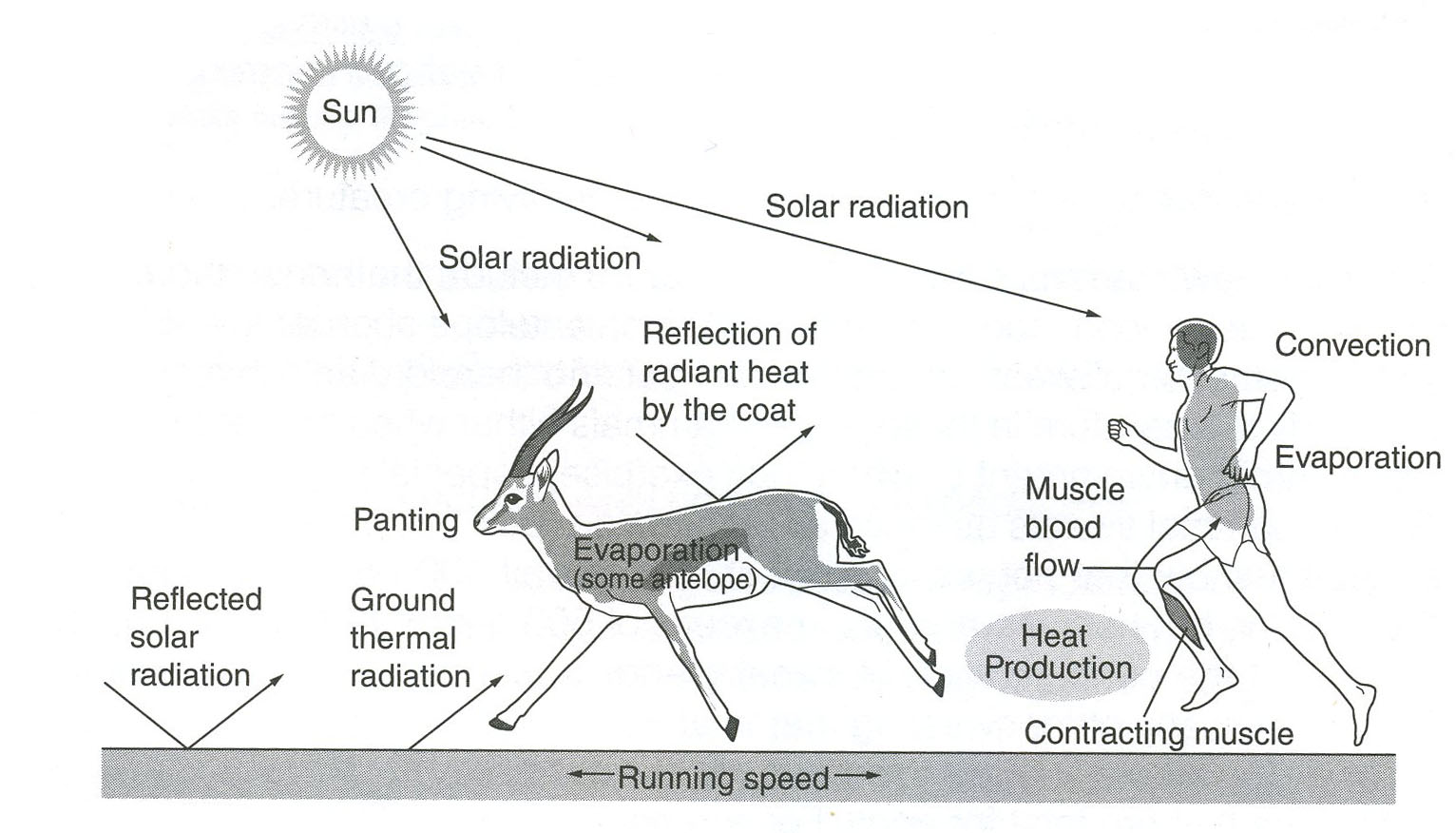
In Waterlogged, Timothy Noakes explains how these traits all come together in the human animal. As desert endurance hunters, it was necessary for humans to have big brains, in order to think abstractly and plan pursuits that would last for many hours into the future. But big brains aren’t enough. The air that’s closest to the ground (where most four-legged animals live) is also the hottest. In that hot air, the human brain—our supercomputer, the reason we outclass every other animal on the plains and otherwise—will overheat, and force the body to halt all athletic activity.

So how did we get around this problem?

In two ways: First, by standing up. This not only takes our center mass outside of the hottest part of the terrain, but it also puts our body in a vertical position, meaning that, during the hottest part of the day, we have much less surface area exposed to direct sunlight (than say a deer). Second, by dramatically increasing the amount of sweat glands, we can take advantage of the wind. Because our skin is uncovered, sweat lets the wind take heat directly from our skin, resulting in massive convective heat loss that other animals just can’t match.

From "Waterlogged: The Serious Problem of Overhydration in Endurance Sports" (Noakes, 2012).
From “Waterlogged: The Serious Problem of Overhydration in Endurance Sports” (Noakes, 2012).

(When an animal’s skin is covered by fur, the majority of their body heat remains trapped in that fur layer, and never gets exposed to the wind). In other words, while most animals were “designed,” if you will, for heat retention, we humans were “designed” for heat loss. Talk about natural athletes.

Thanks to this confluence of extraordinary adaptations, we can bring the rest of the features of the human body—our pack dynamics, our nimble physique, our massive aerobic engine, and the supercomputer that allows for productive, recursive symbolic manipulation (the human brain)—to bear on the hunt.

Given all of this, it’s amazing that we think of ourselves as frail, sedentary creatures. We are the athletes of the animal world, being able to run down just about every ungulate but camelids (llamas, camels, etc.) because we can’t drink saltwater (while most desert ungulates can), because we choose slow (and relatively inefficient) two-legged propulsion over quick and efficient four-legged propulsion, and because we play hardball with the desert climate—betting our internal water on the idea that we’ll be able to chase down that deer and still be able to replenish the water we lost. We take all of these apparent disadvantages and use them to our advantage.

And we can run down these “athletic” animals because our brains use 20% of our oxygen and 16% of our energy. (Comparatively, the brains of other mammals use between 2 and 10% of their total energy).

The powerful sweating mechanism lets humans act like that annoying poker player a lot of us know—while everyone else at the table is betting in a friendly, conservative manner, they’re changing the rules, out to make money, constantly going all-in.

Our sweating mechanism lets us fundamentally change the game. While other animals are stuck playing conservatively, trying to lower their body heat in a body designed for scarcity—a body that is all about water retention and heat retention (to save energy in the long run)we humans exploit this conservative game: we force animals to play by our rules.

It’s just like that poker game: because other animals can’t spend water fast enough, we humans play our aggressive game, betting that they’ll run out of chips before we do.

Next time we run in the heat, let’s remember this. When it’s so hot that running becomes uncomfortable, let’s remember that by unlocking our sweating capacity—by training the sweating mechanism just like we’d train any other muscle—we’re developing a crucial component of our athletic potential. Also, we’re getting in touch with one of the very things that makes us human.

Cheating on Fitness Trackers, explained in systems.

One of my biggest issues with fitness trackers is that they threaten our ownership of our physical development.

“Ownership” is the idea that taking responsibility for something increases our motivation to maintain it, our pride in it, and the attention that we give it. (This is the idea that IKEA uses to rationalize having customers put together their furniture: they believe that it will make them happier with it).

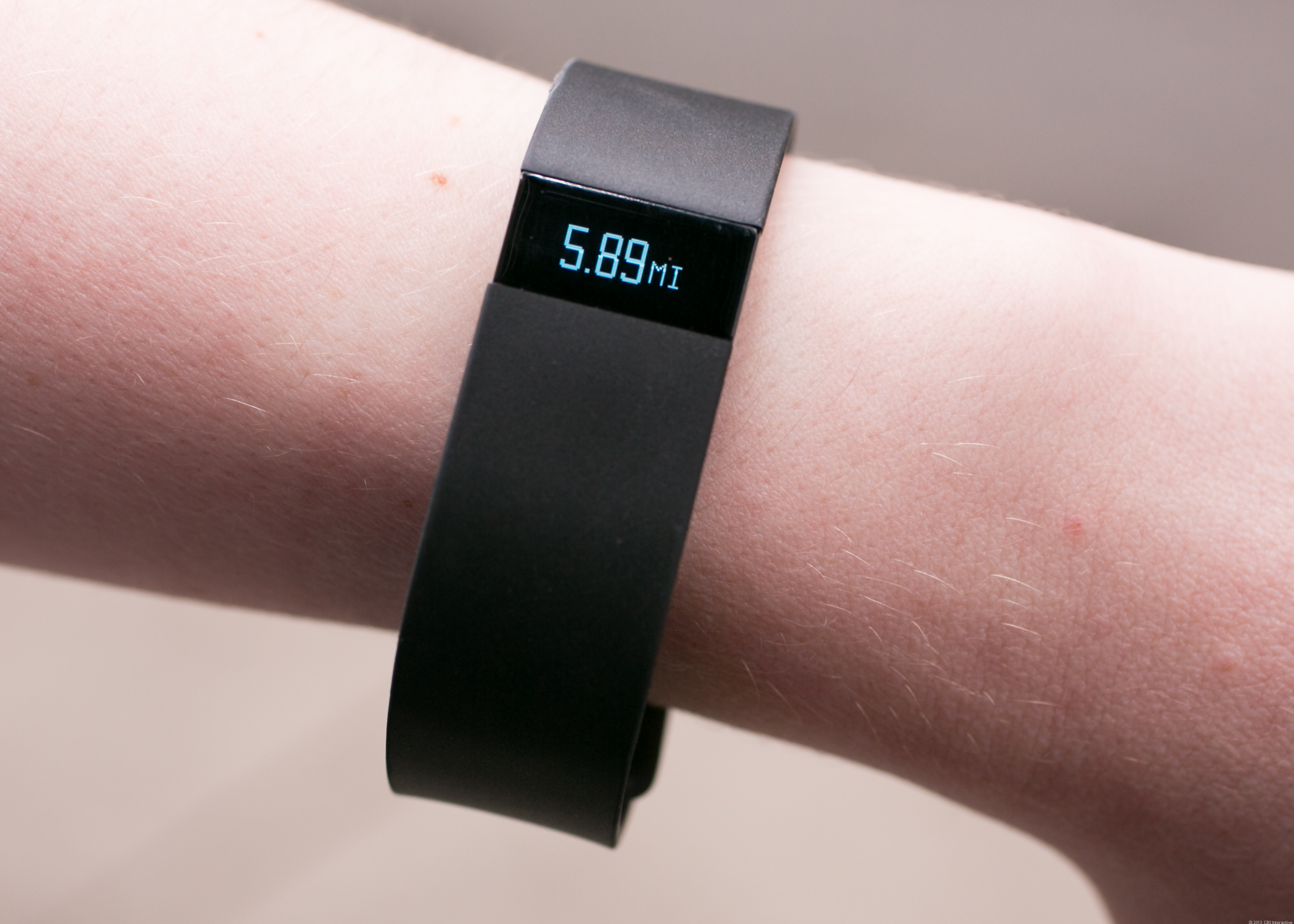
When our fitness tracker beeps at us to get up and walk around the office—and that’s the reason we get up—we put more and more of the responsibility on the tracker, and less on us. In a very real way, the tracker becomes more and more of a nagging parent, while we are relegated to the role of looking for ways to thwart its will.

Fitbit_Force_35828458_31

This is an absurd situation to find yourself in. By making the fitness tracker hold all the responsibility—and therefore all the power in the dynamic—you find yourself being its antagonist, and therefore, antagonizing your own athletic development.

I believe it is because of this dynamic that people put their fitness tracker on their dog to fake miles (or steps), instead of the more straightforward manuever of lying on facebook posts that they write themselves.

This is another classic example of that age-old systemic archetype, Shifting the Burden to the Intervenor. The people that cheat on their fitness trackers have been “shifting the burden” of ownership of their training from themselves onto an intervenor— their fitness tracker—for far too long. Because along with the loss of ownership comes a loss of responsibility, the beeping that was once enough to get them up to walk around now isn’t enough. The use of the fitness tracker means that they don’t have to care as much. The more they use it, the less they care, until one day they don’t care at all.

However, this isn’t a passive process. As mentioned above, there is a power dynamic between the fitness tracker and the fitness trackee. Because the trackee hands of more and more power to the tracker, the loss of caring about fitness is replaced by a guilt associated with not meeting the demands of the powerful party in the dynamic—the fitness tracker. Because all the power has been shifted, it’s very unlikely that the trackee can just toss away the tracker.

The tracker has certain expectations, and they must be satisfied: the power dynamic requires it. And how do these expectations get satsified? By putting the tracker on someone who is lower on the power dynamic: the family pet.

There is another, subtler transformation at play, common to all the iterations of this archetype. The game is no longer what it once was. At the beginning, getting the fitness tracker was about increasing fitness. Now, it has become about fulfillling the expectations of the tracker, in the easiest way possible.

Don’t do this. Our engagement with our athletic development, for it to have any lasting effects, must necessarily be one where we increase our ownership and responsibility, not decrease it.

Want to change your stride safely? Learn about your body.

In my last post,  reader Ana Maria Castro Monzon commented:

“Great contribution! something that happens to me eventually when I’m running is that I feel that I run too slowly. I identified with “I’m just a slow runner.” How can I observe the alignment of my body when I run to improve my step?”

That’s the million-dollar question. I’ll say again what I answered in the comments: aside from going to a gait specialist, the best thing that you can do is observe, observe, and observe.

Most of us don’t really zoom into what we’re doing when we run. But if we did zoom in, and we watched and felt our body move, we would feel the slight disparities in our pushoff, the small differences in our arm swing, etc. That’s the very first step. Simply stated, look for differences.

First, we need to see that something needs to change, in order to change it. And when we develop experience in observing the motion and shape of our bodies, something happens. Just like when we develop experience observing brush strokes on a canvas, we develop an intuitive awareness of what’s wrong, of what’s missing, or what should be removed.

Observation and introspection are the key to developing this intuition, which later translates into knowledge. Why? Our bodies are systems, and systems are like puzzles: every single piece has a particular place in the whole, and its shape and color reveal its place relative to the others. In our bodies, every muscle, bone, and tendon has a particular place, and all of these parts function relative to every other. When one of these parts is functioning incorrectly, this reflects on itself and on the parts that surround it: when you put a puzzle piece in the incorrect location, not only does it seem out of place, but the pieces that surround the spot where it should have been are also negatively affected.

In the human machine, not a single part is superfluous, or out of place. Just like when you look at a car’s engine block: even if you don’t know much about cars, or engines, and at first glance you swear that one of its parts is superfluous—that it’s there just because, for “no rhyme or reason”—you’ll likely find that it has a very specific function, that you couldn’t pinpoint because you weren’t an expert.

This is the story of the appendix: some 20 years back, it still was thought that the appendix was a remnant of evolution. People would jokingly say that its only purpose was to get infected so that it could be cut out. But now we know better: the purpose of the appendix is to safeguard intestinal bacteria in the case of diarrhea or disease, so that the intestinal flora has a chance to repopulate.

All systems, across all domains, function largely like this. If something exists, it is there to perform a certain function. And when we introspect about our bodies and observe them, we’ll realize two things: first, that our bodies are systems, and second, that if we’re slow, or sick, or injury-prone, we can be certain that it is because some part is not doing its job, and certain that it’s not because we are slow, or sick, or prone to injury.

Further introspection will reveal what part (or parts) that is.

Even more introspection will reveal what to do about it.

And then there is the research. Although not every one of us has to become a physical therapist or a doctor—who are experts in all bodies—there is no good reason why each one of us shouldn’t become an expert in our own body. That’s the path that will take us towards being injury-free, and towards speed. While some of us may just want to be told what to do by a coach or a physical trainer, firsthand knowledge of our bodies is the most invaluable tool. Let me put it to you this way: two-thirds of the way into a marathon, we can be wondering why we’re getting hamstring cramps, or we can be exactly sure why we aren’t. There may be a few shortcuts to success, but there are no shortcuts to excellence.

It’s not about training more—or less. It’s about training correctly.

One of the most prevalent problems in sports is that people consistently and continually train their compensation patterns. Practitioners and athletes put so much time and energy into their training, and quite often, they’re doing it wrong.

This is where the old saying “quality over quantity” hits full force.

There’s a lot of literature out there on the dangers of persevering though pain, and on the problems with leaving compensation patterns unresolved. Often, when we continue training despite the pain, we force our bodies into suboptimal patterns of muscle use. Because avoidance of pain is an extremely powerful impulse, those habits remain ingrained long after the pain has ceased.

Similarly, when we leave compensation patterns unresolved (and strengthen them by training), we’re developing our body, but along a suboptimal vector. Instead of training all of our body parts to interact with each other, we sideline a few of those parts, and leave them undeveloped and out of the game.

This is a bigger problem than it seems: one of the key tenets of systems thinking is that the whole is bigger than the sum of its parts. For example, let’s suppose that our imaginary athlete is compensating for weak gluteus maximus activity with an overactive quadratus lumborum (lower back muscle). Not only will their hip extension on the weak side be, well, weaker, but the overactive quadratus lumborum will likely be impinging on their ability to take full breaths.

Overuse one part, and you guarantee underusing another.

Because their breath is impinged, their aerobic system becomes resistant to training. Because their hip extension is reduced on one side, their maximum speed is much lower than it could be, and they lose their ability to exercise with maximal weight across their entire body.

Since these compensation patterns often go unnoticed, our imaginary athlete might tell another “I’m just a slow runner,” or “I’m injury-prone,” never knowing, never realizing, that their slowness (or their proneness to injury) is not due primarily because of some deficiency that is essential to their bodies, but largely because they’ve spent all of their training reinforcing existing compensation patterns.

In my opinion, the most important piece of advice that any runner—any athlete—can take is that athletic ability doesn’t have to do with lung power or muscle power, but with the synchronization between the lungs and the muscles. The body’s power isn’t simply a measure of how powerful individual systems are—it’s a measure of how well they work together.

Let’s give a quick example: throwing a baseball. Throwing a baseball isn’t about arm power. It’s about initiating the motion with one-leg hip extension against a solid object, and translating the resulting force across the torso, through the opposite arm, and into the ball. An athlete with a hugely powerful arm but weak hips (or strong hips that don’t work together with the torso and arm) won’t be able to throw nearly as well as someone who is strong and athletic but uses her body in a synchronized fashion (Mo’ne Davis comes to mind here). To put this claim in context, I doubt that miss Davis could win an arm-wrestling match with my father (who is massively strong even at 60), and yet there is no way that my dad could throw a ball half as fast as miss Davis could.

mone-davis

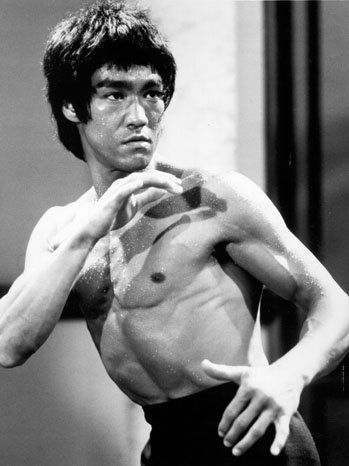
Back when Bruce Lee was still thrown around as an example of athletic excellence, I’d often hear people remark on the speed and power of his movements: “how is he that powerful, when he’s that skinny?” Even though Bruce lee had an extreme level of muscular power and definition, the sheer speed that he had was due to the fact that his body was extremely synchronized, and the mechanical energy generated by that muscle power could be effectively translated from one part of his body to the next.

bruce lee

All of the masters of athleticism share particular characteristics. It’s not enough to just have the genetics—that’ll merely make you good. It’s not enough to just put in the time—that’ll make you great. To be the very best, you need a special bit of knowledge, knowledge that often seems counterintuitive—how can power not be about muscle power?—and you need to apply that knowledge in training.

Take this quote from Bruce Lee:

“The less effort, the faster and more powerful you will be.”

Wait, what? Doesn’t effort mean that you’re training hard? Doesn’t effort mean that you’ll be exerting yourself more, and therefore moving faster and more powerfully? Sure—if power was about muscle power. But power is (and always was) about alignment. That’s why Lorena Ochoa’s golf swing is so powerful. That’s why well-employed Judo techniques let small women beat much larger men.

Lorena ochoa

Let’s think about this quote in biomechanical terms. In these terms, this quote serves as an inoculation against compensation patterns. Above all, compensation patterns are effortful. By seeking to do the same movement with decreasing effort, the athlete puts herself on a path where athletic development means eliminating compensation patterns, and finding the simplest, most parsimonious way to do things. This doesn’t mean using less muscles. It means using more, in order to shape the body in such a way that it allows the generated mechanical energy to travel in the straightest line possible.

Every athlete is different, and the solution to what “the straightest line possible” means will always be different for every athlete. But ultimately, that’s what training correctly really means, and that’s what separates the fast runner from the slow runner. Answering that question for ourselves is the key to athletic excellence.

Shifting the burden, recovery techniques, and systems thinking.

The mainstream of sports therapy and recovery is catching on to the idea that a lot of the most common techniques are actually shifting the burden systems.

Shifting the burden systems are systems that get created when there is a problem that has certain symptoms. Because it’s often easier or simpler to mitigate the symptoms than to address the fundamental solution that takes care of the problem, the symptoms get mitigated while the problem continues to grow (and becomes harder and harder to solve).

Icing, stretching, and using foam rollers are three great examples of shifting the burden systems. While icing can help reduce swelling, it often damages the surrounding tissue, causing even longer delays in recovery. Stretching, while helping muscle soreness, causes muscles and tendons to become elongated, breaking the patterns of structural tension in the body. Using foam rollers, as a recent article suggests, mitigates the pain caused by muscle imbalances (which allows the imbalance to grow until it becomes debilitating).

In other words, all of these systems share the same characteristics: they create “quick-fixes” that seem to solve the problem, while actually the problem continues to grow.

Systems thinking lets us take these three examples and find the underlying similarity between them. When a therapy, recovery, or growth solution seems to work extremely quickly, it is important to lead with the following question: “Am I looking at a shifting the burden system?” Most often, when something works extremely quickly, it is just the symptoms that are being resolved. The hidden problem keeps growing and growing, until damage to the system—the inevitable sports injury—“comes out of nowhere.”

As athletes, we all have to keep a lookout for shifting the burden systems. Did we get too tired, and shift the burden of pushing off from our gluteus maximus to our gastrocnemius and soleus (in our calves)? Did we get injured in our non-dominant leg abductors, and shift the burden of supporting the body to our dominant leg adductors?

These are all examples of compensation patterns. While they may work in the short-term, but ultimately hinder our ability to develop and perform athletically.

Furthermore, it’s important for us athletes to realize that once we have defined what a shifting the burden system is, we don’t have to study every new therapy, recovery, and exercise technique and impartially judging its merits.

For example, a recent article initially referenced by the Gait Guys suggested that a possible treatment for hip pain/reduced hip mobility would be to coach patients into pushing off with their gastrocnemius (calf) muscle. Thanks to systems thinking, we don’t need to look further than this short mention to know that this is a shifting the burden system. The main drivers of the body’s athletic expression are the hip muscles and the thigh muscles. They are the ones that should be pushing off, period (as the Gait Guys sensibly mention). Shifting the burden of pushoff from the hip muscles to the calf muscles will address the symptoms (hip pain) while reducing the need for the hip muscles to remain strong. The hip muscles will weaken over time, and their suceptibility for injury will increase. Classic shifting the burden system.

This is what systems thinking lets us do: extrapolate cleanly and freely from one system to the next. What works in one economy will work similarly in another, because they are the same kind of system. When we restrict the body’s inputs (by dieting), the body will respond like any other economy: it will shrink, beginning by cutting back on infrastructure. Just like economies respond to a policy of austerity by cutting back on public infrastructure, education, and health, the body starts cannibalizing bone and muscle, and starts winding down the functioning of non-essential organs.

Restricting inputs of energy (food, resources, money) does the same to every economy, no matter what economy you’re talking about.

We athletes should become well-versed in systems thinking, to develop a deeper and more intuitive understanding of the forces that shape our athletic expression, and athletic development.

The underlying similarities between seemingly different things should become obvious to us. Rather, it behooves us to look beyond superficial differences in everyday things to understand the underlying patterns and the systems beneath those patterns. That’s what this blog is for.