All posts by running in systems

Stop referring to meat as “protein.”

Everywhere I go, it seems that people just don’t understand where protein comes from. At the bus stop, I hear someone asking a vegetarian how they get their protein. At restaurants, I hear meat being referred to as the “protein option.” I see this in random articles throughout the internet.

Frankly, I’m tired of it.

Meat is not the only source of protein. It’s not even the only source with significant amounts of protein. (There’s no conflict of interest here: I’m an enthusiastic meat eater with a vegetarian girlfriend.) But some truths must be spoken. And the truth is that while meat may be the first among equals when considering the sheer percentage of protein, it ranks considerably lower when you look at its cost-effectiveness.

A few days ago I went into the local co-op—This is Portland, by the way—and took a picture of the nutrition facts of a $5.00 packet of turkey alongside a $4.00 packet of tempeh:

IMG_0132 IMG_0133

I’ll lay it out for you so that you don’t have to do the math (or look at the tiny text in the picture). The turkey had 5 grams of protein per ounce, while the tempeh had 4 grams per ounce. When you consider that there are 12 ounces (four 3-oz servings) in the package of tempeh and 6 ounces (3 2-oz servings) in the package of turkey, you’re looking at the following results:

  • Tempeh has 12 grams of protein to the dollar.
  • Turkey has 6 grams of protein to the dollar.

You don’t need meat—or any animal products—to get protein. In fact, you’ll get a lot more bang for your buck in your protein consumption of you go full vegan.

And those aren’t the only benefits—go back and look at the sodium content and other nutrients. The tempeh is amazingly better for both your wallet and your body than the turkey could ever be. Not to mention that the tempeh is also strongly probiotic.

Setting the very serious ethical considerations aside, there are immense benefits to eating animal products—that’s why it’s good to eat them when they’re ethically sourced. An enormity of fat-soluble vitamins (A, B12, D, E, K, etc.) are present in animal meat and animal fats (especially those from beef), and other animal products such as eggs.

Animal products are incredibly important, and should be permanent fixtures in any diet—just not for the protein.

Please, leave your robotic performance-enhancing devices at the starting line.

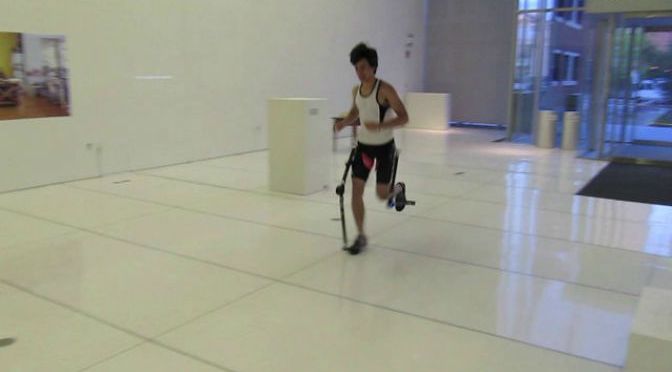
Scientific advances in assistive devices such as supportive robotic exoskeletons can have great benefits for people with irreversible musculoskeletal problems or severe movement impairment. These devices may have excellent military applications.

In this post I’ll discuss something different: the claim, as covered by an article in Outside Magazine, that these devices have a legitimate and lasting place in the domain of athletic performance.

In a word: no. In two: bad idea.

Continue reading Please, leave your robotic performance-enhancing devices at the starting line.

Athletics’ dysfunctional marriage: can injury prevention be reconciled with performance training?

Show me a runner. You’re showing me someone who’s run through pain. Isn’t that true? When you’ve been in the middle of a long run and felt the beginnings of a shin splint, you’re finally in the club. But we can’t stop now! There’s miles to be logged. Our marathon training plan says 60 miles a week, and this long run is 17.

We’ve faced with having to ask the dreaded question: should I choose to continue this training, or should I choose to prevent the injury?

Continue reading Athletics’ dysfunctional marriage: can injury prevention be reconciled with performance training?

Gait control, running experience, and injury.

One of the constant grievances that I have towards classical running coaching is that beginner runners are treated like “mini-pros.” For novice runners, coaches typically use a scaled-down version of the training that elite runners do. The overall strategy is to develop speed, power, and endurance by periodizing training. Little attention is given to gait consistency or gait characteristics.

This is a problem: Learning how to run isn’t the same as training how to run. For the sake of everyone’s knees, it’s time we incorporated this knowledge into how we coach.

I run a systems thinking blog because I’m interested in, well, systems. A multitude of scientists have been using dynamical systems theory to study the fluctuations in a runner’s stride. They’ve had two very interesting findings: the first is that fluctuations in stride interval—the amount of time between footstrikesbecome reduced with increased experience and speed. (This reduction is referred to as “long-range correlations”—that previous steps are more similar or correlated with subsequent steps.)

This seems obvious: when we get more experience, our movements get more consistent, less variable—better trained.

The other finding is that that fluctuations in the stride also decrease when there is injury present. In other words, long-range correlations also increase.

What?

As Nakayama et. al. rightly point out, “the findings that long-range correlations can be decreased as a result of flexible and adaptive motor control utilizing rich information and at the same time as a result of less flexible control due to pathological states or aging seems confusing.”

Yes it does—until you look at the particular claims involved.

The study that claims that variability decreases with experience and speed was studying stride interval. On the other hand, the study that claims that variability increases was studying biomechanic characteristics and particular tissues. Why is this important?

Because there are two different requirements to be satisfied here. Gravity, the force that causes us to accelerate towards the ground, is a constant. This means that there is an optimum time for the human body to be suspended in the air, with the goal of maximizing flight time but reducing landing velocity. Typically, this means a stride rate of ~180 steps per minute. In other words, there is a really good reason for why stride rate would become more constant with experience.

On the other hand, if our particular kinematics—the characteristics of our motion—can’t (and won’t) change, we are going to repetitively stress the same tissues over and over, resulting in injury. Think of it this way: when we start out running, only a few muscles are strong and used to moving together. As we become more practiced, more muscles and body parts become integrated into the stride, and our brain becomes comfortable with a wider array of movements.

J. Hamill et. al. corroborate this: “An optimal solution [means] that no soft tissue would be repeatedly stressed. The healthy state, therefore, is one in which no tissue is repeatedly stressed which results from the relatively greater variability of joint couplings.”

Gaining experience essentially means that we gain greater control. When you’re doing target practice with a rifle, this means that you have to reduce motion—hold the rifle steady. But when you’re running, this means that you’re interacting with variable terrain for a long time.

In other words, not only does your brain have to adapt every landing slightly differently, but it has to do so with control. It’s not enough to make every stride different just to spread out the wear and tear—this has to be done in a way that recognizes the differences in substrate, inclination, etc.

To simplify this and bring it back to coaching, this means that control takes time and practice. Furthermore, this adds evidence to the idea that increased control makes you less likely to be injured. What should coaches be teaching those who are learning to run? Control.

If you’re new to running, this means that it’s extremely important to take it easy, and do first things first. That’s why I always recommend jumping rope as a way to get comfortable with gravity. Also, look for a strength/stability program for runners containing exercises like these, presented by P.A.C.E. coach and strength training guru Dr. David McHenry.

If you want to reduce your risk of injury, get control. This takes time. Until you have control, and you’ve developed substantial speed and even greater endurance based on that control, you’re not ready to run a marathon.

Don’t train with your eye on today’s finish line. Train with your eye on next year’s.

Eli Goldratt’s Theory of Constraints in running coaching: can we reliably create sustained athletic achievement in runners?

“Sustained athletic achievement” is a phrase seldom heard when talking about runners. By now, nobody needs to quote the staggering injury statistics in Western running populations: According to an epidemiological study, there are 2.5 to 12.1 injuries for every 1000 hours of running. 20 to 70% of those injuries are recurring, and 30 to 90% of those injuries result in a reduction in training.

Is this because running is inherently injurious? Probably not—and some would argue that we’re in no position to know: the rates of injury aren’t due to the fact that we’re running, but instead due to the fact that we’re running unprepared. In Movement, Gray Cook writes that “many times, the activity gets the blame when the blame should be placed on the poor foundation the innocent activity was placed upon.”

Let’s translate this: are our calves mobile and strong? Are our hips stable? Are our flexors and extensors working well together with our abductors and adductors? These are questions that runners typically only ask themselves after an injury or ten.

Whenever we train an athletic activity such as running, it’s important to figure out what might hold our training back, rather than just going out to hit the pavement and hope for the best. There is a theoretical framework that may provide us with a systematic way of finding solutions to these widespread problems: Eli Goldratt’s Theory of Constraints (TOC).

At the general level, the Theory of Constraints consists of 5 steps:

  1. Identify the system’s constraint.
  2. Decide how to exploit the system’s constraint.
  3. Subordinate everything else to the above decision.
  4. Elevate the system’s constraint.
  5. Find the new constraint.

In Critical Chain: the theory of constraints applied to project management, Graham K. Rand writes: “The system’s constraint is the part of the system that constrains the objective of the system.”

Overuse injuries in running are rarely generalized. In other words, it’s always something specific: either a bad knee, or shin splints, or plantar fasciitis is stopping us. In other words, that’s the constraint that doesn’t let us log more miles.

A lot of us are really good at doing the first two steps. We already identified the constraint (at least superficially speaking)—say it was a tight IT band. Then comes step two: deciding how to exploit the system’s constraint. We roll out our tight IT band, so that we can log as many miles as possible.

But a lot of us don’t get past step 2: we keep logging miles and more miles, until our IT band is so sore that we can’t run at all. Doing step 3 would mean figuring out how many miles we can run without injury. Here’s the problem: if we actually did an honest assessment, the answer would typically be “not many.” Certainly not enough to train for a marathon, probably just enough to train for a 10k.

Which brings up to step 4. We’re trying to train for a marathon—or train for a fast 5k—and this IT band doesn’t let us go far or fast. What do we need to do? Elevate the system’s constraint. Otherwise, that tight IT band won’t let us develop the speed or endurance we need for our event.

When you look at the problem of athletic development broadly, it doesn’t make much sense to spend time and effort developing endurance when a problematic knee or IT band isn’t letting you progress.

In Critical Chain, Eli Goldratt writes: “What property typifies the chain? It is the strength of the chain. If one link breaks, just one link, the chain is broken. The strength of the chain drops to zero.”

This is the tired story of overuse injuries and recurring injury in runners. We often sideline ourselves by running through injury. We break the chain, instead of strengthening it.  We try to increase our endurance, when ironically our present endurance may be greater than we know—but we can’t experience it, given that the system is constrained by a malfunctioning part.

We should always focus on the weak link. “Remember,” Goldratt writes. “You are not really interested in my link. You are interested in the chain. If I made my link stronger, how much did I improve the strength of your chain? Nothing. Absolutely nothing.”

In previous posts, I’ve alluded to the possibility that “the plateau” may be deeply related to the flawed thinking that Goldratt attempts to correct: perhaps the case is that we’re training endurance when the constraint of the system is strength, or hip stability. We don’t see gains in endurance because we don’t address the constraint, and we perceive that we “plateaued.”

What’s the problem? Why did we miss the constraint?

The problem, Goldratt proposes, may be in our ideas and in our personal culture. A typical assumption in project management is that “the only way to achieve good global performance (is through good local performance everywhere.” Although this idea seems to make sense at face value, Goldratt disagrees: “The fact that so many managers and almost all our systems are based on this assumption is regarded by TOC as the core problem…”

Project management and athletic training are not so far apart: the same problem is present in both. Look at your training plan.Most athletic programs look for good local performance everywhere. Chances are that your training plan is similar to many other training plans: do fartlek, strength training, endurance, cardio.  The mainstream philosophy is to hit every side of the problem, all at once. Of course this works, in the sense that the body develops, but does it work well?

By the best standards, probably not. And if you keep getting sidelined by injury, certainly not.

I hope to have shown that the principles provided by the Theory of Constraints can be easily adapted to create a system for athletes and coaches, by which they can jointly achieve two objectives that are typically at odds with each other: injury prevention/management and athletic development. Applying the Theory of Constraints to athletic coaching may allow us to define athletic development in such a way that these two objectives cease to be in conflict. I believe that on a deep level, this conflict of interests is the likeliest culprit of the staggering running injury statistics. Settling it will benefit athletes, coaches, and the running culture in general.

I’ll devote my next post to fleshing out the details of this conflict of interest (and how to resolve it).

Descriptive vs. prescriptive in running.

When I read articles about running, I often come across phrases like “no single foot-strike pattern is representative of the entire running population.” True enough, but it doesn’t really help runners: all it does is describe the present state of affairs of the running population.

The problem that I see with this is that many people—many scientists, even—take this descriptive observation about the world and turn it into a prescriptive one. Within their statement is a hidden interpretation (shown in italics):

 “No single foot-strike pattern is representative of the entire running population. Therefore, no single foot-strike pattern should be adopted as a baseline gait for a human population.”

Why is this problematic? Let me give you another example—one that we’re all comfortable with.

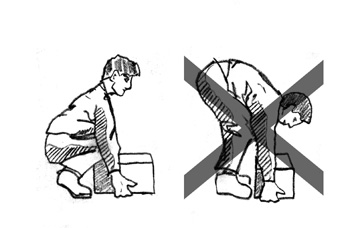
Let’s suppose that we did the very same research, only about how people lift heavy objects. Statistically, our findings would be similar to running; as researchers, we’d be prompted to say: “no single lifting pattern is representative of the entire human population.” In other words, we’d make our analysis, and see that some people lift objects by bending at the waist, and others lift objects by bending at the hips.

knee5

The difference, of course, between running and lifting heavy objects is that we have a clinical standard for lifting. We know that bending from the waist is a bad idea for virtually any human out there. There are only three options for lifting objects, and when you really think about it, there’s only one:

  1. Bend from the waist to lift a heavy object and get injured
  2. Bend from the waist and only pick up light objects without injury
  3. Bend from the hips (correctly) to lift heavy/light objects without injury

In light of this knowledge, let’s review the following statement: “no single lifting pattern is representative of the entire human population. Therefore, no single lifting pattern should be habitually adopted as a baseline lifting pattern for a human population.” This statement seems ridiculous, and kind of insistently missing the point.

But we should keep in mind that the reason it seems ridiculous is because we have a clinical standard for lifting heavy objects, namely, to minimize trunk flexion throughout the lifting action.

This, of course, doesn’t mean that midfoot/forefoot striking is better than rearfoot-striking (although it certainly sets me up to make that argument).  What it does mean is that descriptive observations about a population’s habits tell us very little about what that population should be doing. They only tell us much about what it is doing. And what we do know is that given the stratospheric injury rates for runners, the running population is doing something wrong.

We need a clinical standard for running. In order to get one, the first step is to stop interpreting descriptive statements as if they were prescriptive ones.

UPDATE: Here are a couple of good articles on how foot-strike could be a function of running speed. This all adds to the question: what should the clinical standard be—which part of our foot lands first? Probably not. But we need a standard. There are a few ideas out there, but I’ll leave that for another post.

How do we measure athletic performance?

In Critical Chain, Eliyahu Goldratt captures a statement that has been immortalized in the arena of business management:

 “Tell me how you’ll measure me, and I’ll tell you how I’ll behave.”

When the criteria that we measure are wrong, or incomplete, we can create disastrous consequences.

Goldratt tells the story of a steel company, in which the standard for measurement for the production division was tons per hour. This is great, right? Measure how much the production division is putting out, and everything should go well! Well, not so much: this form of measurement wasn’t taking into account the needs of the company as a whole.

As Jamshid Gharajedaghi writes in Systems Thinking: Managing Chaos, “Major organizational theories have implicitly assumed that perfectly rational micro-decisions would automatically produce perfectly rational macro-conditions.”

That was the assumption in this case: measure tons-per-hour (which is a rational measurement for the production division) and the macro-conditions would be rational too: the company would just make more money!

As you probably can intuit, that wasn’t the case: the imperative to maximize tons per hour created a situation where materials that were easy and quick to process were processed first (regardless of delivery promises), and specifications that the buyers asked for were ignored, in order to reduce production time: if the buyers wanted say, a ton of 12” steel beams and a ton of 10” steel beams, the production division would just produce two tons of 12” steel beams (cutting down set-up time by half) and then complain to the supply division that they only received a single ton of steel to work with.

A very similar thing happens in athletic training: we tend to create all the wrong results because here too we measure the wrong things.

For example, look at how catastrophic it has been for a majority of people to focus on weightloss when they want to become “fit.” People have been pushed into disregarding a majority of the body’s systems to focus on only one variable: the amount of visible body fat. That’s what we measure, and people’s behavior typically homes in on body fat (or on any one thing), disregarding anything else.

As Goldratt cautions us, “Most of the local improvements do not contribute to the global.” In other words, by homing in on body fat we might be creating huge problems for us further down the line (see: thyroid problems).

A similar thing happens when we try and measure “miles.” That we measure this is ridiculous, given the well-known saying “quality over quantity.” Well, what is a “quality mile”? Do you know? I certainly don’t—or at least, it hasn’t been defined for me. How many runners out there hobble out their miles, fighting through knee pain and achilles tendonitis, popping kidney-destroying doses of ibuprofen? A lot.

We’re measuring the wrong things, we’re seeing the majority of people behave the wrong way, and we’re achieving the wrong results.

The successful ones are those who staunchly ignore the ravings of modern exercise culture—“fight through the pain,” “pain is inevitable”—and concentrate, against all odds and against the prevailing cultural current, on quality, precision, and correct function.

Even though we’d like to think that these problems are intractable, and solutions are difficult to find, they’re actually out there. Solutions to these problems have been diligently developed in the realm of business management, and have yet to reach the domain of athleticism.

The fact of the matter is that by measuring the wrong things, we’ve created these negative, pathological systems for ourselves. It is because we measure the wrong things, that we create the wrong behaviors. Injury, overtraining, and hypergymnasia don’t exist in a vacuum. They exist in a context of social pressures and cultural expectations—cultural measurements of people. And they’re the wrong ones.

So what are the right ones?

That’s the million dollar question.

The beauty of the thing is that tens of millions of dollars have been already spent in answering this question—and the answer has already saved smart businesses hundreds of millions of dollars. We have ten-million dollar answers to our million dollar question.

And the answer, generally speaking, is to make measurements that reflect the whole, instead of a particular faculty, property, or variable. Generally, this means changing a quantitative measurement (position of the heel upon foot-strike) with a qualitative one (gait harmony).

Instead of measuring foot-strike, let’s measure correct movement. Instead of measuring miles, we can measure distance covered without injury. Or, for example, if we must insist on measuring power, let’s make sure it’s not muscle power (of one or two muscles or isolated systems) but rather athletic power (of various systems in various domains across the whole body).

Always, always, measure the whole. That’s what coach Alberto Salazar does with his Athletes at Nike: he learned the lessons of overtraining—what he calls “extreme athletic excess”—the hard way. And he knows that the only way to get quantity—lower times for his athletes (or perhaps, more medals), is by addressing the qualitative aspects of training, and by being better at it than maybe anyone else in the world.

Most of us fitness enthusiasts know how to periodize training plans so well that we can’t get any better at it. Most of us would benefit little from broadening an already encyclopaedic knowledge of training exercises. How we implement training programs is where most of us fail. And our behavior, the execution of the “how,” is tied above all to the way that we measure ourselves, and to the measurements that we conceive for others.

Let’s make damn sure that they’re the right ones.

A bit of running advice.

During the swing phase, lead with your knee, not with your foot. By “floating” the knee in front of you as your leg swings up, maintaining knee bend as long as possible, you will:

  1. Increase full-body forward lean.
  2. Allow a complete contraction of the extensors (gluteus maximus, hamstrings, and calf muscles).
  3. Allow a complete contraction of the flexors (Sartorius, iliopsoas, frontal calf muscles).
  4. Increase your speed by increasing thigh spread (the distance between your swing thigh and your pushoff thigh).

Galen Mo

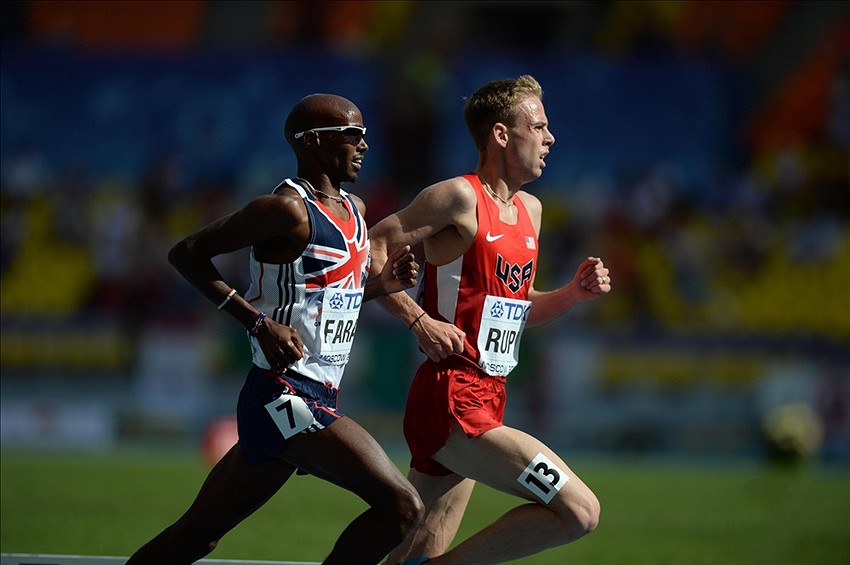
Look at Galen Rupp and Mo Farah in the picture above: their swing thighs are in a very similar angle to the ground despite Galen being in late stance phase and Mo in early pushoff. (The main difference is the angle between their thigh and their calf, not the thigh and the ground). You can see that their swing hip is completely rolled forward, meaning that their feet (off camera) can easily manage full pronation.

Floating the knee should feel like you’re falling, similar to what you feel during a lunge, except that your foot ends up coming down under the center of gravity. You should feel your swing hip hike up and your pushoff hip press down. Master this by skipping, focusing on bringing your knees far, far in front of your body with your thighs in a straight line.

Bonus points: Look at their body geometry. At the height of the swing phase, you can draw a straight line from the top of the knee to the bottom of the elbow in both athletes, smoothly connecting thigh and forearm. Elegance always holds the key to speed.