Category Archives: Biomechanic Issues

Gait control, running experience, and injury.

One of the constant grievances that I have towards classical running coaching is that beginner runners are treated like “mini-pros.” For novice runners, coaches typically use a scaled-down version of the training that elite runners do. The overall strategy is to develop speed, power, and endurance by periodizing training. Little attention is given to gait consistency or gait characteristics.

This is a problem: Learning how to run isn’t the same as training how to run. For the sake of everyone’s knees, it’s time we incorporated this knowledge into how we coach.

I run a systems thinking blog because I’m interested in, well, systems. A multitude of scientists have been using dynamical systems theory to study the fluctuations in a runner’s stride. They’ve had two very interesting findings: the first is that fluctuations in stride interval—the amount of time between footstrikesbecome reduced with increased experience and speed. (This reduction is referred to as “long-range correlations”—that previous steps are more similar or correlated with subsequent steps.)

This seems obvious: when we get more experience, our movements get more consistent, less variable—better trained.

The other finding is that that fluctuations in the stride also decrease when there is injury present. In other words, long-range correlations also increase.

What?

As Nakayama et. al. rightly point out, “the findings that long-range correlations can be decreased as a result of flexible and adaptive motor control utilizing rich information and at the same time as a result of less flexible control due to pathological states or aging seems confusing.”

Yes it does—until you look at the particular claims involved.

The study that claims that variability decreases with experience and speed was studying stride interval. On the other hand, the study that claims that variability increases was studying biomechanic characteristics and particular tissues. Why is this important?

Because there are two different requirements to be satisfied here. Gravity, the force that causes us to accelerate towards the ground, is a constant. This means that there is an optimum time for the human body to be suspended in the air, with the goal of maximizing flight time but reducing landing velocity. Typically, this means a stride rate of ~180 steps per minute. In other words, there is a really good reason for why stride rate would become more constant with experience.

On the other hand, if our particular kinematics—the characteristics of our motion—can’t (and won’t) change, we are going to repetitively stress the same tissues over and over, resulting in injury. Think of it this way: when we start out running, only a few muscles are strong and used to moving together. As we become more practiced, more muscles and body parts become integrated into the stride, and our brain becomes comfortable with a wider array of movements.

J. Hamill et. al. corroborate this: “An optimal solution [means] that no soft tissue would be repeatedly stressed. The healthy state, therefore, is one in which no tissue is repeatedly stressed which results from the relatively greater variability of joint couplings.”

Gaining experience essentially means that we gain greater control. When you’re doing target practice with a rifle, this means that you have to reduce motion—hold the rifle steady. But when you’re running, this means that you’re interacting with variable terrain for a long time.

In other words, not only does your brain have to adapt every landing slightly differently, but it has to do so with control. It’s not enough to make every stride different just to spread out the wear and tear—this has to be done in a way that recognizes the differences in substrate, inclination, etc.

To simplify this and bring it back to coaching, this means that control takes time and practice. Furthermore, this adds evidence to the idea that increased control makes you less likely to be injured. What should coaches be teaching those who are learning to run? Control.

If you’re new to running, this means that it’s extremely important to take it easy, and do first things first. That’s why I always recommend jumping rope as a way to get comfortable with gravity. Also, look for a strength/stability program for runners containing exercises like these, presented by P.A.C.E. coach and strength training guru Dr. David McHenry.

If you want to reduce your risk of injury, get control. This takes time. Until you have control, and you’ve developed substantial speed and even greater endurance based on that control, you’re not ready to run a marathon.

Don’t train with your eye on today’s finish line. Train with your eye on next year’s.
Descriptive vs. prescriptive in running.

When I read articles about running, I often come across phrases like “no single foot-strike pattern is representative of the entire running population.” True enough, but it doesn’t really help runners: all it does is describe the present state of affairs of the running population.

The problem that I see with this is that many people—many scientists, even—take this descriptive observation about the world and turn it into a prescriptive one. Within their statement is a hidden interpretation (shown in italics):

 “No single foot-strike pattern is representative of the entire running population. Therefore, no single foot-strike pattern should be adopted as a baseline gait for a human population.”

Why is this problematic? Let me give you another example—one that we’re all comfortable with.

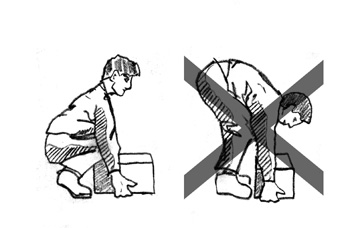
Let’s suppose that we did the very same research, only about how people lift heavy objects. Statistically, our findings would be similar to running; as researchers, we’d be prompted to say: “no single lifting pattern is representative of the entire human population.” In other words, we’d make our analysis, and see that some people lift objects by bending at the waist, and others lift objects by bending at the hips.

knee5

The difference, of course, between running and lifting heavy objects is that we have a clinical standard for lifting. We know that bending from the waist is a bad idea for virtually any human out there. There are only three options for lifting objects, and when you really think about it, there’s only one:

  1. Bend from the waist to lift a heavy object and get injured
  2. Bend from the waist and only pick up light objects without injury
  3. Bend from the hips (correctly) to lift heavy/light objects without injury

In light of this knowledge, let’s review the following statement: “no single lifting pattern is representative of the entire human population. Therefore, no single lifting pattern should be habitually adopted as a baseline lifting pattern for a human population.” This statement seems ridiculous, and kind of insistently missing the point.

But we should keep in mind that the reason it seems ridiculous is because we have a clinical standard for lifting heavy objects, namely, to minimize trunk flexion throughout the lifting action.

This, of course, doesn’t mean that midfoot/forefoot striking is better than rearfoot-striking (although it certainly sets me up to make that argument).  What it does mean is that descriptive observations about a population’s habits tell us very little about what that population should be doing. They only tell us much about what it is doing. And what we do know is that given the stratospheric injury rates for runners, the running population is doing something wrong.

We need a clinical standard for running. In order to get one, the first step is to stop interpreting descriptive statements as if they were prescriptive ones.

UPDATE: Here are a couple of good articles on how foot-strike could be a function of running speed. This all adds to the question: what should the clinical standard be—which part of our foot lands first? Probably not. But we need a standard. There are a few ideas out there, but I’ll leave that for another post.

Walking, jogging, running, and how gravity defines them.

What is the difference between walking and running? As runners, particularly runners who often stake their identity on running, this is a question that we should have thought deeply about. But the reality is that in the vast majority of cases, it remains ignored.

Say, the simplest and perhaps most important difference between walking and running—or at least the one with the most consequences—is that running includes a flight phase while walking does not. In other word, walking has a static interaction with gravity, while running has a dynamic one. But upon further consideration, there’s a lot more to be said:

Bounding (by which I mean jumping continuously) also has a flight phase. So does skipping. Of course, these are obviously different from running in that running alternates support, similarly to walking, whereas bounding does not (since both feet land together) and neither does skipping (since each foot repeats its support of the body before alternating to the other).

Running is somehow special when you compare it to bounding and jumping, at least as far as the body is concerned: when we need to travel faster than walking allows, neither bounding or skipping are our go-to methods of travel. Instead, we run. Although this may seem too obvious to be important, it’s important precisely because of that: What is it exactly that running offers us?

All the biomechanics junkies are way ahead of me at this point. Running offers us a way to contralaterally (read: using one leg and its opposing arm) maintain balance and support: when one leg pumps down, the other arm comes up, allowing the body to push on the ground alternately while not compromising balance.

And there’s another requirement: running uses the energy return capabilities of our tendon system (in particular the achilles tendon) to maximize running economy. This means that, by loading the achilles tendon like you would load a spring, the body manages to put the force that it arrives at the ground with into the next step, to make running more “economical” by reducing the amount of energy that the body puts into the next stride cycle: the achilles tendon stretches during the landing and stance phase, and then shortens explosively during pushoff, when the leg and foot, well, push off against the ground to begin the next stride cycle.

Neither bounding nor skipping allow us this increase in economy: to be able to bound successfully, we would have to be counterbalanced in the sagittal plane, (read: front to back) in order to put the hips at the midline of the body. Basically, we’d need a tail. But since we don’t, when we land from a bound (or squat), the hips are behind the center of gravity, and the knees are in front, in order to compress the body properly.

But if we had a tail like a kangaroo, the hips would remain under the center of gravity during the landing phase, because our weight would be more evenly distributed behind and forward of our hips. Without going too far into it, this means that the force put into each bound is primarily generated by muscle power for us, whereas for the kangaroo it is a product of tendon energy return. Skipping doesn’t increase economy either since energy is lost in that second step before alternating legs.

Flying-kangaroo

So, we can begin to lay down the differences between running and walking in this short list:

  1. A flight phase
  2. Contralateral stance and equilibrium
  3. A maximization of running economy

This is where we finally get to why “interaction with gravity” is so important: when running, the human body puts itself at risk of injury by taking off and then accelerating back to the ground, but it is counting on using that acceleration, generated by the force of gravity, to power its next step. This means that an important amount of the energy that is being put into each step is borrowed from the last, and doesn’t come from inside the body at all.

Running diverges from jogging in the following way: Jogging doesn’t really harness the energy return properties of the tendon system. It doesn’t allow for an improvement in running economy. Why not?

In order to create energy return, the relevant tendons (say, the achilles) have to remain taut during the landing phase, in order to stretch. This means that as the foot lands, the extensor muscles along the rear of the leg (hamstrings, gastrocnemius, glutes) begin contracting even as the frontal muscles (quads, tibialis anterior) take the majority of the load.

When the back and front muscles play together like that, a large amount of the energy that the body accelerated towards the ground with goes into the tendon system, and gets released as the foot leaves the ground.

During a jog, the leg muscles are working in a fundamentally different way. Because a jog is slower than a run, the forces being generated are a lot smaller, and so a the rear and the front muscles of the leg can work relatively independently of one another: the front muscles take the body’s load when the foot comes down, and the back muscles push off as the leg goes back. The tendons never become stretched, so they don’t get loaded that much at all.

This means that the jogging cadence is much slower than the running cadence: in order to maximize tendon load, the body is forced to increase the speed and rate at which the legs hit the ground: since the muscles at the back of the leg tense the tendon springs, this drives the leg down at a much greater speed than otherwise, resulting in a faster transition from landing to pushoff, resulting in a much faster stride rate.

However, this also separates jogging from actual running from a power standpoint: in order to run rather than jog, the muscles must be powerful enough that they can hold the tendons taut while the weight of the body comes down. (And of course, the tendons must be resistant enough to support this).

This is the minimum bar in order to run—developing enough leg power (and naturally, the aerobic power necessary to sustain it) that three interrelated capabilities emerge:

  1. The ability to hold the tendons taut throughout the stride cycle.
  2. Increasing the stride rate and successfully maintaining it.
  3. Equipping the body to successfully load tendons instead of absorbing power with muscle and bone tissue.

I believe it is these three capabilities that make someone a runner.

Muscle strength and running economy — a “chicken or the egg” problem?

Runners are often told that strength training is integral to improving running speed and running economy. But there might be a little bit of a problem with this advice. I recently posted about a body of research that pointed to the idea that, for a variety of biomechanical reasons, weaker muscles in a trained runner correlated with a greater running economy (specifically at the calf region). The consensus was that running economy increased with achilles tendon loading, and decreased with calf muscle (gastrocnemius and soleus) activity.

More muscle means worse economy. A recent article in Runner’s World confirmed this, citing a study that found that running economy was related to the balance of strength between the anterior and posterior muscles (specifically, the quads and hamstrings). It was not, as most of us suspect, a function of pure muscle strength—overall, competent runners had weaker muscles than novice runners.

This brings up several questions. The first is, of course, how can weaker muscles make you run faster? The answer, I believe, is systemic, and our ability to find it hinges on what we mean by “strength training”—and how usefully we’ve defined it for ourselves. In the most basic terms, the strength of an individual muscle has little to no bearing on how the hip-leg-foot mechanical system will function in practice.

The power of this system—when power refers to how much force the leg can put out per unit of time—is much more a function of how well the parts move together, than how strong any individual part (or indeed, all of its parts) are individually. Someone endowed with extremely strong muscles that are all just slightly out of sync will have a completely rigid leg, not a powerful one.

It’s necessary, therefore, to make sure we all mean the same thing by “strength training.” Strictly speaking, the kind of explosive power (plyometric) training that a lot of runners do, which actually does develop hip and leg power, is “strength training”—but of the entire system. We need to be clear on what we mean by this to know if strength training will actually help us become better runners. Do we mean pure strength, or explosive strength?

The second question is more related to a practical matter, and is a consequence of answering the first. What are our reasons to train pure “muscle strength” in the first place? We’d better have them, given the above evidence that muscle strength correlates with low running economy. If we do prescribe a strength training program to runners, are we potentially hurting their running economy?

I don’t have an answer for this. Most of my training is either isometric or plyometric, and the few strength exercises that I do—such as barbell squats—are for balancing my body out, more than anything.

The third question is a matter of causality: why did the novice runners in the Runner’s World article have stronger muscles? To speculate about this, we have to return to the body of research mentioned above. The reason that weaker muscles correlated with greater running economy has to do with the biomechanics of particular bodies. One of the abovementioned studies looked at the ankle region of highly-trained runners, and found that runners who had longer heels (meaning a greater distance between the ankle and the heel) had poorer running economy and greater muscle power.

None of this is surprising, once you think about it. When the hip-leg-foot system pushes against the ground, it exerts force directly into the ground, at a perpendicular angle. To achieve this, the foot works a lot like a lever: the achilles tendon is connected to the end of the lever arm (the heel bone). When it shortens, the heel raises, meaning that the foot rotates downwards around the ankle—the fulcrum—allowing force to be exerted into the ground. Because every action has an equal and opposite reaction, force also travels in the exact opposite direction: into the calf, parallel to the calf bones.

Achilles-tendon-function

Because of the properties of the muscle-tendon system, this results in a trade-off. If you increase the length of the lever arm—the distance from the ankle to the heel—leverage increases, meaning that the calf muscles have an easier time pulling on the lever and causing the foot to point.

However, this also means that the tendons work more like a rope and less like a spring: The elastic fibers that make up the tendon have to be aligned with the direction of force in order to store that mechanical energy. If the lever is longer, the achilles tendon is at a greater angle to the direction of force, and therefore less capable of storing mechanical energy.

In other words: greater leverage = less energy return. When your skeletal structure compels you to use your muscles more (resulting in stronger muscles), you also have less energy return, which is a critical component of running economy.

The reason that the novice runners in the Runner’s World article have stronger muscles may have less to do with the fact that they’re untrained and more with why they’re untrained. Perhaps one of the reasons is that they are not dimensionally prediposed to train running. Supposing this is the case, you might look at their bodies and find that they are built for leverage, not for energy return.

You might. A longitudinal—long-term—study would confirm this (or not). If the untrained runners started training, would their running economy get better? According to the abovementioned study, not really—or at least not completely: the study estimated that 56% of running economy could be accounted for by heel length alone. In addition, the runners they looked at were all highly trained (and had comparable running performance) and their running economy still varied by 20-30%.

(This also means that while longer heels contribute to a lower running economy, they do not necessarily contribute to lower running performance. The human body has many faculties, each of which contribute differently to performance. Energy return is only one of them).

One thing is clear: as a collective, we need to be a lot more careful with the advice that we give runners. As I mentioned above, what does “strength training” mean, and what exactly are we recommending that runners do, if we make such a suggestion? The skeletal mechanics of the body (let alone the possible interpretations of the phrase “strength training”) means that the same advice given to two different runners can have very different ramifications—or worse yet, none at all.

Understanding our own imperfections isn’t just for self-acceptance; it may help us reach greater athletic heights.

In every sense that matters, nobody’s perfect. Not physically. Everyone’s body is slightly asymmetrical. We have to keep that in mind when we train: those asymmetries are natural, and we should take them into account. Trying to create the “perfect” body—a body that is perfectly symmetrical—will mean that our bodies are less functional, because part of our biological systems will be devoted to maintaining those artificial symmetries.

A recent article discusses this at length, from the perspective of CrossFit. It makes the point that a lot of CrossFit injuries occur because of too much symmetrical training with an asymmetrical body: since we have a dominant side (larger, more powerful, more easily trained) and a non-dominant side (smaller, less powerful, less easily trained), training both sides “equally”—say, by doing barbell squats that load both sides equally—we are actually contributing to our body’s asymmetry.

We should train our non-dominant side more than our dominant side: when we get tired during a marathon, our form will collapse first on our non-dominant side. Then our dominant side will be forced to pick up the slack. Even if our dominant side is super strong, the mechanical energy is no longer translating properly from our bodies into the ground (and vice versa), eventually leading to injury.

But there’s more to this than just training. Lateral differences in people’s bodies have important effects on how mechanical energy is translated into the ground. When we run, it’s important to push off with the foot tripod (a.k.a the entire foot, with the weight on the first and second metatarsal). However, in order for both feet to do this when we have two different-sized left and right legs, the muscles of one leg need to work differently from those of the other: muscular asymmetries must be created in order to balance out skeletal asymmetries.

A right-dominant person’s right side is typically larger than their left. In the case of their hip bones this means that the right hip will be wider and longer than the left. (Their right femur is further away from the body’s centerline than their left femur). This means that the right foot is prone to evert (rotate outwards) more than the left. Supposing that the right foot pushes off correctly (with the entire foot tripod firmly planted), the left foot is likely to naturally underpronate during the swing phase, which means that this foot is likely to push off with more weight on the outer metatarsal bones.

In order to make the pronation (and therefore the pushoff) equal between the left and the right foot, the relevant hip muscles (usually hip abductor muscles) at the left hip, leg, and lower leg must be correspondingly stronger than those on the right side.

You see this happen in a lot of elite athletes, from Buzunesh Deba’s right leg swing to Haile Gebrselassie’s right arm swing (seen best at 1:47). During the swing phase, Deba’s right leg rotates inward slightly more than her left leg (and her right hip is consistently higher than her left). Similarly, Haile’s right arm ends the upswing with his hand just above the collarbone, while his left hand ends up just below. (These asymmetries are very slight because both these athletes have a very clean gait). Possibly, these athletes’ muscles are pulling asymmetrically in order to compensate for slight asymmetries between their right and left sides. These seeming imbalances allow their legs and feet to translate the mechanical energy generated by their bodies into the ground in the most efficient way possible. Trying to “correct” these asymmetries would likely result in a reduced athletic output.

Deba’s and Gebrselassie’s bodies are quite simply done pretending that they’re symmetrical. Neurologically, muscularly, and skeletally, their bodies are quite in touch with their own imperfections.

I’m making a case for self-awareness and self-acceptance. And I’m certainly not saying that self-acceptance will magically grant you good biomechanics. But biomechanical acceptance isn’t that far removed from the physical acceptance we need when we look at our bodies in the mirror. Not really.

None of this means that “perfect” symmetry is the ideal situation. Dominance is something that happens naturally, in order for us to be able to move the body asymmetrically. Having a dominant hand is far from a drawback: it allows us to write, paint, or to throw a javelin. Neurologically speaking, dominance lets both hemispheres of the brain provide greater computing power to a single extremity, resulting in much finer movement, and much greater skill.

Furthermore, the organs of the body aren’t arranged perfectly symmetrically: the heart is slightly on the left side, and the liver is on the right, for example. Because of how the body is organized, weight is distributed in odd places. More blood reaches some parts of the body than others, and dominance means that the touch, and proprioceptive receptors of some areas of the body are getting far more stimulation than others. The body grows differently in different places, and that’s a good thing.

But some of the most important movements we can make harness the body’s symmetry: running and walking. We somehow need to reconcile the need for symmetry with the need for asymmetry. Because each of us are different in different ways, we each reconcile those needs differently.

It’s not easy to reconcile these things. When we don’t have a lot of experience moving our bodies, our neuromuscular system makes the computationally simplest assumption: that both sides of our body are identical in length, width, height, and weight. It takes the brain a lot of data mining (from a lot of training) for our mental map of our bodies to include our biomechanical quirks and musculoskeletal idiosyncracies.

Training isn’t just about self-improvement. I believe that, above all, athletic excellence is about self-knowledge. Firsthand knowledge of our bodies leads to better, safer, and more efficient training. But it can also lead to a much better athletic experience, with much greater personal satisfaction.

Running “correctly” will mean different things for different people—up to a point.

Next time you go see a marathon, go look at the elite runners—and then look at everyone else.

You’ll see that elite runners run like little toy soldiers: although they have different body types, their running forms are all nearly identical. The further back you get in the pack, the more “variety” of running strides you’ll see. In other words, across all humans, there is a specific recipe for speed.

Our bodies are all different. Some of us have big feet and short calves, others have long calves and really short arms. When a runner has really long legs but small feet, it becomes really easy for the knee joint to open and close: even though the feet are far away from the hinge (the knee joint), it doesn’t take a lot of power to move them because they don’t weigh very much.

In comparison, a runner with short legs and big feet might use the same amount of energy to open and close their knees. This short-legged runner is at a disadvantage, however: shorter legs means that they cover less ground with each gait cycle, meaning that more energy is expended across the same distance.

However, these differences don’t mean that different runners should use different stride types or different body positions. Achieving a “correct” stride will mean that for one runner, the parts of their body will be at certain angles relative to each other, while for another runner, those angles will be slightly different.

But our bodies all express strength in the same way.

For example, let’s suppose that somebody has a really short abdomen but a really long chest. This person may be inclined to hunch down to lift a heavy object, instead of bending their knees. For them, it may be simpler to stretch and contract the longest part of their upper body, their chest, instead of bending their knees, which is what they should do, mechanically speaking. In other words, this person has to work much harder to develop the muscles that hold their lower spine rigid (back extensors, illiopsoas), in order to safely be able to perform this maneuver. But despite these differences, the only mechanically feasible way to lift heavy objects is by bending from the knees.

Similarly, there is only one mechanically feasible way to run: by forming a smooth, unbroken arch from the base of the head to the ankle of the leg that’s pushing off the ground. This arch can only be formed when there is a very pronounced knee drive with the opposite leg (which means that the knee continues to be fully flexed at the end of the swing phase).

Because of individual differences such as those mentioned above, certain runners will have to work a lot harder than others at developing certain muscles, in order to create this continuous arch.

In my case, I have short legs, a short lateral arch (of the foot), and a long medial arch. Without going into the nitty-gritty details, this means that it is very easy for my foot to supinate too early in the running stride. Note that this does not mean that I am “a supinator”—or whatever. This means that my anterior compartment (hip abductors and hip flexors) has to be significantly more powerful than if I had longer legs and shorter feet, in order to maintain a midfoot strike while still using the entire foot tripod for pushoff.

My body has to work harder to keep my foot “more” pronated, and my leg “more” everted, throughout the  running stride, because the muscles that cause my foot to supinate are longer (and therefore get powerful more easily) than the muscles that cause my foot to pronate.

This means that the “untrained” version of my body (without a strong anterior compartment) wants to overstride. Why? Because in order to push off with the entire foot tripod, my body wants to start the contact phase when my foot is at its most pronated. In other words, because I supinate early, my body wants my foot to contact the ground early—and the easiest way to do that is by overstriding.

Furthermore, the only way for that untrained version of my body to midfoot-strike is by contracting the soleus muscle early in the contact phase. In order to go from the contact phase to the stance phase, my ankle has to dorsiflex. But because the soleus was already contracted, it has to work eccentrically in order to allow for this dorsiflexion. This form of midfoot striking put a huge eccentric load on the soleus, which means that my calves can get really really tight really fast if I don’t work heavily on strengthening my anterior compartment.

When I first started running for real, that’s exactly how the story went. My calves were chronically tight, and the answer to that was in developing my frontal compartment. Although different people may have to develop slightly different muscles (for example, someone may need a quadriceps muscle whose lateral head is relatively more powerful than the medial head), the answer for basically everyone who overstrides, or has posterior muscle tightness, is to strengthen the frontal compartment in some fashion.

My end goal was to create a particular structure—a structure which can hold a lot of tensile force, which is firm yet mobile, and which is correctly aligned relative to the force of gravity. As I mentioned above, that structure is a smooth, continuous arch from the base of the head to the ankle. Going about the process of creating that means something slightly different for me than it does for anybody else on the planet.

But nobody will be the most resilient (or fastest) version of themselves without first creating that arch.

On the importance of the Internal Obliques.

I just read a very interesting article on the importance of the internal obliques for the walking and running gait. Here’s a tidbit:

If you don’t own your obliques, you don’t own walking. If you don’t own walking, you don’t own movement. If you don’t own movement, you don’t own your spine. It’s that simple.

When the gluteus maximus (butt) muscle isn’t working well, the internal obliques sometimes take over the task of extending the hip. This compensation pattern can devolve into a series of other musculoskeletal problems. The article makes some key observations:

  • Since the internal obliques (quadratus lumborum) control the deceleration of the spine’s rotation, they are instrumental in maintaining spine stability and avoiding injury.
  • One of the hallmarks of oblique weakness is that people stop breathing when performing simple movement patterns to maintain stability. (This makes it essential for runners to focus on oblique function; incorrect breathing patterns and/or an inability to change them may be rooted in oblique weakness).
  • Because spine rotation is essential for gait, improperly-functioning obliques will impair the production and absorption of mechanical energy.

It’s always important to remember that a particular dysfunction has repercussions all over. Oblique functioning isn’t just about spine stability or just about breathing, or just about production and absorption of energy. A dysfunction in any one system has repercussions on many levels in a dynamic system like the body.

The “heel-striking” running gait doesn’t observe the requirements of the human body’s mechanical paradigm.

Those who say that the midfoot strike is the “ideal” running stride often conclude that midfoot striking is “better” for a variety of reasons. One of those reasons is that, allegedly, the midfoot strike is more “natural” than the rearfoot-strike (also known as the heel-strike).

It’s a bad idea to call the midfoot strike more “natural”—aside from the fact that the allegation is wrong: humans use a variety of different footstrikes for a variety of different activities. Rearfoot striking ahead of the center of gravity is the default walking strike. Rearfoot striking is also used to abruptly halt forwards momentum, and sometimes, to turn by using the heel bone as a pivot. Conversely humans use a very anterior (forefoot) strike during the acceleration phase of sprinting.

In short, the problem with this “natural” argument is that human feet strike the ground all over the foot map.

So stop calling it natural.

Which is why I prefer to adopt a more technical term: paradigmatic function. This term means that a certain function X is more in line with a particular structure, or a particular configuration of a structure.

For example, variable-geometry aircraft—those which have the ability to “sweep” the wings back from an extended position to create a triangular shape (such as the F-14 Tomcat)—use the swept-back configuration for combat and supersonic flight, while they use the extended (regular) position for takeoff and landing. For the F-14 Tomcat, the paradigmatic function of the extended configuration is takeoff and landing, whereas the paradigmatic function of the swept-back configuration is combat and supersonic flight.

tomcat

Although it is no doubt possible for the F-14 to land with the wings swept back and enter combat with the wings extended, there are two things to consider: (1) each configuration works better for each activity, meaning that (2) each configuration “solves” a different problem: the swept-back configuration allows for greater maneuverability and speed, while the extended configuration allows for greater stability and reduced speed during landing.

Central to systems thinking is the idea that every system (or configuration of a system) is built to solve a particular problem. For example, a system with a branching structure, like a tree, a lung, or a network of roads, solves the problem of getting the maximum amount of energy or nutrients to and from various places with the least amount of effort. The shapes of systems always correspond to the most parsimonious way to solve a particular problem. In a very real way, you can think of all systems—and each individual configuration of those systems—as solving a problem that is specific to each system or configuration.

The very same goes for walking and running, the two important gaits—the two functional configurations—of the human body.

Although it would seem easy to say that these two functional configurations are “walking” and “running,” it’s better to get at this conclusion in a more roundabout way:

In terms of the stresses absorbed by the body, the most important difference between walking and running is that in running, there is a flight phase, while in walking, there isn’t. This means that one of the things that the body needs to do while running is absorb the shock of landing, while in walking, this particular need is largely absent.

This theory is largely borne out by looking at the muscles used during walking: the largest muscles in the body—the gluteus maximus, the psoas major, and the hamstrings—are largely inactive.

Because of this, the knees remain locked during the walking gait. This means that by walking, the body “solves” the problem of preserving energy while remaining in motion; that’s what the walking configuration is for.

Because a necessary component of running gait is the absorption of shock, the landing portion of the running stride should incorporate a shock-absorbing motion. So, in order to figure out what kind of motion comprises the landing portion of the running stride, let’s review what a “purely” shock absorbing motion looks like: landing from a jump.

When we land from a jump, our hip and leg mechanism works largely like a shock-absorber: we land on our midfoot or our forefoot, and all the joints of the lower extremity go from a lot of extension to a lot of flexion in less then a second, meaning that the hip, knee, and ankle all flex together. (This is known as triple flexion). This means that the paradigmatic function that the body uses to absorb shock is triple flexion. Similarly, in order to jump again, the body extends the hip, the knee, and the ankle simultaneously (which is known as triple extension).

Exchanges_Triple-Flex-Ext

In order to create triple flexion and triple extension, the body must recruit the largest muscles of the body, including the hamstrings, gluteus maximus, psoas major, and quadriceps. In other words, the triple flexion/extension configuration solves a very different problem than the one solved by walking: it allows the body to safely absorb the energy of impact, while powerfully exerting force against the ground.

Because running necessarily has a shock-absorption component and a takeoff component (because of flight time), it stands to reason that, during running, triple flexion and triple extension should form an integral component of the contact and pushoff phases (respectively).

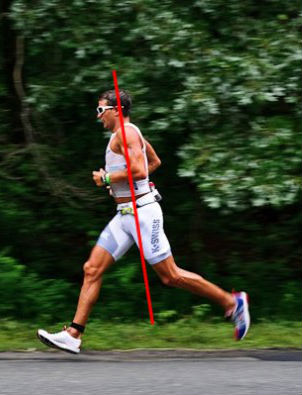
This is where it gets problematic. The typical heel-strike (overstriding with initial rearfoot contact) plays out very differently from triple flexion: as the foot strikes the ground, the knee is mostly locked but the leg is stretched out in front and the foot is raised. The hip is in flexion, the knee in extension, and the ankle in flexion. This means that the shock absorption capabilities of the leg are reduced—and because the leg flexes less, it has a lower capacity for pushoff.

heel-striking

(The lower achilles tendon loading of heel striking as compared to forefoot striking may attest to this).

I’ll leave the issue of heel-striking under the center of gravity for another post. For a taste of why it might be problematic, try jumping up and down in the same spot while landing on your heels. It’s extremely difficult.

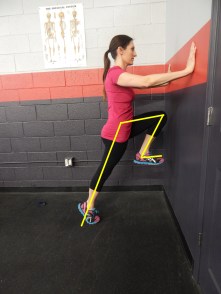
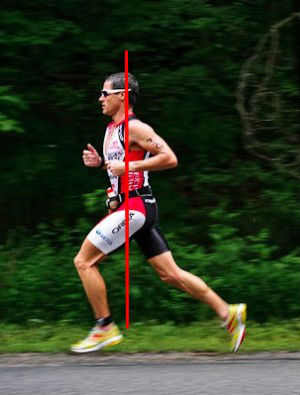
In contrast, the midfoot/forefoot strike is a great example of the triple flexion/triple extension principle at work: When you land on your midfoot, your leg compresses like an accordion: the ankle, knee, and hip create a zig-zag shape, which straightens as you push off. Midfoot striking adheres strongly to the musculoskeletal configuration used for shock absorption/propulsion movements.

forefoot-striking

In my opinion, the best way to know if you “are” a heel-striker in some essential sort of way is to jump up and down, and to see if it is easier for you to absorb shock by landing on your heels than by landing on your midfoot or forefoot. (Unlikely). If that isn’t the case, and yet you heel-strike while running, it might be time to look at muscular imbalances and power leaks, particularly in regards to muscular interactions at the hip area (illiopsoas, lower back extensors, gluteus maximus, quadriceps, and hamstring).

And then, embark on the long road of responsibly changing your gait.

A question of systemic resilience: is it more “efficient” to run shod than barefoot?

The idea that running barefoot offers a metabolic advantage over running shod may be an “appeal to nature” fallacy.

Although some studies have found that running barefoot is actually “more efficient,” there have been a host of other studies that contradict those results.

So we can’t say for sure.

In a 2012 study titled Metabolic Cost of Running Barefoot Versus Shod: Is Lighter Better?, Franz et. al. set out to debunk the claim that barefoot is indeed more efficient. In a nutshell, their results found that not only did barefoot running have no metabolic advantage over running shod, but actually seemed to be more metabolically costly to do so. It has been suggested by several studies that the reason for this added metabolic cost is because of a “cost of cushioning.” According to these studies, the body is making an effort to absorb impact when running barefoot, that it doesn’t make when shod (more on this later).

I largely agree with the research question, experimental design, and results of Franz et. al. But reading this article stirred up several theoretical issues that don’t have much to do with the article in particular, but are important in terms of how the shod/unshod and hindfoot/forefoot striking debates have unfolded, particularly regarding what the terms “efficiency” and “better”—as in the title of the study mentioned above—have come to mean in this debate.

Franz et. al. begin the article by writing that “advocates of barefoot running claim that [barefoot running] is more “efficient” than running in shoes.”

First I’ll address the question of what we mean when we say “efficiency.”

It’s important to be clear that the advocates that Franz et. al. cite (Richards & Hollowell, authors of The Complete Idiot’s Guide to Barefoot Running and Sandler & Lee, authors of Barefoot Running) are using the classical definition of “efficiency” as do Franz et. al.—meaning that they claim there is a lower energetic cost to barefoot running. That claim may well be a fallacy, and Franz et. al. are right to debunk it.

But I want to draw attention to a different use of “efficiency,” which will eventually get us to analyze what we mean when we say that one function (say, shod running) is better than another (say, barefoot running). In order to do this I need to bring in one of my favorite concepts from systems thinking: resilience.

One of the hallmarks of a resilient system is that it is built out of many tightly-coupled feedback loops, which basically mean that there is a lot of movement and interaction between its various parts. And for that movement to exist, the resilient system must be spending larger quantities of energy than the less-resilient system.

(This idea is rooted in thermodynamics: the movement of molecules and atoms correspond to the amount of energy stored in a certain space, i.e. the temperature of that space). The idea that greater movement can only be produced by a greater use of energy is generalizable to basically everything.

Note, however, that the causal relationship between resiliency and increased consumption of energy only goes one way: all other things being equal, a more resilient system must be using more energy than a less resilient one, but a system that uses more energy than another is not necessarily more resilient.

In the classical definition of “efficiency” that Franz et. al. and the barefoot running advocates are using, the resilient system is less efficient—i.e. it is at a metabolic disadvantage, since it uses more energy—than the non-resilient system. It isn’t very useful to speak in terms of “efficiency” when we’re talking about complex behaviors like athletic performance: for example, when the body finds itself in crisis, it will begin shutting down major organs to conserve energy. And for every organ that it shuts down, the less resilient it is: it becomes less and less able to cope with new and unexpected crises. Is this more “efficient” in any reasonable sense of the word but the classical? Not really.

“Efficiency” in the classical sense has never been the goal of human running. In Waterlogged, Tim Noakes explains how running on two legs has a much greater metabolic cost, across the same distance, than running on four legs, and yet, because humans run on two legs, we are capable of running down antelope and other ungulates in the desert. (The advantages that running on two legs offers are thermodynamic, but that’s a story for another time).

Simply stated, if efficiency was what the human body wanted in the first place, we would have never gotten off all fours. Actually, we would never have become runners at all. But we did. So there has to be more to this story. By standing on two feet, there has to be another problem that we were trying to solve beyond “efficiency.” That problem is most likely how to be resilient in the performance of particular function: human endurance running.

The human body—like any system—has other goals beyond pure efficiency. Indeed, one of the primary goals of the human body is redundancy. Studies have shown that even when we exercise at maximal intensity, only a fraction of our sum total muscle fibers are recruited. In the classical sense of “efficiency,” you could say that it is less efficient to be redundant, since more energy and nutrients must be spent building these redundancies instead of using them for athletic performance.

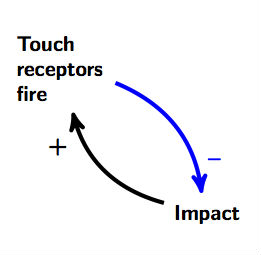
All of this gets us to what we mean when we say “better.” In a very real way, (and for a variety of reasons), it isn’t “better” for the human body to be “more efficient” in the classical sense. It’s better for the body to be more redundant, and more resilient. In theoretical systemic terms, the fact that the number of active “feedback loops” increase when  running barefoot—since the touch receptors on the soles of our feet “feed back” information to our muscular system, which works to decrease impact—is indicative of the likelihood that the unshod system is more resilient than the shod system.

touch rec m

Furthermore, when we blow up the term “efficiency” onto the large scale (divorcing it from its classical meaning), we can ask ourselves: in time and energy, what are the advantages of protecting the system, over not doing so? According to the literature, wearing shoes doesn’t protect the system in its entirety, beyond the skin on the sole of the foot: It has been shown consistently that shoe cushioning doesn’t affect peak impact force, only our perception of that impact. Peak impact force is alleged to be the main cause of repetitive stress injury in runners. While it has also been shown that in hindfoot-striking, shoe cushioning decreases loading on tissues), loading is a very different issue, with different consequences to injury, than impact.

Given that running shod reduces the activity of our cushioning mechanism, it would be extremely informative to do a long-term study on the amount of impact absorbed by the tissue (as opposed to loading), when the cushioning mechanism is deactivated. (Short-term studies already provide evidence that impact forces are indeed reduced when running barefoot as opposed to running shod). In turn, it should be explored how the increased impact translates to tissue damage, recovery time, and ultimately time not spent developing athletically.

In these terms, we may yet discover that it is more “efficient” for the body to run barefoot than shod. Being this the case, we could say that it is “better” for the system to run barefoot than shod.

Whether this is actually the case remains to be seen. What we can do at this point is to observe how our words shape our perception, attention, and inquiry, and what it is that systemic insights can bring to the table, both theoretically and with an eye towards future experimental research.

A functional argument in favor of midfoot striking: putting the research in context.

The human body is a machine with particular characteristics. So is a car. Just like the many different makes and models of cars have slightly different capabilities, human bodies are all different.

But they are not that different. For example, the operational requirements for all cars are very similar: the centrifugal force generated during a turn must not exceed the friction generated by the tires. And they are the same in humans.

But that’s not the way in which much of the medical and sports science literature treats it. Don’t get me wrong: everybody is in agreement on what the individual parts do: the gluteus maximus abducts and extends the hip; the gastrocnemius points the foot, etc. But there is a vast amount of disagreement as to how these parts are supposed to work together. Rather, there seems to be quite a bit of agreement that for the same systemic function (running), the individual parts can be performing wildly varying functions, and yet the system will still be somehow performing correctly.

I am, of course, talking about the footstrike debate. Before I continue, let me be clear that by “heel-striking” I don’t refer to how the foot hits the ground. I refer to the set of gait characteristics that contribute to overstriding by reaching forwards with the leg and striking the ground heel-first. The same goes with the gait characteristics associated with midfoot striking.

I’ve been reading a series of articles that associate different patterns of loading with different stride types. For example, a heel-strike is typically associated with increased loading of the knee, while a forefoot or midfoot strike is typically associated with an increased loading of the ankle and achilles tendon.

Most of the articles that I’ve read tend to conclude that therefore, we should see greater knee injury rates for heel-strikers, and greater achilles injury rates for forefoot/midfoot strikers.

However, that’s a hypothesis. By this I mean that thus far I’ve found no studies that have shown that these hypothesized injury rates actually occur.

The question is this: are all tissues equally amenable to loading? In principle, absolutely not. Buildings often have central support structures to carry the load. So does the body. The question is whether, say, the presence of the achilles tendon—a dense, springy structure capable of storing massive amounts of potential energy (also the largest tendon in the body)—makes the ankle more amenable to loading than the knee.

In principle, it makes sense that the presence of the achilles allows the ankle to be loaded more than the knee. However, this remains to be ascertained by future studies.

For now, what we can say is that the differences in loading associated with one foot-strike pattern aren’t “equal” to another. Because certain structures are paradigmatically employed by the body to support weight, absorb shock, and store potential energy, a foot-strike pattern that offsets loading to these structures will, in general, be more amenable to the overall health and functional performance of the body. Whether experimental research ascertains that the achilles tendon is such a structure remains to be seen.

However, I certainly agree with the general supposition that a stride type that places more emphasis on loading of the achilles tendon (such as midfoot striking) generates a higher incidence of injury for that structure. Across a population, use of a particular structure will almost necessarily correspond to an increase in injury and overuse rates of that structure.

It remains to be experimentally ascertained whether a stride type which offsets loading onto dynamic structures (muscles) and energy storage structures (tendons and fascia), will, across a population of individuals, create lower overall injury rates despite the likely increase in injury rates due to simple use of those structures.

However, we can still make a systemic analysis.

Let’s use the example of an airplane as an analogy: it is much more efficient for an airplane to use flaps, than to not use them. By increasing the total wing surface, flaps allow landing and takeoff velocity to decrease by a significant amount. An increased use of flaps will no doubt mean that, overall, more flaps will become damaged and broken than if flaps weren’t used at all. But because flaps help reduce the speed at which the aircraft lands, using them contributes to a decrease overall structural stress and damage associated with the impact of landing.

You could even make the argument against using flaps by saying that increasing the wing’s surface area will put more stress on the wing housing and the airplane’s airframe. Even though this is the case, making this argument misses the point. The point of the airframe—and especially of the wing structure—is to absorb the increased stresses associated with increasing the wing surface. Flaps should be used during landing regardless of the fact that both stresses to the wing and incidences of damage to the flaps will increase.

Along similar lines, if we posit that a certain body structure has a certain function, such as the achilles as a structure to store mechanical energy, the gluteus maximus as the main driver of hip extension, etc., then, under optimal conditions, the body should preferentially load the achilles upon landing and put the burden of moving the leg on the gluteus maximus. (All of which seems to agree with the findings of this study):

“When compared to RFS (rearfoot strike) running, FFS (forefoot strike) and BF (barefoot) running conditions both resulted in reduction of total lower extremity (leg) power absorption particularly at the knee and a shift in power absorption from the knee to the ankle.”

All of this said, the systemic analysis of the body is simple: in systems thinking, you look at the functions of different parts, in relation to the whole, to ascertain their function. The achilles tendon seems to be primarily a shock absorber. It certainly works that way when jumping—that’s why it’s almost impossible to land on your heels when you’re jumping straight up and down. So, any stride type that uses the achilles tendon as a shock absorber will likely be more amenable to the body.

Until evidence otherwise settles the matter—and only until then—the most reasonable conclusion to make is that a stride type that uses load-bearing structures to carry weight, offsets torque (rotational force) to joints that can rotate dynamically, uses shock-absorbing structures to absorb shock, and employs energy-return structures to return energy, are “better” than stride types that do not. Given the evidence currently in the literature, everything seems to point to (but not prove) the idea that midfoot striking is an example of the former, and heel-striking is an example of the latter.

AN IMPORTANT CAVEAT: The body is a dynamic system, which means that you can think of it this way this way: if you change one thing, such at the angle at which your foot touches the ground, three other things will change along with it. Perhaps you’ll see a change in your forward lean, a change in your hip extension moment, and therefore a change in the loading of a variety of muscles. In other words, you can never change only one thing. If you oversimplify your understanding or implementation of the changes you need to make in order to be faster, more efficient, or less prone to injury, you will end up being slower, less efficient, and more prone to injury.

This is why it’s important to talk about forefoot striking, midfoot striking and heel striking as “types of gait” and not as “types of footstrike:” the angle at which the foot hits influences (and is influenced by) a variety of other factors. My contention (which I believe is also the contention of proponents of midfoot striking) is that for a supermajority of people, the resolution of all of the biomechanic factors surrounding injury, muscle imbalance, power leaks, and resolvable musculoskeletal asymmetries, will result in the adoption of a midfoot/forefoot strike.

Again, whether this is actually the case has not been borne out by research.

I’d love to read what you have to say about this. Please put your comments, criticisms, and questions in the comments.