Category Archives: Biomechanic Issues

The biomechanics of running backwards.

Not long ago I wrote a post about the benefits of running backwards. This post is a follow-up, discussing the biomechanical and structural reasons that running backwards addresses so many of the typical muscular imbalances that lead to back and knee pain.

It is my firm belief that mere training tips don’t constitute real answers. As with all forms of training, running backwards only does what it does because of how it develops certain mechanical systems and components. It is important to know what those components are or how they are developed, in case we’ve discovered a new and amazing way to “beat” the mechanical requirements of a technique running backwards—therefore precluding ourselves from reaping the benefits of our training.

Problems at the knee can be addressed by looking at the hip or even beyond, because the knee, like any other part of the body, doesn’t exist in isolation. When we push against the ground, the same amount of mechanical energy (the reaction of our action, according to Newton’s Third Law) flows into our body.

That’s why it’s a requirement for all of us, regardless of race, creed, or nationality, to lead with our hips as we throw a punch. Kinetic energy travels through the knee in a straight line, and if a lower or upper muscle doesn’t pull correctly to align the knee with this vector, we will experience knee pain.

Continue reading The biomechanics of running backwards.

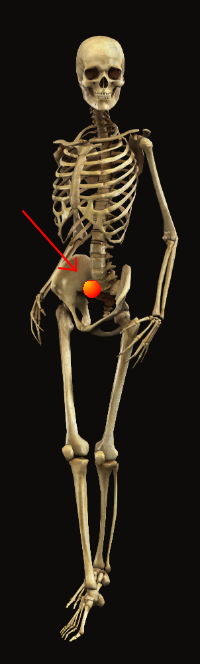
The “hip complex:” The reference point for the center of gravity.

Most of us know that when we run (or just walk around), our weight should be on our hips. This allows us to move faster and more powerfully, and to prevent injury. It’s also often said that the hips are the “center of gravity.”

skeleton m
The “center of gravity” is represented by the red dot.

All this is completely true. But what does “center of gravity” mean, anyway?

The “center of gravity” is the point in a body around which the resultant torque (or “resultant force“) due to gravity and other sources of mechanical energy vanishes. In other words, all of the forces that are generated by the body, as well as their interactions with the earth’s gravitational field, all get canceled out at the center of gravity.

The resultant force. This isn’t a commonly used term, but it’s one whose implications we should understand if we want to become safe, effective runners.

Continue reading The “hip complex:” The reference point for the center of gravity.

Deconstructing “flexibility.”

Throughout our lives, most of us have heard that it is extremely important for us to be “flexible,” for a variety of reasons. Off the top of my head, I’ve been told that flexibility is important to make movement easier, so that my joints don’t deteriorate, and so that I don’t get hurt lifting heavy objects. This is excellent advice. But the problem is that basically all of us go about achieving greater flexibility in exactly the wrong way: by stretching, or more specifically, static stretching. And that is because we don’t understand the concept of flexibility in a mechanically useful way.

One of the main physiological problems of westernized people is poor biomechanics—a phemonemon that basically boils down to the idea that the muscles across our bodies are badly synchronized. Simply stated, they don’t know how to work well together, and when they are subjected to trying circumstances (such as exercise or age), the mechanisms freeze up and become damaged.

For some non-athletes, stretching may help initially. In a very low-risk environment, stretching helps these frozen mechanisms because it increases the net joint range of motion (ROM). This means that the joint can go just a little more before it gets hurt. But that doesn’t solve the problem: the muscles haven’t become synchronized; we’ve only ameliorated the symptoms because we’ve created ROM by isolating the muscles (due to stretchier tendons and weaker muscles), instead of developing their synchronization.

This is a classic case of a systems management problem called “shifting the burden.” We have a perceived need to increase flexibility (because of a particular set of assumptions), and we shift the burden of flexibility away from synchronization and towards isolation. When the symptoms ameliorate, we think that the problem is solved, and we subject it to higher-risk circumstances, such as sports. Soon, we find ourselves caught in an unending roller-coaster of injury.

We can solve this problem. But in order to do so, we must deconstruct our notions of “flexibility.”

Continue reading Deconstructing “flexibility.”

The tales of forgotten subsystems, part I: The Fasciae

People typically think that becoming a stronger runner is all about training muscles, tendons and bones. It’s not.

It’s mainly about developing the connective tissue that holds them together.

Runners don’t dread getting injured by twisting their foot, or by becoming concussed, (even though those things do happen). Most “runner-specific” injuries are blown knees, torn ACLs, lower back pain, plantar fasciitis. All these injuries have one thing in common: they occur because the body was subjected to excess repetitive shock.

What do we typically say to this?

We say: let’s strengthen the muscles, tendons and bones (besides the usual “what did you expect? You went running”). But that advice is inaccurate, and largely useless.

That advice doesn’t take into account the existence of what is cumulatively one of the largest organs, whose main structural function besides connecting other tissues happens to be absorbing the mechanical stresses applied to the body.

Continue reading The tales of forgotten subsystems, part I: The Fasciae

(Re)defining the notion of “sport” through an argument from biomechanics.

In my opinion, a “sport” is any activity for which an increase in the relevant hip extension abilities is a necessary component of developing greater performance in that activity.

(“Hip extension” is the ability to move our thighs back and forth. When we consider what function the act of moving our thighs back and forth has in relation to the whole system, hip extension amounts to the ability to push on a surface or object with our feet by using our thighs and butt as the primary movers).

But why would I define “sport” that way? Because I’ve looked at which activities we tend to label as “sports,” which we don’t, and which fall somewhere in the middle. Furthermore, I’m interested in what ideas we use to categorize these activities. In my opinion, the idea that most people use to categorize activities as sports—or not—is whether hip extension (the ability to move our thighs back and forth) is a central component of that activity.

Admittedly, I believe that when they categorize activities in this way, most people aren’t aware that their parameters for defining a “sport” are tied much more closely to the presence and importance of hip extension, than, say, to whether it is goal-oriented or physically strenuous.

However, for most people, a big part of calling something a “sport” comes from the notion that it is—or must be—physically strenuous. But that alone is not enough: although we certainly consider football, baseball, the decathlon, weightlifting, and sprinting to be sports, what about going to the gym and lifting dumbbells?

As opposed to the first examples, lifting dumbbells seems like “working out,” or like “exercise,” but not like a “sport.”

Why is that?

And for that matter, how about ballet dancing, yoga, and other forms of physical expression?

This is where the line begins to get murky, and, in the opinion of some, with good reason. Yoga and dancing are, at first blush, not goal-oriented. There is no competition involved. And yet, the intuitions of many people would squarely place these disciplines within the boundaries of the concept of “sport.”

Those intuitions strongly correspond with the knowledge that dancers and practitioners of yoga have: that these arts are as goal-oriented as “typical” sports—if not more. Most “sports” have a single goal: winning in one form or another, whereas these pursuits have a multitude of goals. Posture, consistency, and strength are all goals of dancing and yoga. But let’s look at a deeper difference (or similarity—however you look at it): other sports also value posture, consistency and strength. It’s impossible to become an elite athlete in just about any discipline without mastering these. Except that they are placed in service of an external goal. For dancing and yoga, the aesthetic qualities that appear through function are ends in themselves.

So, there seems to be quite a bit of overlap between dancing, yoga, and “typical” sports, even on commonly-contested grounds. But let’s discuss a more interesting topic: why do some people have such strong intuitions that these activities are sports? In other words, what is it about yoga and dancing that prompts people to try and classify them as sports in the first place?

Superficially, the argument is simple: there’s something about the mechanical particulars of yoga and dancing that should put them in this category, alongside running and football. After all, they are somehow different from, say, chess, (which is more “typically” goal-oriented).

To throw a kink in my argument, the International Olympic Committee does consider chess to be a sport. I don’t—and not because I don’t think it’s worthwhile. I’d call instead that chess is an athletic endeavor (the greek word athlein means “to contest for a prize”). I don’t include chess in my list of sports because I’m interested picking apart the intuitions that underlie the common usage of the term “sport,” which emphasizes the physical use of the body.

In that sense my argument does massage institutionalized notions of what a “sport” is.

However, we can still make the argument that chess is physical, in ways that are both obvious and non-obvious. The obvious, of course, is that we use our hands to move the pieces. That observation is also uninteresting. But there is also the non-obvious: in The Art of Learning, former chess champion Josh Waitzkin talked about how his rivals would often tap the board in a certain rhythm to quicken his thought process and make strategizing more difficult. In other words, competitors in chess often find themselves in physical battles of some sort. But enough to term chess a “sport” (beyond its obvious status as an athletic endeavor)? That’s a long shot.

Then what makes yoga and dancing different from chess, but similar to “sports”?

Simply stated: hip extension.

I turn to a discussion in a book by editor Ian Jeffreys, Developing Speed. Jeffries writes:

“During a sprint, forces are developed initially through the hips, then the knee joint, and finally through the ankle joint. Therefore, activities that maximize the triple extension abilities of the athlete should play a large role in the training to enhance speed and acceleration. Exercises such as the squat, Olympic lifts, and hip extension exercises such as the Romainan deadlift should form the basis of a strength and power program for speed enhancement.”

In other words, one of the most important components of increasing the level of performance in sports is to develop the hip extension characteristics necessary for that sport. Different sports will need different hip extension characteristics, such as strength, flexibility, explosiveness or dexterity, but they all center on hip extension.

This brings us back to my definition of a “sport:”

A sport is any activity for which an increase in the relevant hip extension abilities is a necessary component of developing greater performance in that activity.

For clarity’s sake, let’s reiterate this backwards: if developing some kind of hip extension ability is not necessary to become increasingly skilled in some activity, it is not a sport.

For reasons that I will discuss in the future, the center of gravity (and therefore the mechanical center of the body) lies in the hips. In order to achieve proper flexibility, and range of motion of the entire body, practitioners of yoga must emphasize the flexibility, range of motion and strength of the hips (as well as the core). But no amount of core strength and flexibility will allow a yoga practitioner to climb the tiers of difficulty—that can only be achieved by increasing the relevant hip extension abilities: flexibility and strength.

The same goes for all varieties of dancing. Expressing the body against the ground (and fine-tuning that expression) is centered around the speed, power, and explosiveness of hip extension.

The hips are present in all sports: martial arts, wrestling, even arm wrestling. Hence the following saying:

“Have you noticed that whatever sport you’re trying to learn, some earnest person is always telling you to keep your knees bent?”

-Dave Barry

(Bending the knees stretches the gluteus maximus, such that all subsequent movements depend on its contractions).

In conclusion, I believe that because we have intuitive (and often completely unconscious) knowledge that certain activities engage the mechanical center of the body (the hips), we lobby to categorize those activities as “sports.” 
The beginning of a conversation on stretching

Here I share a few excerpts from The Big Book of Health and Fitness, by renowned researcher and clinician Phil Maffetone. (The chapter is titled “The hidden dangers of stretching”):

“It’s astounding that such huge numbers of people, young and old, athletes and those out of shape, have bought into the notion that stretching is a good idea. This view is widely held despite little, if any, scientific information demonstrating that static stretching is beneficial for most individuals, especially in the way it’s usually done. As a matter of fact, there’s quite a bit of evidence showing that stretching is harmful.”

“Clinicians who evaluated muscle function in athletes observed one outstanding factor: Stretching a muscle could make it longer, the reason it increases flexibility—and this resulted in a reduction in the muscle’s function due to a loss of power. In other words, stretching caused abnormal inhibition—a neurological name referring to a less-efficient longer moving muscle.”

“Most ligament, joint, and other physical ailments are usually secondary to muscle imbalance, which consists of a tight muscle and a loose one—you usually feel the tight one as tension or pain while its cause is a weak muscle. Treatment of these problems must be directed at the cause—the weakness—not the tightness.”

Stretching is an example of shifting the burden. Answer in the comments if you can figure out why.

Also, I’d like to hear what you have to say about stretching: why do you like it? why do you dislike it?

The conversation about stretching will be a recurring theme here on this blog; settling this issue and continuing on to train in the right way is, in my opinion, one of the most important changes we can make to the “typical” training routine.

AN IMPORTANT CAVEAT: The do’s and don’ts of correct stretching for typical athletes do not apply for the people who need an increased range of motion (RoM), such as dancers, gymnasts and martial artists. That said, the commonly-held ones don’t apply either.

UPDATE: In future posts, I’ll be discussing the issue of stretching in a very detailed manner. There are certain strength exercises that aggressively increase RoM—especially hip RoM—but I’ll get into those once I’ve posted about the biomechanic details of stretching (and of how to develop “real” RoM).

Given the excerpts I shared above, it’s extremely important that we approach stretching from an deeply informed perspective. Actually, it’s not just important. It’s critical that we do so, for the sake of our musculoskeletal system.

Working with chaotic systems: No easy diagnoses in biomechanics.

A few days ago I answered a question by R.B. in this post. R.B. was asking what could be done do to solve a tight hip adductor problem on her dominant side.

I answered that there was a local answer (how to make the symptom better), and a global answer (how to address the underlying cause). The local answer had to do with strengthening the opposing muscles (the hip abductors of her dominant-leg). However, the underlying cause must also be addressed in parallel with the symptom, or the problem will only get worse.

As I was describing how to address the local problem, I pointed out very specific exercises that could be used to take care of it (which I still haven’t posted about). But if we are to extrapolate from there to the global problem (a weakness in the non-dominant leg), we can only have hypotheses, and not conclusions, about what the specifics of the problem are. In other words, we cannot be certain at all of the specifics of the global mechanical problem.

The reason for this is that the body behaves partially as a chaotic system. In layman’s terms, chaotic systems are systems which respond very strongly to very tiny changes in the initial conditions. (Double pendulums are a great example of this). The first time that you let a double pendulum go from a static position, it will exhibit a certain behavior (i.e. spin around in a particular sequence). But the second time you let the double pendulum go from the exact same initial position, the series of spins that it will do will be completely different from the first.

The thing is this: that exact same initial position wasn’t really the same one as before; it was almost the same one. Maybe we would have needed a micrometer to measure the difference, but that’s the thing about chaotic systems—they respond in wildly different ways to very similar conditions.

(The butterfly effect is an example of pop-culture knowledge of the behavior of chaotic systems).

Let’s bring this back to R.B.’s question.

Let’s say that I did indeed properly diagnose R.B’s symptom: Tight hip adductors causing knee pain. But suppose that R.B. had experienced a shoulder injury as a child, which caused tendon damage. Because all of the muscles and tendons of the body are mechanically connected and influence one another (since the entire bone structure shifts as if it were a mobile), that shoulder injury matters both to the global tension pattern in the body and to the brain’s calculations of how it is going to solve the mechanical challenge of keeping R.B. balanced on two feet.

That slight addition to the initial conditions (the addition of a supposed shoulder injury) could make for a wildly different compensation pattern. It’s important to know whether or not that’s the case. The only way to become completely certain is to do an analysis in addition to R.B.’s report of the apparent symptoms. (Medicine practitioners will recognize this as a signs and symptoms assessment).

It’s important to note that because of the brain, the the body a more easily predictable system than a double pendulum, because the brain regulates the body’s behavior. No such regulatory apparatus exists for the pendulum; the pendulum is both chaotic and ballistic; its trajectory cannot be altered from within after it is put into motion. (Hence the saying “he went ballistic”).

The problem with diagnosing R.B. is that it’s necessary that I make a very accurate inventory of the initial conditions (the symptoms) before I extrapolate and ask, “given these conditions, how is the body most likely to solve the global problem of maintaining R.B. vertical?” In fact, even that is irresponsible—which is why I only gave R.B. a set of general exercises that address the whole region of the body that will need to get strong in order for the non-dominant leg to take more of the support.

(Remember that the body is only somewhat chaotic; there are regions of the body designed to perform certain functions). Most of the muscular burden for supporting the body goes to the outside and back of the body. This is especially true for the leg and hip: The largest muscles of the body, the quads and the glutes, are located on the back and sides of these bodily regions.

And it’s not just me that knows this—R.B.’s body also does. In other words, I can depend on R.B.’s brain (that regulatory mechanism), to find a mechanical solution for how to keep R.B. on two feet somewhere within that region. So, by strengthening those muscle groups and muscle chains, we can be reasonably certain that the problem will go addressed.

But for those same reasons, I couldn’t give a specific exercise. There’s no way to know, except by taking that knowledge and making an organized (and hands-on) mechanical diagnosis of the region. Only then can we know what specific effects those particular initial conditions turned out to have in this case.


Gravity: The dilemma of the “slow runner.”

Some of us just want to run slowly. We don’t really want to get fast—we just don’t care.

That’s okay. We’re all entitled to our own ways of running. But while we do that, we should recognize that there are some ways of running that observe the realities of the world (and some that don’t). Someone I met once said:

All models are wrong, and some are useful.

That goes for any and all of our ideas, including our body’s idea of what is the best way to run. No idea will ever be able to exactly model the world. But some are more useful than others—and the useful ones are useful because they account for such realities with a certain success.

We must stand in observation of the reality that, when we run, the most important force we will interact with is The Force of Gravity. The quality of our interactions with gravity will determine whether we become injured or not (among other things, like speed).

In systems thinking terms, we move and live within a particular physical system. Inside of that system, there are certain constant and variable forces which the body must be capable of interacting with. If it isn’t (yet) capable of interacting with those forces, and we push it to do so, we will compromise its integrity.

In that system, if we push off the ground, we will accelerate back to it at a rate of 9.78m/s² (32ft/s²). Which means two very important things: first, that the longer we are suspended in the air, the more we will accelerate. Second, in order to maintain bodily integrity, our muscles (but also our bones and connective tissue) must be strong enough to resist the stresses incurred by interacting with that magic number.

What this amounts to in athletic terms is that body must have (1) very strong muscles, capable of responding explosively in sustained activity, and (2), the ability to maintain the center of mass (the torso) relatively stable throughout the run. In other words, it must have the ability to make the torso rise and fall as little as possible. 

How does the body achieve this mechanically?

By moving the legs faster, i.e. increasing the stride rate (to somewhere around 180 steps per minute). If we can make our feet strike the ground 20 milliseconds (.02 seconds) faster than before, that would be .02 seconds less that we’d be accelerating towards the ground. Stronger and more powerful muscles (to move our legs faster) mean that we’re accelerating less towards the ground. But here’s the kicker:

It also means that they are more capable of withstanding the stress placed on them by gravity.

But wait: there’s more!

As Owen Anderson writes in Running Science, if we could make a 20 millisecond (ms) improvement between footfalls, that would constitute a time improvement of 756 seconds across the duration of a marathon—in other words, an improvement of 12 minutes and 36 seconds! As Anderson himself writes:

[That is] an almost infinitesimal change and therefore one that most runners can easily make.

In the interest of beating this point into the ground (pun intended), that’s 12 minutes and 36 seconds we’re not accelerating towards the ground. And remember the thing about acceleration: the first 20 milliseconds and the last 20 are not created equal.

If we’re running at 150 steps per minute, we might be in the air for 60% of the gait cycle. Doing the calculations for you, we’re accelerating towards the ground for 116 ms.

At the end of the first 20 ms of acceleration, we’d be going at a speed of .09 m/s second (.29 f/s).

At the end of the 116 ms of acceleration, we’d be going at .056 m/s, or 1.64 f/s.

But if we make a 20 ms improvement from 116 (in other words, 96), our maximum falling speed would be of 0.47 m/s, or 1.54 f/s.

Let’s reiterate: A 20 ms improvement from 116 ms means that the runner is going a tenth of a foot per second slower upon hitting the ground, and it’s only that way because of muscles that are stronger.

If take the time and energy to make our bodies more capable of interacting with gravity, we will inevitably end up being the faster version of ourselves.

Let’s internalize this, because it really does constitute the minimum passing grade of the “entry exam” for a runner:

Being strong enough to interact with gravity is the minimum power requirement for a human runner.

Although elite runners have muscles that are much more powerful than necessary to deal with the requisite 9.8 m/s², that number is where the laws of physics and the Earth’s mass have set the bar for human runners. That is our system. Those are its requirements. Let’s stand in observation of that fact.

There are two good ways that I know of, that can get us to meet those requirements. The first is by jumping rope as I’ve described, and the second one is an exercise in this video by Dr. Mark Cucuzella (at 6:09).

(By all means, look at the entire video—it’s very engaging and informative).

Now, go talk to gravity until you’ve gotten to know it like an old friend.

UPDATE: You can find a couple of good discussions on stride rate and running speed here and here.

Tight leg adductors: a common problem, its possible source, and some tips on how to address it.

Over on Facebook, R.B. asked me:

Recently, I’ve been unable to go running for more than 15 minutes without experiencing discomfort in my right knee (my dominant side). Even jumping causes some minor pain. It cracks a lot when I flex and extend it; so does the left side but not nearly as much as the right. From my preliminary research on the matter, I think I have “runner’s knee.” It may have to do with how hard I was training for a while (2x a day, running, weights, parkour, etc.) and then suddenly stopped the intensity for a couple of months this summer when I went to Brazil. Now that I’m jumping back into it, it’s been surprisingly difficult to find the right balance. Anyway, I guess my question is–do you have any suggestions (ie. exercises, readings, whatever) so I can get back to running while minimizing the likelihood of injury? I would greatly appreciate it

Before we begin, a standard disclaimer: I am NOT a physical therapist. I happen to know a lot about the body and I’ve solved this particular problem for myself and others. R.B., I would suggest that you consult a clinician, and take my advice with a grain of salt. That said, let’s go at it:

R.B was referring to a cracking on the inside of her dominant leg. This is most likely a malfunction of one of the muscles that connect the inside of the hip to the inside of the tibia on a spot called the pes anserinus, or “goose foot.”

Note that this is happening on her dominant side.

Let’s think systemically about this: Why is this happening? What problem is the body trying to solve?

Because the dominant leg is the one that supports the most weight, the body wants to bring it further in towards the center of gravity, i.e. towards the midline of the body. Imagine that you are supporting a wooden beam on two columns, but one is strong and one is weak. You’re going to want to put the strong column closer to the center, to support more weight. That’s exactly what the body is doing here:

It’s putting too much weight on the dominant leg because the non-dominant leg is too weak.

This is an example of a systems thinking concept: Shifting the Burden.  (In this case, the burden of supporting the body in an upright position is shifted from both legs onto the dominant leg). 

In order to manage that added burden, the body overuses the adductor muscles of the dominant leg, (which pull the leg towards the midline). And because the dominant leg doesn’t come out much (because it has to stay in to support the weight of the body), the abductor muscles, which pull the leg out, get very little work.

So, what happens is that you get adductor muscles which are too tight, and abductor muscles that are too weak.

Now, there are two answers to this question, and BOTH are important. The first answer is global: the system is developing a strategy of how to perform the function that R.B. is asking of it, and it’s putting too much weight on the dominant leg in order to perform that function. These kinds of sub-optimal strategies are what my favorite biomechanics bloggers, The Gait Guys, call a “compensation pattern.” As they like to say:

What you see in someone’s gait is not their problem, but rather their strategic compensation around the problem”

Let me reiterate that R.B.’s dominant leg had tight adductors because her non-dominant leg was carrying too little of her entire weight. In other words, the problem is that her non-dominant leg—particularly, the extensors and abductors on her non-dominant leg—are probably not strong enough. (In other words, the same analysis that we did within the same leg can be tentatively extrapolated to the entire body): If a set of muscles on one leg are too tight, the opposite set of muscles on the other leg will be too weak.
 
The second answer is local: It has to do with the adductors of the dominant leg. I’m going to post a video about how to train the adductors for this kind of problem in a few days, so for now let’s talk about ways in which we can solve the likely global (systemic) problem.
 

In order to see the most likely systemic problem, we have to cut across the whole body: if the muscles on the front outside of the dominant leg (abductors) are too weak, it is likely that the muscles on the rear outside of the non-dominant leg (primarily the extensors but also probably the abductors) are also too weak. Let me be clear that these are just the most likely culprits. It’s impossible to know specifically without looking at your particular case. The job of the muscles I mentioned is to hold up the leg—the very task that the non-dominant leg wasn’t doing well the first place.

R.B., I can’t give you a specific exercise for your non-dominant leg. That would be irresponsible on my part. But I can give you a general one:

The Gait guys have a cool abductor\extensor exercise that I think would be useful in your case (for your non-dominant leg). Here’s the link to the video.

What you could also do is this: during the same period (say 2-4 weeks) you are training the abductors of your dominant leg, also jump rope for a few minutes in the way I suggest. However, since you want to strengthen the extensors/abductors on your non-dominant leg, I would suggest that you emphasize jumping on your non-dominant foot. By that I mean that if you jump rope (with both feet) for a total of 6 minutes, jump 30 times on your non-dominant foot every minute.

You DON’T want your muscles to get too tired while doing this; you just want to get the non-dominant leg used to the motion of carrying your body alone.

Especiallyyou want the extensors/abductor muscles of your non-dominant leg to develop along with the abductors of your dominant leg. 

You should ensure that the relative strength of both relevant muscle groups stays constant, or you’ll create another compensation pattern.

Also the reason you want to jump rope during this period is to ensure that the strength is being incorporated into a motion pattern. It doesn’t matter how strong any of your muscle groups are if your body doesn’t know that they should be used as part of the holistic motion pattern. Getting them this motion pattern will allow you to eventually succeed on this task.

The best way to get the most bang for your buck out of this would be to jump rope after the training session for your dominant-side extensors/abductors. That way, they’ll be activated and slightly tired when you jump rope, so your body will be able to incorporate them into the motion much more easily.

Please put your questions in the comments; I’ll address them there.

Thanks for reading!

UPDATE: If something about running is difficult for you, or it’s difficult to get started running, there’s a comment thread going here.