All posts by running in systems

Strategizing Stress, Part 1

Training, like life, is a messy business.

I say this because lately I’ve been working with two excellent models of athletic training, Pose Method and MAF. Writing about them is the easy part. Applying them is more difficult. I recently ran across a very interesting case of a Pose/MAF enthusiast who wants to develop an aerobic base according to MAF principles, but has to sacrifice the correct form (a.k.a. running Pose) to do so.

(And ends up getting plantar fasciitis in the process.)

However, just because you get plantar fasciitis when you run at an aerobic intensity—which for most people means “running slowly” (OK, very slowly)—does NOT mean that you get to skip building an aerobic base. Building an aerobic base is important. And to ensure any sort of long-term well-being (particularly as an athlete), it’s necessary. One of the key functions of the aerobic system is to buffer and absorb the stresses induced by high-intensity activity.

In order to develop a good aerobic base, it’s important to stay at a low intensity. According to the MAF Method, the point at which you get the most bang for your buck out of aerobic base building is just under the MAF Heart rate (what researchers refer to as the “aerobic threshold”).

But a certain amount of energy is necessary to maintain good running form. If the aerobic system can’t provide enough energy, then your body has to work harder (increasing the intensity) and recruit the anaerobic system to provide the rest. When the aerobic system becomes relegated to its auxiliary function—processing the by-products of anaerobic exercise (lactate and hydrogen ions)—it will begin to break down. Two strategies help protect its health:

  • Allowing it to rest between periods of high-intensity activity.
  • Creating opportunities for it to be the main provider of energy for exercise.

So, when someone has to forgo the period of low-intensity training that we typically term “aerobic base training,” it becomes very important to strategize the stresses of exercise. On the metabolic side, running slow isn’t worth the plantar fasciitis it’ll create (in this case). And on the biomechanic side, we have to be careful that the stresses of running at a higher intensity don’t exceed what an untrained aerobic base can handle.

A safe way to do this is by taking a hybrid approach:

Combine 2-3 days a week of relatively easy Pose training (running+drills) with 2-3 days a week of walking, jumping rope 5 days a week anywhere from 5-15 minutes. While this isn’t really aerobic base training, it is still a way to develop (or at least maintain) aerobic fitness while taking steps to remain injury-free. While the Pose training is “higher intensity,” there are two options for how to manage it correctly:

  • Keep sessions short (read: fatigue-free) and high-intensity (threshold pace and above).
  • Do longer (also fatigue-free) sessions below the anaerobic threshold.

In regards to aerobic training: even if you walk quickly, you’re unlikely to come close to your MAF HR. However, you’ll still be able to develop aerobically at a slower pace. A better option, if you have the means, is to go doing moderate hiking with your heart rate monitor, which should put your heart rate a little bit closer to MAF, for the most part. I myself happen to have trails 5 minutes away from my doorstep (downtown!), but that isn’t the case for most of us.

Jumping rope will get your heart rate closer to MAF than walking. Another benefit is that it helps you train one of the key components of running: the Pose. The Pose is that snapshot of the running gait where one foot is on the ground, the other is passing under the hips, and the body is in a slightly S-shaped stance.

By jumping rope—or even better, (a) jumping rope while alternating feet or (b) doing simple Pose drills in the process—it’s possible (for a lot of us) to train the running Pose without going over the MAF HR. (Remember: trying to maintain the running Pose was the initial reason for exceeding MAF.) But after having practiced the running pose under the MAF HR, it’ll take comparatively less aerobic base training to be able to produce the running Pose at the desired, low-intensity heart rate.

How long will it take to develop an aerobic base that’s good enough to maintain a running Pose throughout a run? It really depends on the person: their metabolic and biomechanical starting point, lifestyle, and devotion to their pursuit of athleticism.


 

Running form and aerobic training

Training at a low intensity—often referred as “aerobic training”—is extremely important to allow the body a respite from the stresses of high-intensity training, and to develop the mechanisms that increase its resilience. We know that much.

But when training aerobically is our only focus, even during a period of “aerobic-only” training such as base-building, we may be hindering our improvement: improving our running form, by reducing the difficulty of running, also reduces the stress on our body. Because stress suppresses the function of the aerobic system, taking the time to develop our form hastens our aerobic gains.

The standard set by The Pose Method is the best example of “good running form,” as I see it. I fully adhere to the notion that pursuing a standard—the right standard—of running form is the quickest and surest way to reduce the difficulty and stress of running. But I also believe we don’t need to go as far as mastering the tenets of The Pose Method to reduce stresses and bolster our aerobic training.

This is because of a concept called “power leaks.” Running is all about moving the center mass of the body forward in a straight line. Some vertical and horizontal oscillation can’t be gotten away from. However, minimizing that up-down and side-to-side movement lets more of the body’s energy to go towards moving it in a straight line, and removes the need to spend energy balancing the body’s odd movements.

Power leaks, in essence, are those jerky movements that happen in odd places of the body—a sharp outward rotation of the knee combined with an upward collapse of the hip, which causes the weight of the body to fall to the outside. The body then has to recover, shifting its weight back in, to produce the next step.

When this extraneous weight shift and joint movement happens, the force of the footstrike travels through the body at an odd angle. Muscle fibers, and tendon and bone tissue are meant to move in alignment with the major force the body experiences: gravity, which pushes the weight of the body downward, and the opposite and equal ground reaction force the body experiences when the feet are on the ground. When tissue does not align with force, the likelihood of injury skyrockets.

“Stress.” is the body feeling that its likelihood of injury increases. Therefore, its defense mechanisms kick in. As a result, it does one of two things:

  1. It slows the body down in order to mitigate those forces to a comfortable level.
  2. It kicks up the stress response (and the heart rate), because it remains in a situation where there is a dangerous challenge to its physical integrity.

The increase in heart rate (and decrease in speed) is commensurate to the magnitude of the challenge.

Here’s the big lesson: if you want to reduce the body’s stress response to a particular task, increase its skill level.

Of course, there are myriad other stresses that conspire to wreck the body’s aerobic function: environmental, nutritional, even social. But the physical stress of poor alignment, due to the lack of skill required for the task, may be the larger part of the equation.

Running is an exceedingly complex task, biomechanically speaking, and it is performed by a full-fledged, multifaceted human, with imperfections and worries and commitments. Very few people have the privilege to be monks. Very few people have the privilege to increase their sleep, move far away from the chemicals endemic to the urban sphere, and detach themselves from the social preoccupations that come from being social animals.

But every one of us who has the time to run also has the time to perfect our running form. The problem is that few of us are aware that running form can be perfected, and that it is a way to reduce the stress of running. Misalignment is a real thing.

Alignment, or a lack of it, determines whether three astronauts get to return to Earth (or not). It determines whether our knees and hips survive the gauntlet of a hundred thousand steps we take during the marathon. It determines whether the body feels relaxed and competent when it analyzes its capability of performing a task.

“Aerobic training” isn’t the only way to approach the functionality of the aerobic system. Improving our form can do that too.

Reader question: How would I fuel during a long run?

A couple of weeks ago, SteveL asked me in the comments:

“How would you fuel during a long run?”

Allow me to be a bit tongue-in-cheek here. If SteveL means what we usually do by “long run”—that is, a training run and not a race—my answer is, “with body fat and oxygen.” In other words, not at all.

The physiological details of this are best left to another post, but the short answer is this: the goal of a long run is not just to run for a long time, but to develop the system that helps us run long. Crucially, that system is known as the aerobic system, which you can think of as the system that burns fats in presence of oxygen.

Here’s the critical detail: the fat you eat doesn’t reach your bloodstream for a few hours. So, unless your long run is very long, any fats you ingest during the run aren’t really going to go towards fueling that run.

Let’s discuss the more conventional fuels people use on their long run (sugar-laden fuels such as a 3-6% carb solution or gels). Great for races, but I’ll get to that in a bit. If you ingest them during a training run, you’re enabling your body to lean on its sugar-burning energy system (which it uses for short-duration, high-intensity bouts) for a long time.  This means 3 things:

  1. First and foremost, it enables your long run to be faster than is healthy: you’re liable to do what looks like a long run but is actually a bunch of short, medium/high-intensity training runs that in aggregate masquerade as a long run.
  2. Because you’re fueled with sugar lets your aerobic (fat-burning) system off the hook , which is the system that is supposed to power your long run.
  3. You’re using the short-duration, high-intensity (sugar-burning) system for a what should theoretically be a long-duration, low-intensity activity (which you’re effectively turning into a long-duration, medium/high intensity activity). You’ll wear your body down disproportionately.

To recap: no fuel for long training runs. Fats won’t help, and sugar is counterproductive.

(While the body does burn a mix of sugar and fat at all times, the longer the duration, the more fat should be in the mixture. Because the rate of fat-burning peaks at around 50-55% maximum work rate for most people, very long training sessions shouldn’t exceed this low intensity.)

Fueling during a race

Fueling during a race is different. You’re not trying to train anything here. You’re trying to get every bit of power you can from the machinery you’ve been developing in training, with the provisos that you (1) finish the race and (2) don’t blow the engine.

This means that you want to make sure you’re well-fueled (and you stay well-fueled) during a race. For anything that’s marathon length or below, fats still won’t help. For the vast majority of us, it’s still too short of a race. So, such races are the ones you want to approach with the run-of-the-mill advice on race fueling: your carb solutions and gels work great here.

There’s one consideration: don’t start fueling until you’re 20-30 minutes into the race. When your body isn’t already warmed up, it’s very easy for a shot of sugar to kick up your insulin levels, which reduces your fat-burning ability. But once you’re warmed up and burning fats at a high level, sugar has a much smaller effect.

 Fueling during an ultramarathon

Here’s where it gets tricky. There’s two sets of priorities to discuss: the physiological needs of the body and the practicality of fueling on the run.

The physiological needs:

  • Hydration (water plus electrolytes)
  • Nutrition (the right combination of macronutrients)
  • Digestion (continued function of digestive system throughout the run).

The practicality of fueling on the run:

  • Combining hydration with nutrition.
  • Creating a food that fits easily through the valve of a handheld water bottle.

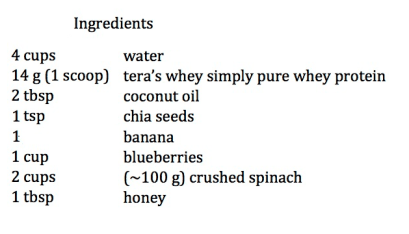
Here’s a drink recipe which (for me) meets all these criteria:

Basic Ultramarathon fuel 

Ingredients_1

Directions:

  1. Add 1 cup of water into blender.
  2. Add all ingredients (heavier ingredients first).
  3. Blend on low until well-chopped.
  4. Add the rest of the water.
  5. Blend until smooth.
IMG_0506
This is what I use…

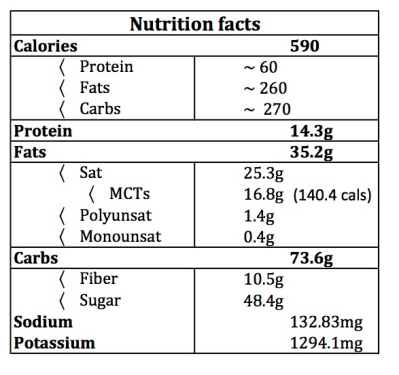
Nutrition Facts_1

Nutritional Rationale

Timing:

For a recipe such as this, I usually drink one serving (about 42 oz) over a period of 2-3 hours. This generally takes care of both my fueling and hydration concerns.

This suggestion is a TEMPLATE for people to try out during training runs. It’s important to adapt this or any recipe, workout, training plan, or racing strategy to your personal needs.

Protein

The reason I like including sizeable portions of all 3 macronutrients (carbs, fats, and proteins), is to incentivize the body to maintain the digestive system activated in a low-key but comprehensive way. This applies for protein in particular: while protein will not go towards fueling the body during a race, I put a small amount of it in order to create a more balanced digestion process.

The same goes with fiber (occurring mostly in the spinach, blueberries, and chia seeds). Ultramarathoners are prone to cramps, indigestion, and other digestive issues during the race. By putting a small amount of natural fiber in here (not so much that it slows down digestion), we can help “smooth out” digestion during the race.

Electrolytes

As you’ll notice, one serving of this drink has a staggering amount of potassium (almost 1.3g) and a respectable amount of sodium (just over 0.13g). The reason I like this 10:1 ratio of potassium to sodium is because a lack of potassium is linked to muscle cramps, and reduced nervous system function. (This can lead to lower coordination and reaction time, which can cause an injury).

Generally speaking, more potassium is better (up to a point, of course). 130 mg of sodium every 2-3 of hours is quite enough to keep a well-adapted athlete going during a long race.

Carbs and fat

The sugar calories are straightforward: these will go towards topping off your glycogen tank, in order to stave off fatigue and help your aerobic engine continue to burn fats.

Now we get to the tricky bit. Supposing that you drink 1 serving of the recipe in 2 hours, you’re getting around 160 calories of carbs and 155 calories of fats an hour. You might think that’s not really a lot of carbs. However, that’s the reason a majority of the fats in the drink come from medium chain triglycerides (MCTs), sourced from coconut oil.

Why MCTs?

MCTs are relatively easy to digest relative to other fats, and they also become available for fat-burning very quickly upon hitting the bloodstream, helping to increase fat-burning and accelerating the metabolism. In other words, “reducing” the possible sugar content of this drink by balancing it out with coconut oil is an excellent strategy for endurance races.


Athletic training: a game of physiological Jenga.

The 80-20 rule in athletic training* goes like this: train 80% of the time at a low intensity and 20% of the time at a high intensity, and you’ll achieve the best results.

Understandably, a lot of people—particularly us urbanites who are extremely busy and almost completely devoid of free time—might say: “but I only have a few hours to spare every week! I can’t afford to run slowly 80% of the time. How can I possibly expect to make gains?”

(Or something like that.)

This is exactly the wrong question. What running (a.k.a. training) at a low relative intensity—which people often refer to as “running slowly” does for the body is that it develops the aerobic system. (For most, but not all of us, training at a low relative intensity does indeed mean running slowly.) The aerobic system is extremely important: it mitigates oxidative stress (also known as chemical aging), it helps us recover from anaerobic efforts by processing lactate, and it keeps us well-fueled over the long-term by burning fats.

The aerobic system is the very foundation upon which any “gains” are built. In this sense, aerobic training increases what I like to call our “physiological capital,” that we can invest in high-intensity (anaerobic) training and develop what we typically refer to as “strength” and “power.”

To explain this relationship, I like to use the metaphor of a Jenga Tower.

Suppose that you have a particular strength or power goal: you want to run 6 minute miles. This is equivalent to wanting your Jenga tower to be 10 levels tall. But the problem is that you only have 20 bricks (each full level of a Jenga tower is 3 bricks).

The result is that you can only build 6 complete levels to your Jenga tower. You’re faced with a stark choice: you need to add levels to get to 10. But you don’t have any more bricks. So you’re forced to take from the lower levels. (This is essentially what strength training does). Your tower gets higher and higher—which is fine, until you pull out or lay a brick juust too quickly or a light breeze comes along—and the tower, which had grown increasingly unstable, plummets to the ground.

(You’ve just become injured.)

But there’s a way to add bricks to the base of your tower: aerobic training. This is what I mean by “increasing our physiological capital.” While aerobic training adds bricks at a pretty good rate, left to its own devices it turns your tower into a pyramid: the lowest level grows wider, until at some point  your body decides to start growing the next level.

That’s not a bad thing: a lot of ultrarunners (the healthy ones) have metabolisms that look like a shield volcano: gargantuan aerobic systems, but very little power. (If the height of the tower is how much power you possess, then the width of the base is how much distance you’re good for.)

Mauna_Kea_from_Mauna_Loa_Observatory,_Hawaii_-_20100913

That said, it’s not necessary to build a pyramid, when it’s a tower you want. Although it’s important that your tower be stable, that’s about it: most of us are not trying to be an ultrarunner, nor do we have to be. All you really need is a few extra bricks around your base—enough to plug any holes you may have created, and to be able to add a couple of levels. Rinse and repeat.

A quick disclaimer: the body doesn’t convert the actual aerobic machinery into anaerobic machinery in the way that a naïve reading of the “Jenga metaphor” would suggest: the brick that you take from the base is not literally the same one you put on top of the tower. However, the reason I like the Jenga metaphor is because the stress and wear-and-tear incurred by anaerobic work (compounded by the fact that it is the job of the aerobic system to absorb those stresses), means that the process of adding strength and power basically always means carving into your aerobic base.

How often do you switch from adding bricks to adding levels? If you’re looking to run an endurance race, for example, then you need a very wide aerobic base.

Supposing that you want to develop some all-around fitness, a basic (but certainly not universally applicable) recipe is this:

  1. For 2 weeks, train primarily easy 95-100% of your training.
  2. The next 2 weeks, train at a moderate-to-high intensity 35-40% of the time.
  3. Rinse and repeat.

This process will give your body two weeks to recover well from strength training (read: replenish the bricks you took from the base, and add a few more). Two weeks of low-intensity training isn’t really long enough to start losing high-end fitness: the small amount of strength training 0-5% during the easy weeks is more than enough to maintain your gains. But when you’ve cycled through this process several times is when you’ll really start to see your gains stack up.

Building and maintaining an aerobic base, and making sure that our strength gains are well-buttressed by wide lower levels of our metabolic tower, is non-negotiable. Some of us are lucky: for good or ill we spent our formative years playing at the beach, kicking around a soccer ball, or going hiking with our oudoorsy parents. This person (unbeknownst to them) has been stacking more and more bricks around the base their fledgling tower, broadening their aerobic base until they’ve accrued what seems like a limitless amount of bricks.

Others never had that chance.

But not having had that chance doesn’t mean we have any more of a choice. Sometimes, the unconscionable choice—running “slowly” despite the horrible feeling that time is slipping away and we’re not getting any faster (forgetting the fact that our pool of bricks is growing ever larger)—is also the right one. That choice will put us in a position from which we can develop speed . . . and get to keep it.


*NOT the Pareto Principle.


No good reasons to prioritize anaerobic training. At least 9 great reasons to do some.

A friend of mine recently asked for my thoughts on an article titled Nine reasons to prioritize anaerobic training over cardio. Leaving aside the issue that “cardio” is ill defined and often contains an anaerobic component (which means that it bugs me when people use the word), this is an extended version of what I answered.

My contention is that the article in question doesn’t actually give any good reasons to prioritize anaerobic training over “cardio”—by which I’m assuming the author means “aerobic training.” (For the rest of this article, I’m defining “aerobic training” in opposition to anaerobic training: “aerobic training” is training with no anaerobic component whatsoever).

Don’t get me wrong: the article gives 9 excellent reasons for why to include anaerobic training into your exercise routine. But I’m unconvinced that these are reasons for why to  prioritize anaerobic training in the sense of “if you only have time to do one of these two kinds of training, do anaerobic training.”

Simply stated, that’s not a good idea. While many may argue that I’m splitting hairs, consider what the effect of “why you should prioritize anaerobic training” is to a lay audience. (I believe that) the effect is “anaerobic training is better than aerobic training”. This raises an important question: if it’s good to prioritize anaerobic training, when exactly should we do aerobic training?

Although no training can be said to be “better than another” in a strictly metaphysical sense, aerobic training and anaerobic training each have their advantages. And it is when you consider their relative advantages over one another that the question I italicized above becomes so pertinent: the time to do aerobic training is in fact before and so that you can safely perform anaerobic training.

 So we return to the beginning: while anaerobic training is important and necessary and has its place, its place is auxiliary to aerobic training. This is why:

In my most popular article on the site, titled High-Intensity Fitness Culture, Explained in Systems, I discussed how the anaerobic system is essentially the emergency, high-intensity, powerful, dangerous, and rapidly-exhausting turbocharger that an organism uses to overcome an immediate threat to its existence.

While the anaerobic system is a critical system (worthy of development and training), there are costs to using it: anaerobic activity produces acidic hydrogen ions, which wear down the body. Those costs will become exacerbated insofar the anaerobic system becomes the dominant energy system in the body.

All of which brings us back to the aerobic system. What exactly, does the aerobic system do? Essentially, its function is to provide long-term energy to the body by oxidizing fats (combining fats with oxygen to provide energy), and to assist recovery from anaerobic activities by processing its main by-products: lactate and positive hydrogen ions.

Insofar as your anaerobic system is more powerful than your aerobic system, your body will have a more difficult time recovering from anaerobic workouts. This is a problem for those who gave given anaerobic training priority over aerobic training, and consequently possess anaerobic systems that are more powerful than their aerobic system can sustain.

The aerobic system also happens to be the system that the body uses for its upkeep and longevity. This is an issue for another article, but the reason is because “longevity” is essentially “long-term recovery”—in other words, the ability of the body to keep recovering for longer, before breaks down enough that it dies. (Here’s a hint you can use to reverse-engineer the content of my next article for yourself).

For the sake of clarity, let me reiterate what I discussed in paragraph 4: all the reasons given in the article I’m discussing are great reasons to do anaerobic training, all legitimate and grounded in extensive research. My contention is NOT that the reasons given in the article are somehow illegitimate, but rather that when they are cast as reasons to prioritize anaerobic training, they become (1) quite misleading to the lay audience and therefore (2) dangerous to those who take the article at its word(s)—the particular words in question being “prioritize over”—and naively follow them to their logical conclusion.

(I am NOT arguing that anaerobic training will become dangerous to those who take the words “prioritize over” to mean “modestly include” regular anaerobic workouts into their predominantly aerobic training).

More often than not…

WARNING: Rant Ahead. Be advised: lack of objectivity. Proceed with caution.

More often than not,

You don’t become resistant to fatigue by training in a fatigued state.

You don’t create more strength and power by training yet more strength and power.

You don’t become better adapted to running more miles by running yet more miles.

More often than not,

You need to train without fatigue in order to develop the systems that help you resist it.

You need to train easy in order to let your body grow from strength and power training.

You need to develop the capability to run more miles so that your body doesn’t break when you try to.

More often than not, performance and training are different things.

What do you think (and why)?


Is there really a difference between “injury-prevention” and “training specificity”?

A lot of us are familiar with sports specificity: you tailor your training to achieve greater performance in individual sports. Some of us go as far as being “event-specific.” We train trails for trail running events. We practice running the inclines and hill lengths we’re likely to encounter during the event.

But I think that we can take the concept of training specificity a lot further: particularly as it pertains to the realm of injury prevention.

What does an injury mean from the perspective of athletic competency? It means that there was some stress, supposedly germane to the sport, that the body simply could not tolerate. Presumably, this is a stress that the body can (and should) adapt to.

I’m not talking about obscene stresses such as the micro-concussions that have been shown to cause brain damage in football players. I’m talking about simpler things: dehydration and hypoglycemia after a marathon, shin splints, etc.

Let’s take shin splints, for example. Shin splints are reputed to occur due to the repetitive stress associated with running. Shin splints—and the subsequent stress fracture—cause people to lose training time and training quality, increase the overall stress of training, etc.

My point is this: an inability to cope with a particular stress (resulting in an injury) is a bottleneck to development.

If an injury prevents a runner from improving, or puts their athletic future at risk (and it does), then injury-prevention should be at the very top of the priority list. Put another way, injury-prevention is the ultimate sports-specific training: it means training the body not just to get better at the sport, but to train the body to handle the basic stresses associated with the sport.

This is a difficult proposition for many people: it is different on a case-by-case basis. The same symptom (shin splints) can have a multitude of causes. When the issue is the amount of stress, increasing lower-leg strength by itself can solve the problem. But others may need to fix an imbalance between the front and back muscles of the lower leg, for example. Others yet may be erroneously unburdening the big calf muscles by giving the job of knee flexion entirely to the hamstrings.

Failure to address any of these issues can dramatically reduce the training response: tighter muscles and less mobility means less neuromuscular feedback. But a higher heart rate is necessary to drive stiff (and weak) muscles. This means more stress. And because some muscles are stiff, the body geometry is disadvantageous: it isn’t going to align itself (or remain aligned) with the primary vectors of force.

Fixing any of these issues will allow the body to learn from and adapt to the sport. Ultimately, I believe that the runner who “paradoxically” spends time correcting muscle imbalances or strategically strengthening bone, muscle, tendon, and connective tissue—and running less miles because of it—will need to run far fewer miles to observe the benefits of training.

We need to make the choice to not merely roll out our tight quads or hip adductors after the fact. I think we need to address the underlying cause of that tightness (a process which may or may not include myofascial release). And I think that we need to put this within the larger context of our training and racing: in no way does injury prevention or rehab constitute “taking time off” from training.

Preventing injuries and doing the rehab is a much better—and more honest— example of “training the body” than going out and slogging miles that are just going to put us back on the table. In every way that matters, we’re doing the training that our body needs, right now.  Tomorrow, we’ll be able to go out and do the training we want, and achieve the effects that we want.

And how much happier, faster, and healthier would we end up if we can trick ourselves into wanting to do the training our body needs?

Stability and Strength Training a la Maffetone

This post continues a little saga I have going on about the aerobic system and fat-burning in relation to other aspects of training, mostly due to my continuing work with Phil Maffetone and MAF Fitness.

People often ask how—or whether—strength training fits into the MAF method, particularly during times of aerobic base building.

My answer, of course, is YES. (Provided, of course, we usefully define what “strength training” means).

The MAF method prescribes exclusive aerobic exercise—defined as exercise that has a virtually nonexistent anaerobic component—in 3 different situations:

  • When ill, injured, or overtrained.
  • When recovering from any of the three.
  • When doing a period of sports-specific aerobic base-building.

In all other situations, we recommend that 80% of all athletic activity be aerobic, while the remaining 20% (which includes competition) can be anaerobic. But this post I want to talk about how strength training fits into situations 1-3.

The foremost problem with asking how (or whether) strength training fits into these situations is definitional. Strength training, broadly defined, is training which allows the body to exert more force into its environment. And based on this definition, some, but not all, strength training is accepted.

The big question is this: what kind of training is aerobic?

For that, we have to look at why the body recruits the anaerobic system for certain activities. The answer is twofold: (1) because it needs to produce a lot of low-end torque—a relatively high amount of power in a short amount of time—and (2) because that activity is going to last for a few seconds—before anaerobic channels exhaust themselves.

This rules out one particular kind of activity: heavy strength training where the body fatigues itself after a few repetitions. Here is your benchmark: if you can only do 5-8 repetitions before exhaustion, it is because you have recruited anaerobic channels.

This holds regardless of whether the heart rate is “low enough” to be aerobic—or hasn’t climbed enough to “be anaerobic.” So, my suggestion to people is to do strength exercises of more than 12 repetitions.

But there’s another caveat: exercises of more than 15 repetitions are not necessarily aerobic. (For example, a 100 yard sprint consists of 65 repetitions—65 steps—at best). So, for these high (15+) repetition exercises, it’s important that the heart rate reflect that the body is working overwhelmingly aerobically—at what Dr. Maffetone describes as the MAF Heart rate.

Good examples of strength exercises with the potential to be aerobic are: proprioceptive (very light load) deadlifts and squats, push-ups, pull-ups, etc.

I also often recommend stability training as an acceptable supplement for periods of “exclusive” aerobic base training. However, this comes with an important caveat: while stability training is very low-intensity work—which means that it very rarely interferes with aerobic base building—strictly speaking, it is an anaerobic exercise.

Stability is achieved and maintained by very quick, continuous movements of the small muscles of the body, in order to counteract tiny losses of balance before they become serious. Providing stability is therefore largely the responsibility of extremely fast-twitch Type IIX muscle fibers, which rely primarily on anaerobic uses of sugar in order to produce energy quickly enough.

Whenever we are training stability, we are training the anaerobic system.

Is this a problem for aerobic-only training? Not in most cases. If you think about it, “aerobic-only” running has a massive stability component: the entire body must be stabilized every step through constant use of Type IIX muscle fibers.

But these stabilizations are small enough in comparison to the primarily aerobic work of running, that anaerobic debt doesn’t rack up in a way that transforms aerobic running into “anaerobic exercise.”

The point at which stability training becomes anaerobic is when it starts raising the body’s stress levels—when it asks the body to exceed the aerobic threshold (a.k.a. the MAF heart rate).

Whenever you want to do stability or strength training without hindering your aerobic base-building, take your heart rate monitor with you. It’s (almost) as easy as that.

Defining the “long run” for better endurance training.

The long run is touted by many to be the centerpiece of training for marathoners and other endurance runners.

Most people think of the long run as a protracted effort that causes their body to produce the mental and physical adaptations needed for endurance races. But the ways in which people prepare, fuel, and run during these long efforts are often not the most optimal. And the reason is because long runs aren’t about running long per se—they are about training the particular systems of the body that enable us to run long.

This isn’t just wordplay: I often see well-intended runners filling their hydration belts with sugary foods and energy gels in preparation for a long run.

That’s a problem.

Let’s consider which of the body’s systems are designed to help us run a long distance. We need a very abundant fuel source, as well as an engine that can burn that kind of fuel for a long time. Sugars (a.k.a. carbohydrates) won’t be a good primary fuel source: they exist in relatively small quantities inside the body compared to fats. Furthermore, the Type II (fast-twitch) muscle fibers that utilize them fatigue quickly.

So we need to rely heavily on a more plentiful fuel: fats. In order to burn fats, we’ll need to use several systems: the hormones that help break down and transport fat, and the Type I (slow-twitch) muscle fibers that can burn them (as well as the lungs, heart, and blood vessels, which together allow oxygen to get to the muscle fibers and enable fat utilization).

Running for a long time is all about burning fats. But when a runner depends on sugar to fuel their long runs, as far as the metabolism is concerned, it’s not a long run.

Using sugars to fuel the long run means that (1) not only is the quickly-fatiguing sugar-burning engine being used for much longer than it’s designed for, but (2) it’s only being relied upon because the engine that is supposed to do the job isn’t powerful enough to produce the required activity levels.

The body is getting tired and worn down at an absurd rate. But that’s also only happening because it was already not capable enough to run that fast for that long.

As the body gets tired, it gets stressed. As it gets stressed, it use of oxygen declines, and it starts being forced to consume sugar anaerobically—without the presence of oxygen. This compounds the problem: the main by-product of anaerobic activity—lactate—suppresses the body’s ability to use fat for fuel.

What does this do to our definition of a “long run”?

I like to define the “long run” as a run that occurs (1) below a threshold of stress that allows for burning fat at a very high level, and (2) long enough that the various systems necessary for burning those fats (and for supporting and moving the body for the duration) become challenged enough to develop.

In my opinion, the ratio of fat to sugar utilization necessary for a run to qualify as a “long run” is 42% fats and 58% sugar, a Respiratory Quotient (RQ) of .87. This measure correlates with the aerobic threshold—the highest level of activity at which virtually all of the body’s energy is being processed in the presence of oxygen.

While the percentage of fat utilization at this point is already declining, after an RQ of .87 it begins to drop much more quickly. Since the lactate produced by anaerobic activity inhibits fat usage, the percentage of sugar used increases dramatically.

You can get an RQ test at any exercise lab, or even some doctor’s offices. But my favorite way of finding a ballpark measure of the aerobic threshold is Phil Maffetone’s 180-Formula. The 180-Formula gives you the heart rate at which you reach your aerobic threshold, which makes it very easy to keep track of your fat utilization while running.

Using sugars to support ourselves through a long-run is a self-defeating endeavor. We won’t create the adaptations we hope for. Because the body hasn’t adapted, we’re subjecting it to stresses it can’t really handle. It’s not going to grow that well, or that quickly, or in the direction we want it to, and it might break down on us a few times along the way.

Let’s keep our long runs easy enough.

UPDATE (10:46 AM, 12/14/15) : I’d previously written that total fat utilization was at its peak at an RQ of .87. A reader pointed out to me that this wasn’t the case.

UPDATE (11:35 AM, 12/14/15): I should mention that the criteria I discuss in this article are perhaps necessary but not sufficient to call something a “long run”: Commenter “Van” suggested that a better definition for “long run” is that which occurs at the heart rate which corresponds with the maximum rate of fat oxidation (rather than the maximum rate of oxygen use at which there is no anaerobic function). I’m not convinced at this point, but I’ll be sure to update again—or maybe write a follow-up post—if that changes.

Tranforming Thought into Action with the Pose Method

A great write-up on the Pose Method Sports Technique Specialist Certification!

lynnonmovement's avatarbodyweightmovementsystems

No recent scientific advance in the world of running has generated more discussion about how we run, and move, than The Pose Method of Running. In fact, this theory, based on Newtonian physics, is what brought about the ‘Natural Running Revolution’ that is transforming running cultures around the world today (misinterpretations and misrepresentations notwithstanding) .

Now, with his new Sports Technique Specialist course at the Romanov academy of Sports Science in Miami,  Dr. Romanov, its founder, is poised to foment yet another athletic revolution inspired by Nature, by teaching students how to apply his unifying theory of movement to all sports – golf, soccer, football, baseball, etc… and all their respective movements –  swinging, kicking, throwing etc…

I recently attended the inaugural clinic and, as one of the first athletes and coaches to learn and successfully apply the Pose Method of Running in the US, I was not surprised to…

View original post 486 more words