Good discussion by Drew Seaver
All posts by running in systems
Congratulations to the USA ultrarunning team!
A shout-out to the United States National Ultra Trail Team and their great performance at the IAU 5th trail championship! Great performance by my friend, favorite athlete, and of course, Inov-8 sponsored ultrarunner Yassine Diboun!
What is the role of efficiency in athletic performance?
In various social media, the following observation was made several times about my last post: efficiency plays an important role in athletic performance.
Yes. Efficiency is an essential indicator of athletic performance. However, all efficiencies must be in service of greater power production, not simply sought after without a good reason: efficiency has no real benefit when divorced from other variables.
Here’s a quick but illustrative example: It takes a lot more energy to keep a spine straight, with hips, head, and shoulders evenly stacked, than it does to let that spine develop a pronounced thoracic kyphosis—the spine and shoulder curvature we associate with “bad posture.” Does this consume less energy? Yes. But in doing so, it puts a variety of systems—not just muscles, but even the respiratory system—at a disadvantage.
(Tellingly enough, there’s an important relationship between metabolic and aerobic power and the capability to maintain an upright posture).
If we try doing a front squat with bad posture, we’ll set ourselves up for either a plateau or an injury. In effect, we have to resolve this problem by increasing the body’s energy consumption (reducing efficiency) in order to produce the alignment that allows us to correctly perform this movement under load.
Ultimately, however, efficiency is extremely important in sports such as running. This is known as running economy. Elite runners tend to have great running economy, meaning that they use less energy to cover a certain distance.
There are a few ways that running economy can be improved: one is to increase aerobic power. Six times as much energy can be gotten from molecules of glucose that are burned aerobically rather than anaerobically.
Another way is to increase neuromuscular synchronization and power. A knee that collapses in or hip that collapses up during the running stride is known as a “power leak,” meaning that muscles are misaligned and therefore pushing the body up, laterally, or rotationally instead of contributing to driving it forward.
Yet another way to increase running economy is to become smaller. This includes having reduced fat percentage and increased muscle percentage, but it encompasses more than that: runners that are volumetrically smaller have a much easier time traveling distance than runners that are volumetrically larger. Why? If you’re taller, not only will your bones and muscles have to be thicker (in order to retain the same proportions), but then your organs, especially your heart and circulatory system, will be working that much more to pump blood from your toes to your brain.
It doesn’t matter what aspect of running economy you’re talking about. Not only does the economical runner expend less total energy than the non-economical runner, but a greater percentage of total energy expenditure ends up going towards crossing the finish line rather than being lost in vertical, lateral, or torsional oscillation, power leaks, or greater metabolic upkeep.
The question of efficiency or running economy should always be asked in tandem with the question of athletic performance: is seeking some initial efficiency—for example, bowing my upper back because I’m tired—going to hinder my athletic performance or development?
Personally, I believe that “good form” for any athletic activity is “that form which allows us to express greater athletic power.” That’s how it’s defined across martial arts, baseball, the decathlon, and marbles. That should be how we define it in running too.
When a forefoot strike results from all the correct physiological and gait factors, a greater proportion of the stance will be spent on the forefoot, meaning that a greater proportion of the stance phase will go into force production. The stance is shorter overall, and the speed is faster. Is this stride type more costly (and does it produce its own set of injuries)? Maybe, possibly. Sure.
Do certain distances place such a burden on people’s endurance—even that of elite athletes—that they opt out of the “power producing” stride type completely? That’s the billion-dollar question, and given the answer, we might find that it is completely within reason to adopt a hybrid stride or even a heel strike at certain distances, full stop. (Or, you know, we could just walk).
Great form (and great technique) are expenses of energy, both immediate and in terms of time and training. But achieving them will facilitate efficiency at a higher athletic level: we’ll expend more energy, but we’ll be able to apply a greater percentage of that energy towards the achievement of our athletic goals.
Justin Gatlin Just Wants To Be Loved
Hey, check out this blog! It’s got loads and loads of funny and entertaining sports gems.
Athletic performance is not about efficiency. It’s about power.
One of the most oft-used pieces of artillery in the debate of minimalism versus maximalism, forefoot versus hindfoot, and barefoot versus shod, is the discussion of efficiency. Numerous studies have come out that rank the efficiency of these running types against each other, and consistently find that shod/hindfoot/maximalist tends to be more efficient.
(For the record, I think that the first camp that made the efficiency claim was the barefooter/forefooter/minimalist one. For reasons discussed below, that was a bad call).
Anyhow, it’s time to put this discussion to rest: Better athletic performance has never been a function of efficiency, when efficiency is defined as “lower energy consumption for a given speed.”
It has, however, always been a function of increased power output.
Before going into the science of it, let’s discuss how this makes sense from a logical perspective. Time has alwasy been the primary form of currency. A powerful runner can finish a race and begin recovery much more quickly than a slower runner. This frees the powerful runner from the effects of the race much more quickly, and reduces the time that it takes for this person to engage fully with a new task, relative to a less powerful runner traveling the same distance.
The benefits of this are as obvious as they are many, whether we be talking evolutionarily, or in terms of the body’s economy. This also holds when you look at how we define performance across all sports: increased power (and not increased efficiency) begets greater performance. Whether it be during a running race or a baseball game, whoever can apply the most energy effectively in the shortest amount of time towards achieving the goal will come out on top.
(I’ll discuss the deeper implications of this sentence in another post.)
The science corroborates this theory. In Running Science, Owen Anderson is quite clear: “The marathon is a power race.” He discusses at length how the idea of doing long, slow training for what is (presumably) a long, slow race is superficially logical but ultimately flawed. While developing aerobic capacity is immeasurably important for the marathon, as speeds get faster, greater power becomes more and more important.
The importance of power holds even for the ultramarathon. Numerous studies have been done confirming the idea that phyisological indicators of power maximums—peak treadmill velocity and VO2 MAX—correlate strongly with ultramarathon performance.
The sports technique (whether it be running technique, golf technique, swimming technique, etc.) that lends itself to the development of greater power, and not increased efficiency, can be judged to be “better,” given that what makes us universally better at sports is the application of greater power. As this article finds, more runners rise onto their forefoot the faster they go. Landing on the hindfoot is reserved for the slower crowd.

But there may be other, more insidious problems with seeking efficiency in lieu of (or at the cost of) power. In my last article I wrote how, if increasing efficiency is our primary goal, at some point we are going to be sacrificing power—basically engineering our own performance losses.
It’s fine with me that some people genuinely don’t want to seek greater performance, and rather run (or do other sports) for maintenance, rather than increase, of fitness. But this discussion of performance brings up a series of questions that I believe are legitimate: is heel-striking a “running style,” or is it a biomechanical feature—a hallmark—of subcompetitive fitness? Are heel-strikers slower, or does heel-striking make the runner slower (or alternately, become a barrier to improvement)?
I believe that this discussion merits an extensive inquiry into why heel-striking is the form of choice across a majority of runners. Is this the case because more efficient is better? Or is it the case that a majority of runners are lacking in the aerobic, muscular, or metabolic power necessary to sustain a more costly technique—one which constitutes the gateway to greater athletic performance?
These are not rhetorical questions, and they are certainly not answers. However, we treat the literature’s findings in regard to efficiency as if it somehow settles the footstrike debate (or lends evidence either way). It’s time to open the discussion again, and do so by asking questions that are more relevant than efficiency to the human body’s design, as they are to its athletic performance.
Runners: Let’s not confuse Efficiency with Optimization
We should always be careful, as runners and athletes, when shopping around for new data to help us develop our craft. We should be even more careful when this data comes in a convincing format—scientific research—and alarm bells should go off when that research isn’t put in context.
Recently, I went to take the Pose Method Level 1 coaching certification, which I wrote a pretty popular review about. With this post, I want to begin diving a little deeper into the subject, starting by addressing one of the major scientific critiques towards the outcomes of minimalist running, forefoot striking, and the Pose Method: that these techniques are less efficient than heel-striking—namely, that they use more energy across the same distance.
Well, do they? Perhaps. Most likely, in fact.
However, seeking sheer reductions in energy use may be missing the point.
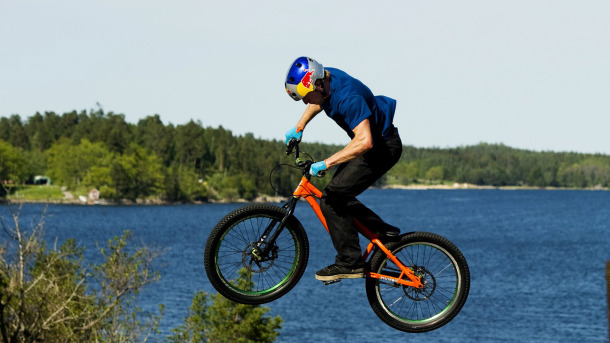
Let’s take a popular sport as an example: mountain biking. One of the first things you consider when buying a new mountain bike is whether you want dual suspension, or only on the front. This is a classic trade-off: the dual suspension lets you go on more rugged terrain, but it also means that less power from every stroke goes into driving the bike forward.
A dual-suspension bike is less efficient than a front suspension bike. That’s it, right? Front suspension bikes are superior. It’s a done deal.
Well, no.
Before I go on, let me be quite clear about the argument that I’m making. I’m not saying that less efficient options are better. I’m arguing that different options can’t—and shouldn’t—be judged on efficiency alone. I’ve seen it at least a few times in the running community: the studies on whether the Pose Method lowers running efficiency are presented in one stand-alone sentence, as if by itself, and without regard for the scope and depth of functions that the human body must fulfill, efficiency means something.
Efficiency alone means nothing. The questions we should ask is: what is it getting us, and what are we sacrificing by pursuing it?
Let’s go back to the mountain bike example.
Adding that rear suspension increases the capability of the bike to interact with more rugged terrain. If you land from a high jump with a dual suspension bike, you’re less likely to break the frame—or yourself.
You’ll see this across all systems: increasing the dynamism of any system (which means both its capability to interact and its rate of interaction) increases its ability to interface with other complex systems (i.e. the environment). In order for this to happen, a dynamic system has to be working with sufficient moving parts, all of which take energy to function. If we just focus on cost-cutting measures—what gets me the least energy consumption, all else aside—we’re going to be undercutting that system’s optimization at some point.
That certainly seems to be the case in human locomotion, as suggested by this study (also cited above).
We’re making a very specific—and very generalizable—trade by adding a rear suspension to the mountain bike: we’re reducing its efficiency in order to optimize it to the environment.
Lowering the efficiency, however, does not immediately mean that you’re optimizing something. In fact, it’s typical to find that if optimization drops below a certain threshold, so does efficiency. A bike needs intact tires to function well. You can’t be riding on the rims during a race and expect to be very efficient.
Optimization, although more costly in the immediate term, is more cost-effective than hard-edged efficiency over the long-term. What happens if the bike frame breaks? The amount of power that goes from your downstroke and into the ground drops to zero.
We all live in this compromise: we want to increase our efficiency, but not at the cost of optimization. Let’s use a gait example. Is it more efficient to shut off your gluteus maximus, hamstrings and quads while running? Probably—those muscles are huge. They’re consuming lots of sugar and oxygen in order to stabilize the pelvis and move it over the femur and the knee joint.
In addition, they’re mostly only active from contact to midstance. They’re the biggest muscles in the body, and they don’t even help you push off. Less efficient? Sure! Why not just let momentum carry your GCM—general center of mass—over your knee joint while keeping the hip extensors quiet?
Because your femur would summarily come off your tibia, and your patella would pop off and land somewhere on the ground in front of you. Once again, the efficiency of your gait would drop to zero.
I’m not making an argument for any particular method or stride type. (I believe those arguments are there to be made, once we have satisfactorily defined what we mean by “stride type,” but not in this post). The takeaway, as I mentioned above, is that in order to optimize something to the environment—say, in order to allow our body to remain in a configuration which can adapt its footfalls to variable terrain—we’re going to be sacrificing some raw efficiency.
Is forefoot-striking or Pose the best way to optimize the body? Well, that’s a different question.
UPDATE: In this article, “Pose” refers to excellent pose technique. (This was brought up by a concerned reader on a Facebook thread.) Indeed, all running and all movement is an alternation of poses (think about the kata in martial arts). For better or worse, the question remains in the scientific and running communities: is excellent Pose technique the best way to run? Many try to detract from it by saying that it is less efficient. I believe that regardless of whether it is or not, that line of argument largely misses the point.
Exercise quote of the day
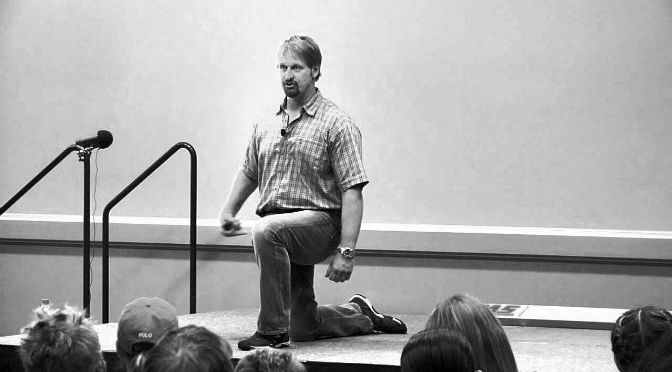
“Son, if you’re gonna be tight, be tight on both sides. Then you’re just slow. If you’re tight on one side, you’re gonna rip yourself in half.” -Gray Cook, on Asymmetry in Movement.
My reflection on The Pose Method’s principles and processes.
The supermajority of runners—of people in general—are fond of saying that there is no one way to run. We accept that there are specific techniques for swimming, throwing a ball, swinging a golf club, doing a spin kick, squatting a barbell, and even for properly flipping a goddamn omelet. We accept that adhering to these techniques will make us better at the motion, and less likely to be injured.
(I’ll bet you a hundred bucks that you’ll get carpal tunnel if you flip an omelet wrong one time too many).
But this doesn’t apply to running. When it comes to running, everyone’s different.
Or so they say.
Dr. Nicholas Romanov, founder of The Pose Method, disagrees. After extensive study and experimentation, he identified the key similarities between everyone’s running style. In order for us to be able to run—to move forward consistently without falling—we have to alternate support: one leg remains on the ground, allowing the body to fall forward (instead of downward), while the other moves through the air to create new support under the body’s new location.
The biggest similarity between everyone’s form, whether we’re talking about a couch potato with a New Year’s resolution or about Usain Bolt, is this: at some moment in time, one foot will be supporting the body on the ground, while the other will be passing under the hip area (which is known in biomechanics as the general center of mass, or GCM).
This is what Dr. Romanov refers to as “pose.” How to achieve pose properly is the centerpiece of his method.
Consequently, the most important difference between that couch potato and Bolt—but not the only difference, of course—is that Bolt takes far greater advantage of the time spent in pose.
When we look at Usain Bolt’s running, we recreational runners and non-athletes get the sense that we are looking at genius. We may not be able to put our finger on this genius or break it down with precise words, but we recognize it as genius nevertheless.
But what we are really seeing in Bolt is a perfect running pose—a masterful, yet unconscious (and possibly unknowing) execution of the principles laid out by The Pose Method.
The Pose Method isn’t a “running style.” Dr. Romanov emphasizes this heavily—he didn’t “invent” the running pose any more than the squat and the snatch were invented. These weightlifting forms were discovered: the squat is the best way to lift weight on the shoulders, and the snatch is the best way to propel weight vertically from the ground. The running pose is also a discovery: it is the best way to harness the force of gravity to create horizontal displacement of the upright human body.
The method part of the name refers to a recipe built around the simplest, most efficient exercises that can help us replicate pose effectively and consistently across distance and time.
To truly understand The Pose Method, it’s critical to grasp the role that gravity plays in running. On the surface, it seems that gravity has little benefit beyond helping us return to the ground so that we can once again propel ourselves forward. Gravity is a downforce. We all know this. So how, then, can it help us move horizontally?
Because of the support phase, that is, the running pose itself. When one foot is on the ground, and we shift our center of gravity even slightly forward of that foot, we begin to fall. But we can look at it in a different way: falling forward is really a rotation, at least at first. When we run, the support foot acts as the vertex of an angle between our hips and the direction of gravity. When we’re perfectly upright, that angle is zero. As we shift our weight forward, that angle increases: our hips (along with the rest of our upper body) travel forward, while our support foot remains behind.
Effectively, we’ve converted the downward force of gravity into a rotational force. The greater the angle, the greater the force.
Of course, if we just keep increasing that angle without doing anything else, we’ll fall on our face. But we don’t—our body has all the necessary countermeasures in place: they’re called reflexes. In order to catch ourselves, we reach towards the ground with the other foot.
Ideally, that foot should land directly under the center of mass. This is the case, at least, in Usain Bolt’s running (and that of a few other luminaries, such as Galen Rupp). In most of us, the foot lands somewhere else.
If our foot lands in front of us, momentum has to carry our center of mass forward, until arrives on top of the foot. Only then can we begin to use gravity to advance. And if it takes too long for our heel to lift, we are not falling forward in the earnest—heel lift is a critical component of any athletic movement. That’s why it is so emphasized across sports.
To the degree that our foot lands ahead of us, we are wasting time. And to the degree that our heel delays from lifting, we are losing power.
In order to prevent each of these two issues, the swing leg (which is off the ground) must remain under the center of mass for the entire time that the weight of the body is supported by the other leg. While one forefoot is on the ground, the other foot must remain under the hips.
The array of injuries and problems with the running of most runners are caused by deviations from pose. When we see a master runner—when we recognize genius—we are unconsciously recognizing that these few conditions are being properly satisfied. All other nuances of form are by-products of these few facts.
Dr. Romanov likes to say that we all run in pose. Regardless of our race, creed, gender, or ethnicity, we’ve all gone through this position every step of every run we’ve ever run. What differs between runners is whether we achieve pose—and retain it—effectively.
Whether there is a proper way to run is not a question. Whether there is a way to find it is not a question. The only real question is whether we hold to old, absurd paradigms—that running is the only sport where there is no One Right Way—or whether we engage our time and efforts in mastering principles which have already been discovered and already been presented as the core teachings of The Pose Method of running.
Reflections on the Functional Movement Screen (FMS) Seminar
Last weekend I attended the Functional Movement Screen (FMS) Level 1 and 2 seminar in San Diego, California.
I’m always looking for ways to simplify the process of correcting the gait of runners that I work with. The FMS is an extremely easy tool to use, and the corrective exercises that I learned are aggressively effective.
But before I go into all that, let me back up and discuss what the FMS is all about. The FMS started when Gray Cook and Lee Burton realized that mainstream kinesiology and physical therapy wasn’t helping a majority of people recover completely: even though injury and physical dysfunction were being rehabbed properly, very little was done to regain proper movement.
As Gray Cook likes to say, “mobility does not equate with movement.”
In other words, it is not enough to simply have active range of motion (ROM) for a particular joint in order to be able to use that ROM in an activity. While the mobility might be there, the body has to understand how to apply that mobility to a global movement pattern.
The FMS has established a baseline for competency and dysfunction of movement, and based on that baseline, has developed a corrective method to bring the body towards proper movement.
Of course, proper movement does not equate with peak performance. But proper movement is necessary to allow the body to tolerate an increased training volume, and to have an efficient training response. Training, then, must be done when there is already correct movement.
As a runner, this is humbling for me. I have a pretty good gait, and although specialists will point out power leaks here and there, the FMS shed light on just how problematic my movement is, and did so in a meaningful way. It’s not just a matter of stretching the glute med or working on the piriformis any more—that’s not how the body understands the musculoskeletal system. It understand that system through movement and gait.
The FMS speaks the language of the body, and seems to speak it well.
Already, within only a week of working on my weakest links, I have increased trunk flexion and extension capacity, and much, much better mobility in my hips and legs.
I look at the majority of runners, who enthusiastically classify themselves as “injury-prone,” or “overpronators.” But if you think about it, there’s very few runners that are “true” overpronators—very few out there who have shoulder, hip, and knee aligned in the saggital plane and still overpronate. Overpronation is born from a movement dysfunction (which of course, may have roots in musculoskeletal dysfunction).
Running is a contact sport. Think about how many times you contact the ground during a marathon. We runners need movement quality prior to training quantity to negotiate those contacts correctly.
Exercise quote of the day
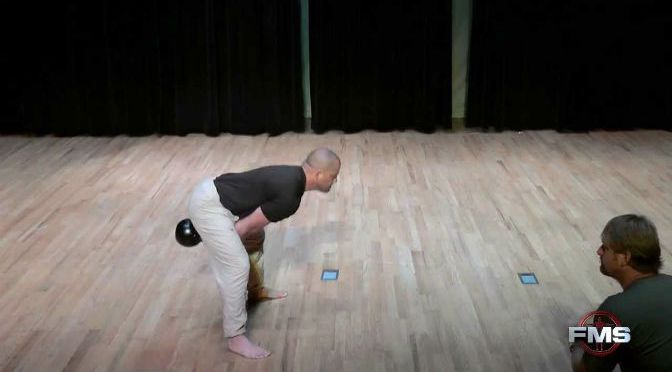
“We’re so enamored of effort, and we get so excited about how hard we’re working, when the reality is, how well do we perform?”
-Jeff O’Connor
 running in systems