It’s really all about sustainability: Reflecting on the Sustainable Brands conference at MIT Sloan.

Earlier this week, I attended the Sustainable Brands: New Metrics conference hosted by MIT Sloan in Boston, Massachusetts. It was a privilege to observe and participate in an event where business leaders have come together to act on climate change and other systemic risks. At New Metrics, the hot topic was, well, metrics: the cutting-edge of what we can measure statistically and probabilistically, with the goal of applying it not to measure climate change per se, but to the impact that leading businesses are achieving, in taking us towards a sustainable future.

One of the core philosophies of this conference is that brands—the web of ideas that surround a particular product of service—already have a great amount of influence in shaping society. Brands can become the leaders for creating the kind of society (and culture of social responsibility) that will drive a sustainable future. Businesses and corporations are increasingly beginning to realize that there is no future but a sustainable future. New Metrics (and Sustainable Brands) offers the platform for intellectual, social and corporate leaders to organize around the idea that sustainability and social responsibility must form the core, rather than the fringe, of how brands address society’s present and future needs.
Continue reading It’s really all about sustainability: Reflecting on the Sustainable Brands conference at MIT Sloan.

How philosophy powers athletic achievement: a personal anecdote.

Earlier this summer I ran the HTC race in Oregon, a well-known, hundred-plus mile relay. I was part of an excellent and enthusiastic Reed College team. I was given the more . . . motivating, if you will, leg of the race. It consisted of a set of three stretches—legs 5, 17, and 24—totaling about 21 miles. The last stretch included an 850-ft hill. I engage with running as a form of expression, and not a form of propulsion. Nowhere does the contrast between expression and propulsion become more stark than when a single group of people—each and every person with their own metaphors, mental models, and training histories—run together up a hill in heat that closes in on the double digits.

As was the case on that particular hill.

Now, I’m not the fastest runner out there. And, I gotta say: should precedent and probability have the final say, I’ll never be. But over the years, I have developed my running to be quite effortless—and therefore, quite fast. I like to run without effort, and fully engaged, like a well-oiled machine where every tiny part is playing its part in exactly the right way, all the pistons moving in perfect synchrony, all of the forces which course through my body coursing through it in exactly the right vectors. This is a story about what effortlessness means, what it does for you, and what it feels like. But more importantly I share what are, in my opinion, the most basic ideas of how to replicate it it.

Continue reading How philosophy powers athletic achievement: a personal anecdote.

Running Backwards: a training idea for runners with lateral knee pain.

The exercise of running backwards helps the runner fix quite a few of the most common biomechanical problems, such as lateral knee pain, certain kinds of lower back pain, and plantar fasciitis. It does this by correcting the location of your center of gravity (CoG).

The CoG is importantly related to the body’s “mechanical solution,” the algorithm of muscle contractions that maintains the body erect and stable throughout the course of activity. Because the CoG is defined as the place where there are no forces acting on the body, any shifts or changes in the muscle firings that the body interacts with mechanical energy—any change in the mechanical solution—will necessarily alter the location of the center of gravity.

Strengthening a muscle that was previously too weak to be used in strenuous exercise will change the body’s mechanical solution: for any particular action, employing more muscles instead of less facilitates the body’s movement through space, since the brain is better able to correct for a center of gravity that moves due to change of direction, change of speed, or variable terrain.

Continue reading Running Backwards: a training idea for runners with lateral knee pain.

The “hip complex:” The reference point for the center of gravity.

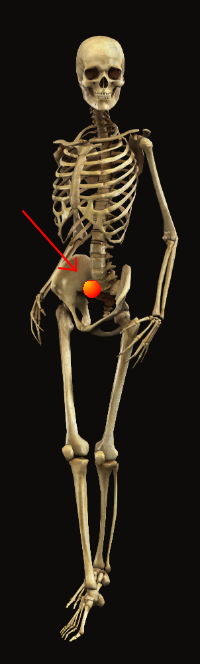
Most of us know that when we run (or just walk around), our weight should be on our hips. This allows us to move faster and more powerfully, and to prevent injury. It’s also often said that the hips are the “center of gravity.”

skeleton m
The “center of gravity” is represented by the red dot.

All this is completely true. But what does “center of gravity” mean, anyway?

The “center of gravity” is the point in a body around which the resultant torque (or “resultant force“) due to gravity and other sources of mechanical energy vanishes. In other words, all of the forces that are generated by the body, as well as their interactions with the earth’s gravitational field, all get canceled out at the center of gravity.

The resultant force. This isn’t a commonly used term, but it’s one whose implications we should understand if we want to become safe, effective runners.

Continue reading The “hip complex:” The reference point for the center of gravity.

On “False Performance.”

I believe that the only way to be as fast as I wish I am, is to think myself exactly as strong as I actually am. I constantly overreach, and even more often arrogate capabilities to myself that I don’t actually have.

Want to know how I get injured?

I blind myself to the interface between my body and the world, and I use willful ignorance to dedicatedly circumvent certain truths about the world—truths that accelerate at 9.8m/s² (32.1ft/s²), and, in my case, slam into my feet with around 450 lbs of force. Somehow, I have to bully myself into greater awareness, and greater humility about myself and the world. Somehow, I have to find a way to train healthy and safe.

And to that end, I use the term false performance. I invite you to use it as well.

Continue reading On “False Performance.”

4-count breathing: An exercise for runners, meditators, commandos, and everyone else.

4-count breathing is well-known as a relaxing exercise, a form of meditation, and a tactical combat tool. This is a very useful tool for runners, because it helps the body function aerobically at a very high level of performance. For those who don’t know what I’m referring to, 4-count breathing is a technique that consists of the following steps:

Square-breathing-296x300

Continue reading 4-count breathing: An exercise for runners, meditators, commandos, and everyone else.

Biological, psychological, and social systems affect our development of speed, power and endurance. Let's discuss them candidly.