Tag Archives: Running

The Tales of Forgotten Subsystems, Part II: The “Central Governor.”

Exercise is one of the biggest challenges to the continuous functioning of our body—also known as homeostasis. When we exercise, we wear down tissues, spend calories, consume nutrients, and basically threaten the integrity of our bodies. That’s not a problem: the human body has been designed and built by the creative errors of evolution to be a high-performance athletic machine. And this machine comes with a regulatory mechanism whose purpose it is to ensure that our homeostasis does not become compromised by athletic activity: the “central governor.”

Although this may be obvious to some, it is news to the majority of exercise physiologists, and it is still being debated by cutting-edge researchers. What can you say? Old ideas die hard.

Continue reading The Tales of Forgotten Subsystems, Part II: The “Central Governor.”

The importance of a “Vision.”

These days, we find ourselves in a multitude of wars, literal and metaphoric. We are always fighting against something. Whether it is obesity, aging, injury or death, it seems that most of what we do is to try and stave off the avalanche of the inevitable. This battle cannot be won—and yet we fight it. But the reality is: we don’t have to.

When the majority of us lay athletes begin to exercise, we often do it to hold something at bay. Maybe it’s heart disease. Maybe it’s something else. In systems thinking, is often referred to as “Negative Vision.” We bring into our minds the image of what we don’t want to happen, and we exercise accordingly.

There are several big problems with this approach: first and foremost, we don’t have a mission in mind—something that we are driven to accomplish. For that very reason, we find whatever it is that we’re trying to outrun constantly nipping at our heels. That is a losing battle.

Continue reading The importance of a “Vision.”

The language of “static stretching:” How to identify systemic archetypes using linguistic clues.

Static stretching is one of the most entrenched exercise habits in the western hemisphere, especially for runners. It doesn’t do any favors to our running economy, our injury rates, our long-term development of power—and yet it endures.

You would think this means that we have an unabashed cultural acceptance of stretching, but that isn’t so. No matter how positively we speak of stretching, or how much we proselytize its benefits, the language that we use to describe it (and its effects) continue to carry hints that it isn’t—and will never be—a real solution.

Continue reading The language of “static stretching:” How to identify systemic archetypes using linguistic clues.

How philosophy powers athletic achievement: a personal anecdote.

Earlier this summer I ran the HTC race in Oregon, a well-known, hundred-plus mile relay. I was part of an excellent and enthusiastic Reed College team. I was given the more . . . motivating, if you will, leg of the race. It consisted of a set of three stretches—legs 5, 17, and 24—totaling about 21 miles. The last stretch included an 850-ft hill. I engage with running as a form of expression, and not a form of propulsion. Nowhere does the contrast between expression and propulsion become more stark than when a single group of people—each and every person with their own metaphors, mental models, and training histories—run together up a hill in heat that closes in on the double digits.

As was the case on that particular hill.

Now, I’m not the fastest runner out there. And, I gotta say: should precedent and probability have the final say, I’ll never be. But over the years, I have developed my running to be quite effortless—and therefore, quite fast. I like to run without effort, and fully engaged, like a well-oiled machine where every tiny part is playing its part in exactly the right way, all the pistons moving in perfect synchrony, all of the forces which course through my body coursing through it in exactly the right vectors. This is a story about what effortlessness means, what it does for you, and what it feels like. But more importantly I share what are, in my opinion, the most basic ideas of how to replicate it it.

Continue reading How philosophy powers athletic achievement: a personal anecdote.

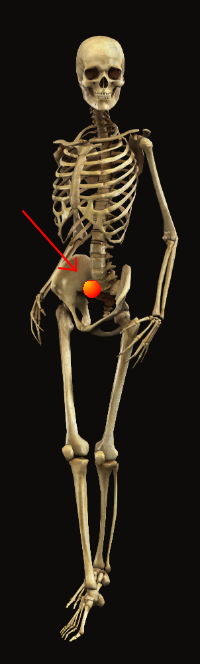
The “hip complex:” The reference point for the center of gravity.

Most of us know that when we run (or just walk around), our weight should be on our hips. This allows us to move faster and more powerfully, and to prevent injury. It’s also often said that the hips are the “center of gravity.”

skeleton m
The “center of gravity” is represented by the red dot.

All this is completely true. But what does “center of gravity” mean, anyway?

The “center of gravity” is the point in a body around which the resultant torque (or “resultant force“) due to gravity and other sources of mechanical energy vanishes. In other words, all of the forces that are generated by the body, as well as their interactions with the earth’s gravitational field, all get canceled out at the center of gravity.

The resultant force. This isn’t a commonly used term, but it’s one whose implications we should understand if we want to become safe, effective runners.

Continue reading The “hip complex:” The reference point for the center of gravity.

On “False Performance.”

I believe that the only way to be as fast as I wish I am, is to think myself exactly as strong as I actually am. I constantly overreach, and even more often arrogate capabilities to myself that I don’t actually have.

Want to know how I get injured?

I blind myself to the interface between my body and the world, and I use willful ignorance to dedicatedly circumvent certain truths about the world—truths that accelerate at 9.8m/s² (32.1ft/s²), and, in my case, slam into my feet with around 450 lbs of force. Somehow, I have to bully myself into greater awareness, and greater humility about myself and the world. Somehow, I have to find a way to train healthy and safe.

And to that end, I use the term false performance. I invite you to use it as well.

Continue reading On “False Performance.”