Category Archives: Biomechanic Issues

An analysis of the paradigmatic features of midfoot-striking and heel-striking.

The term “heel-striking” shouldn’t just refer to which part of the foot hits the ground first. Even in the common parlance, it should refer to the collection of neuromuscular gait features across the body that contribute to a type of overstriding in which the heel lands first, ahead of the center of gravity.

When I write the words “heel-striking,” this is invariably what I mean.

This way, we can neatly sidestep the conversation of whether someone landed on their heel under their center of gravity, or only “appears” to heel-strike. Let’s do away with reductionist analyses: let’s make it about something else than just “the strike.” The most widespread way in which the western runner overstrides is by heel-striking.

In a previous post, I reviewed how there is a paradigmatic body geometry to midfoot-striking, which corresponds to a paradigmatic pattern of muscle use. Heel-striking is no different.

When I say “paradigmatic,” I refer to the core components of the stride; to its most generalizable features. For example, the paradigmatic body geometry of midfoot-striking consists of a full-body arch, which begins at the base of the head and ends at the heel.

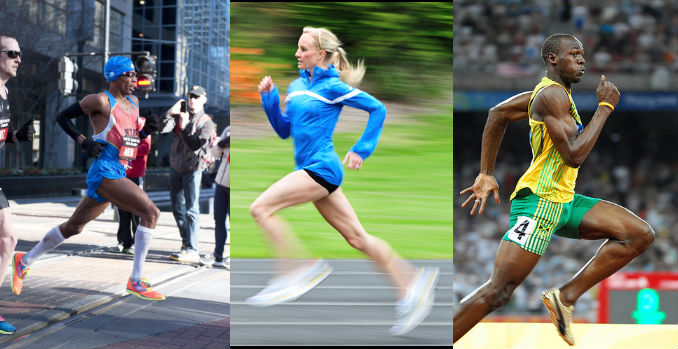
Establishing the paradigmatic features of types of running strides allows us to observe those features and make reasonable predictions about them. If you look at a runner who appears to be heel-striking, and yet is creating a full-body arch starting from the base of the head and ending at the pushoff heel, you can be reasonably certain that if you look closer, you will actually find this runner to be midfoot-striking. In other words, you can know that Meb Keflezighi’s apparent heel-strike (left), is actually a “proprioceptive heel-strike”—rather, a “disguised” midfoot-strike—just by looking at the continuous arch made by his leg and back at pushoff. (This video makes my point rather well). You may notice that other noted forefoot-strikers create very similar arches:
elite arches m

Because every person has a slightly different body geometry, the specifics of their stride will be slightly different. But these specifics are much more similar to each other than it is usually claimed. For example, in the post previously mentioned I reviewed how, necessarily, for all humans, dynamic strength is necessarily achieved by creating a series of consistent and symmetrical arches with the body’s bone structure. The reason this applies to all humans is because it applies to all structures. The integrity of every possible structure—from the Hagia Sophia to the plantar vault—is subject to the symmetry and consistency of its arches.

From this idea, we can extrapolate that no human can be the strongest version of themselves without creating the most consistent and symmetric arches across the body. Therefore, when you look at the differences betwen midfoot-striking and heel-striking, the differences in body geometry stand out starkly: unlike midfoot-striking, heel-striking paradigmatically breaks the full-body arch that makes the midfoot-striking body so resilient.

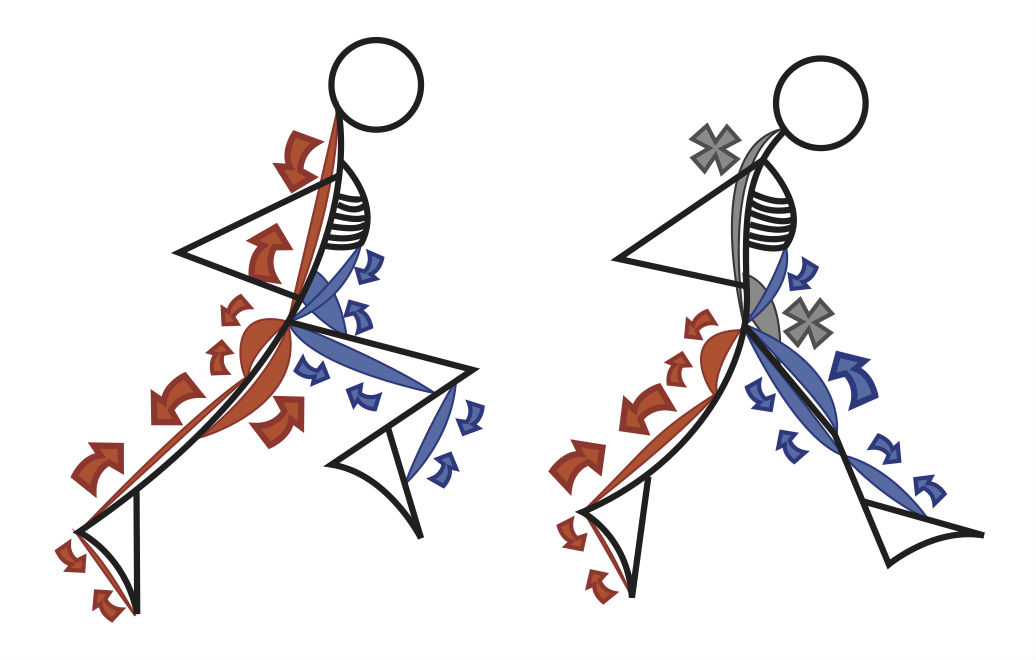
There may be a few runners out there for whom a true heel-strike doesn’t break this full-body arch. There may even be others who can land on their heels, under the center of gravity, without breaking this arch. But paradigmatically, the stride difference between forefoot-strikers (left) and heel-strikers (right) looks like this:
heelforefoot1

As mentioned before, a paradigmatic body geometry corresponds to a particular pattern of muscle use. In the above graphic, you can observe major differences between midfoot-striking and heel-striking in the neuromuscular paradigm of both the extensor muscles used during pushoff (red) and the flexor muscles used during the swing phase (blue). Of course these two types of body geometry load different tissues in different ways. That’s the point.

The most important differences are (1) the reduced iliopsoas function for the heel-striker (depicted by a grayed out X at the hip), (2) the reduced function of the upper back extensors (grayed-out X at the back), and the concentric activation of the quadriceps muscle for the heel-striker (blue arrow at the thigh).

The heel-strikers’s upper leg is in a bit of a predicament: during the swing phase, both the quadriceps (front thigh muscle, blue), and the hamstring (back thigh muscle, blue) are active at the same time. This is a problem because, when the leg is forwards of the hip, the hamstring flexes the knee, while the quadriceps extends it. This means that two muscles of the body which perform opposite functions are active at the same time, pulling in opposite directions. And this is happening as the leg is nearing the ground—during the landing phase—which means that two of the major muscles of the body are fighting each other, and they are doing so at the very moment that the body is about to slam into the ground.

This isn’t a problem for the midfoot-striker: the fact that the front knee is bent, and near the height of the hips, means that the quadriceps is largely inactive at that stage. Full quadriceps activation only occurs towards the end of the pushoff phase (front thigh muscle, red).

Because athletic power is generated through the creation of consistent and symmetric arches, any running body will always be the most powerful version of itself as a midfoot-striker. Furthermore, the body is designed around these principles: because load-bearing structure (the arch) is most consistent when the body is powerfully midfoot-striking, the body is at the peak of structural resilience when midfoot striking. Given that resilience is a hallmark of systemic integrity, this means that a systemic analysis of the body can only basically conclude that the human biomechanical system is operating at its “peak” when it is midfoot striking.

Similarly to the heel-strike, the midfoot-strike doesn’t refer to the part of the foot that hits the ground first. It refers to the constellation of stride components (such as the creation of a full body arch), that allows this part of the foot to hit the ground first.

This post shouldn’t be construed to mean that we should ONLY midfoot-strike. There may be plenty of reasons to heel-strike, such as rapid deceleration, and the opportunity to use the heel bone as a swivel, in order to turn quickly. However, for the purpose of producing safe and sustained forward motion, no type of stride will yield results that are as consistent or as powerful as those allowed by the midfoot-strike.
From maximalist to minimalist footwear (and back): a lesson in resilience, and in “shifting the burden” systems.

The popularity of the trend of minimalist (zero-drop, low-cushioning) shoes has coincided with a sharp increase in running injuries, according to some sources. This has caused a large amount of community, media, and legal blowback on minimalist shoes, the most salient of which is the recent class-action lawsuit against Vibram, for misleading advertisement.

Misleading advertisement should always be punished. Vibram peddled their five-fingers shoes as the solution to running injuries. They are not. They should never have been advertised that way.

But this blowback has created an unfortunate tendency: blaming the minimalist shoes themselves as the cause of injury.

They aren’t the cause. Although this may seem contradictory, it is the fact that so many people get injured when switching from “maximalist” (shoes that are highly-cushioned; often with an elevated heel) to minimalist shoes—but not vice versa—that suggests that minimalist shoes are better for the biomechanics of human running.

This apparent contradiction can be resolved—but in order to do that we must look at the issue from a systems thinking perspective. And for that, we have to begin with the concept of “resilience.”

Continue reading From maximalist to minimalist footwear (and back): a lesson in resilience, and in “shifting the burden” systems.

Don’t run above your pay grade: the (not so) hidden dangers of maximalist shoes.

There is a segment of the running community that continues to insist that maximalist shoes are the way to go, and that minimalism is nothing but a “fad.” This insistence goes against every biomechanical and physical principle that I can think of. One of the ways in which maximalist shoes violate these mechanical principles is by having wide soles. This is incremental: the more maximalist, the greater the violation.

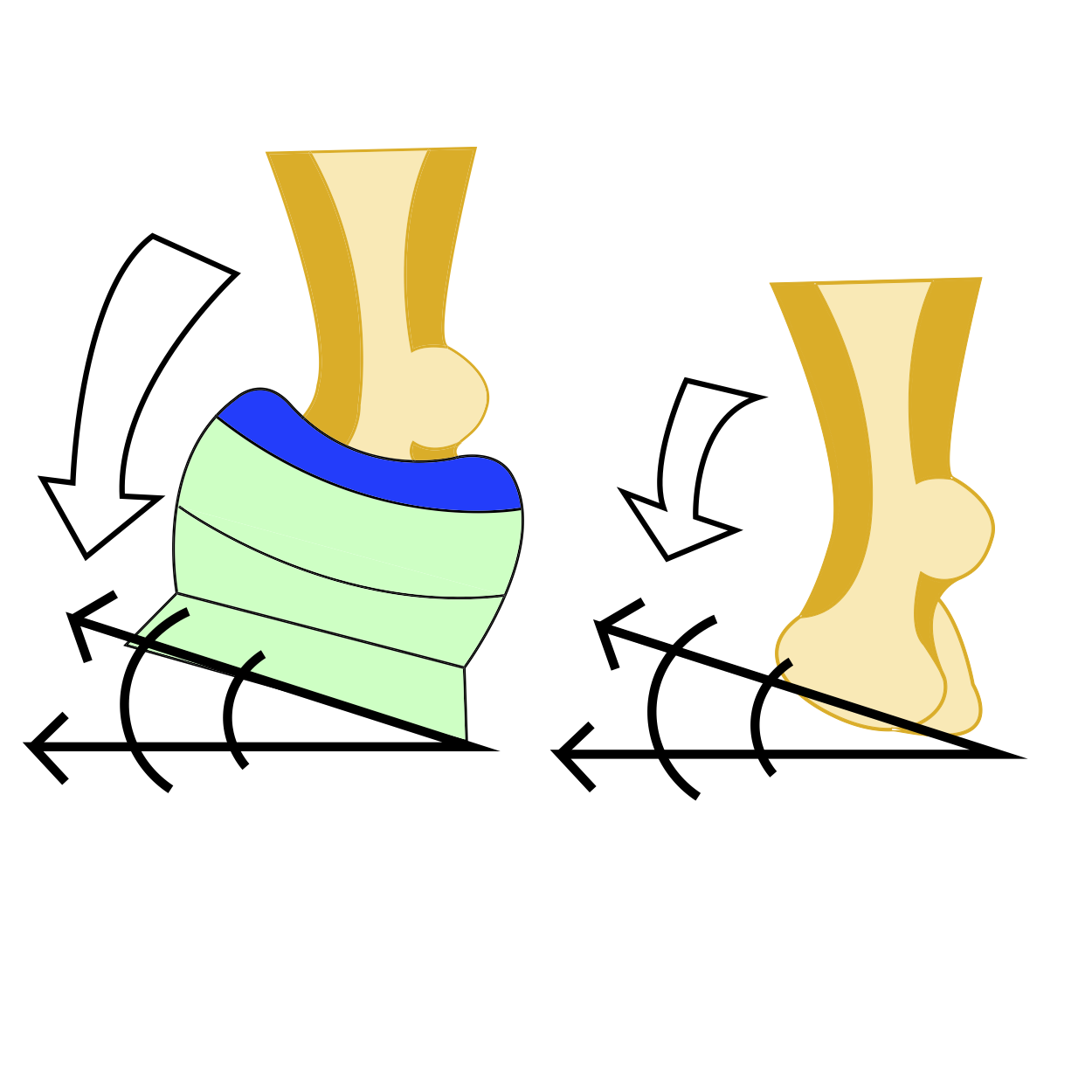
When running in maximalist shoes, the impact forces incurred during the landing phase are much greater. Take for example the following picture, which shows the back of a shod and an unshod foot. When the foot is fully pronated at the point of ground contact, the sole forms an acute angle with the ground. The vertex of the angle is the outside of the foot; the point of contact. When the runner is unshod, the sides of this angle aren’t very long. I represent this as the innermost arc (from the vertex). However, when the runner is shod, the sides of the angle are much longer; this is the outermost arc.

shoe vs. foot

Because the arc is much longer when the foot is shod, the inside of the foot will accelerate over a comparatively longer distance (the length of the bigger arc) in order to lay flat on the ground. This means that the overall forces that travel up through the foot and into the leg are that much greater when running in big-soled shoes.

There are two important points here: first, the modern running shoe was designed to artificially extend the stride. As the stride extends, the impact forces are greater and greater. This isn’t a problem when the runner’s muscles have developed to extend the stride; most likely they have also developed to absorb and dissipate those increased impact forces. But when the stride is lengthened artificially, the runner hasn’t “earned” the right to interact with those forces—and they’ll get injured.

Similarly, the shod foot in particular has no business having a wider sole. By definition, a habitually shod foot is weaker than a habitually unshod foot. And because the forces created upon landing/supination are much greater when shod than when unshod, the possibility of injury skyrockets: the weakened structure is generating with forces much greater than those which the stronger structure would ever generate.

That’s a bit of a problem.

But there is a second point to be made here: this analysis is based on simple physics and geometry. And yet, the multibillion-dollar running shoe industry pays very little heed to the physical, biological, and mechanical principles by which the body moves, and by which it grows and develops.

Out on the road, halfway into the marathon, the maximalist/minimalist debate doesn’t matter. Out there, you aren’t debating the minimalists. You’re debating physics. You’re debating biology. You’re debating geometry. If the worldview that you approach that debate with doesn’t heed the relevant laws and principles, you’re going to lose. In direct measure to how badly you lose this debate, will be the magnitude of your injuries.

The benefits of developing a healthy, dialectic relationship with pain.

One way or another, most of us have an unhealthy relationship with pain. Either we’re scared of it, or we try to overcome it. In both situations, pain is the enemy. But our relationship with pain doesn’t have to be of enmity. If we understand it, it can become a great asset in training and in life.

This especially goes for runners: we’ve become socially conditioned to believe that running is just painful. According to society, when you run, pain is gonna happen anyway, and because running “is injurious”—it’s just that way—well, there’s no point in listening to it, to what it’s telling us about our bodies, and figuring out how to modify our running accordingly. Because running is injurious, our body will break at some point, so we might as well just wait until something happens and then go see the physical therapist.

But pain itself can help us guard against injury. We just have to get to know what it’s telling us.

Continue reading The benefits of developing a healthy, dialectic relationship with pain.

Training starts with an idea. Make sure that idea is correct.

More and more of the newer science seems to fly in the face of conventional wisdom.

This trend brings into question everything that we know—and more importantly, everything that we think we know.

Sitting in the armchair, this isn’t a problem. If we theorize about the differences between barefoot and shod running, and never actually go out for a run, never actually pushing the system to observe its behaviors, theory seems like a great idea. It seems like all we need to do.

But we don’t do theory for its own sake. The point of theory is for it to help us in practice. So we go out and run, and if our mental model—our suppositions, assumptions, beliefs, and beliefs about our knowledge—is different from how the world actually works, the discrepancies between that mental model and the real world will begin to show up as pain on our knees.

One of the reasons I love running is because out on the road, mental models accelerate towards the ground at 32.2 ft/s2. The collision between our mental model and the ground is as close to truth as we lay athletes are ever going to get.

Writing this was brought on when I read a post by The Gait Guys, talking about achilles tendonitis, and possible solutions to it. Conventional wisdom would suggest that the way to reduce achilles tendonitis is by shortening the achilles tendon, a.k.a. raising the heel on the shoe.

Why? Simple. If you raise the heel of a shoe, you loosen the achilles, so it’s not carrying the weight of the body anymore. By all counts, that should do the trick.

(It doesn’t).

But that’s the problem. This solution was thought up in the armchair, and never tested in practice. Theoretically, it should work. But that’s because a theory is a mental model: a self-contained little idea of the world. Given the rules of that model, raising the heel is an excellent solution. Now, all that has to happen is for that model to coincide with the realities of the body.

In academic circles, those kinds of suppositions are known as “pipe dreams.”

The body isn’t just a series of simple machines put together. It is a complex entity, built from stacks and stacks of systems, each doing a different job. And the job of one of those systems is to regulate impact force by using touch receptors.

Because that subsystem—the central nervous system—is also at play, the behaviors of the body/system will be “unpredictable.” But it’s only unpredictable because the theoretical model doesn’t account for that subsystem.

When we account for this system, its actual behavior seems a lot more reasonable: in order to maintain tension on the achilles, the body raises the foot as the leg approaches the ground. However, this means that the leg can accelerate for a longer period of time, making the initial contact forces that much more powerful.

We need to understand the systems we’re playing with.

We need to go out and test them, and get a feel for their behavior. The phrase “push the envelope” comes from test pilots: every one of those pilots climbed into the cockpit fully aware of the mathematical model that predicted the flight capabilities of the airplane—also called the “flight envelope.” Pushing the envelope literally means taking the plane into unpredicted territory—literally pushing the aircraft beyond what the mathematical predictions say that it can take.

Dangerous? Yes. Necessary? Absolutely. The reason flying such a safe mode of transportation these days is because a few brave and knowledgeable people understood that there is a big discrepancy between the armchair and the road—between the predictive model and the actual system.

Let’s take these lessons and put them into our running. Let’s push our own running envelopes to see what sorts of behaviors our body exhibits—and then modify our training and adapt accordingly.

The best exercise ever: jumping rope.

Jumping rope prepares the body to interact with gravity and stress—making it the perfect precursor to running. It strengthens the connective tissue, solidifies the bones, develops the tendons, and teaches the muscles how to “talk” to each other through the stretch reflex.

Here’s how to do it right:

jump rope

Most people jump rope incorrectly: they use their calfs as the major pushoff muscles. But then, why is it so ubiquitous?

Because it is neurologically a lot simpler to use two muscles than to use a lot of them.

Most people’s bodies never learned to use all their muscles in dynamic activities: parents prefer to keep their kids inside throughout their critical periods (1-6 years of age). The parental risk aversion that translates to a reduction in dynamic play impoverishes the brain’s sensorimotor opportunities. Simply stated, the brain never learned how to use all of the muscles together—it didn’t have to.

So the brain chooses the quick way out: it only uses the calfs.

But the calf muscles were never “designed” to push off (in the sense that the arm muscles were never “designed” to support the body while running). Their function is to make sure that the foot remains at the correct angle in relation to the ground throughout the landing and propulsion of all leg-based activities. In other words, the calf muscles are designed to effectively transfer the force from the quads and the glutes into the ground, not as pushing muscles.

If we use them to push off, we overload them—but more importantly we use the entire leg and hip system in a way that it was never meant to be used. And what does this translate to?

Calf muscle tightness. 

To correct this, we need to train our muscles to interact correctly, and we need to make the brain realize that there is a way to use the most powerful muscles in the body, the quads and the glutes, as the main motors of propulsion. If we use the tiny calf muscles as our main pushing muscles, we will never become the fastest, most athletic version of ourselves.

An internet encounter with static stretching.

Yesterday, while I was browsing Facebook, I happened to click on a link that advertised the 30 best premium WordPress themes. Curious, I started to browse through the list, and I came upon one that I was curious about: “spartan,” which has a nice internet-mag style layout.

As I looked at the live preview—nothing fancy; just catchy headlines, stock images and lipsum text—I scrolled down and saw that one of the example articles had a headline that read: “Don’t forget to stretch after your workout!”

Continue reading An internet encounter with static stretching.

Running form of elite female runners—Analyzed!

I’m posting about a great video I found on YouTube, which analyzes the most important gait components of elite female marathoners. The author of the video analyzes the things that make or break someone’s stride, race, or body.

Here’s the link.

Watch it; it’s well worth your while!

Key points:

  • Runners need muscle resilience in order to maintain tension in the tendons.
  • The lower the amount of force produced by muscle contraction, and the more it is produced by passive tendon release, the more powerful the runner will be.
  • Certain types of gait (gliders vs. gazelles) will aid in efficiency, and boost speed.

Answering a common question: I want to run, but I keep getting injured. Where do I begin?

Nothing can show you the way to go better than an expert in the body’s biomechanics: a kinesiologist. But a lot of people think just like me: we’re too proud or too determined to let someone else micromanage our athletic development. We want to do it ourselves.

To do that, we had better start by understanding the principles that pertain to any dynamic system—including the human body. These are simpler than you may think. Consider the advice given to people that are trying to improve their social and personal relationships: the first step is to develop the channels of communication between parties. All future progress depends on that.

Continue reading Answering a common question: I want to run, but I keep getting injured. Where do I begin?

The language of “static stretching:” How to identify systemic archetypes using linguistic clues.

Static stretching is one of the most entrenched exercise habits in the western hemisphere, especially for runners. It doesn’t do any favors to our running economy, our injury rates, our long-term development of power—and yet it endures.

You would think this means that we have an unabashed cultural acceptance of stretching, but that isn’t so. No matter how positively we speak of stretching, or how much we proselytize its benefits, the language that we use to describe it (and its effects) continue to carry hints that it isn’t—and will never be—a real solution.

Continue reading The language of “static stretching:” How to identify systemic archetypes using linguistic clues.