Tag Archives: Running

An analysis of the paradigmatic features of midfoot-striking and heel-striking.

The term “heel-striking” shouldn’t just refer to which part of the foot hits the ground first. Even in the common parlance, it should refer to the collection of neuromuscular gait features across the body that contribute to a type of overstriding in which the heel lands first, ahead of the center of gravity.

When I write the words “heel-striking,” this is invariably what I mean.

This way, we can neatly sidestep the conversation of whether someone landed on their heel under their center of gravity, or only “appears” to heel-strike. Let’s do away with reductionist analyses: let’s make it about something else than just “the strike.” The most widespread way in which the western runner overstrides is by heel-striking.

In a previous post, I reviewed how there is a paradigmatic body geometry to midfoot-striking, which corresponds to a paradigmatic pattern of muscle use. Heel-striking is no different.

When I say “paradigmatic,” I refer to the core components of the stride; to its most generalizable features. For example, the paradigmatic body geometry of midfoot-striking consists of a full-body arch, which begins at the base of the head and ends at the heel.

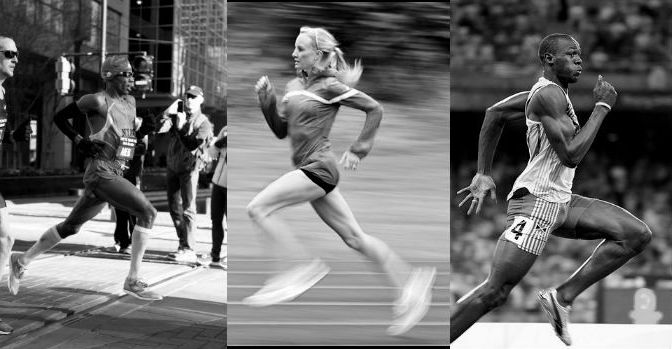
Establishing the paradigmatic features of types of running strides allows us to observe those features and make reasonable predictions about them. If you look at a runner who appears to be heel-striking, and yet is creating a full-body arch starting from the base of the head and ending at the pushoff heel, you can be reasonably certain that if you look closer, you will actually find this runner to be midfoot-striking. In other words, you can know that Meb Keflezighi’s apparent heel-strike (left), is actually a “proprioceptive heel-strike”—rather, a “disguised” midfoot-strike—just by looking at the continuous arch made by his leg and back at pushoff. (This video makes my point rather well). You may notice that other noted forefoot-strikers create very similar arches:
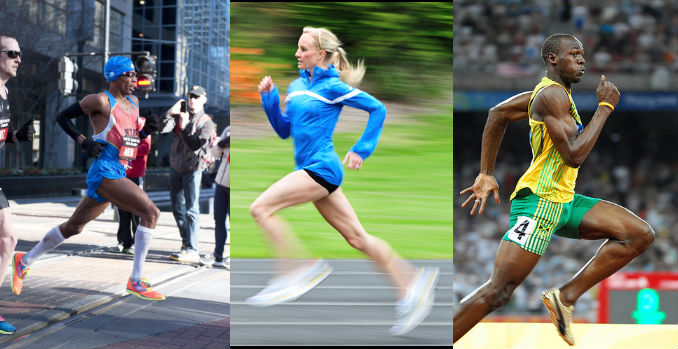
elite arches m

Because every person has a slightly different body geometry, the specifics of their stride will be slightly different. But these specifics are much more similar to each other than it is usually claimed. For example, in the post previously mentioned I reviewed how, necessarily, for all humans, dynamic strength is necessarily achieved by creating a series of consistent and symmetrical arches with the body’s bone structure. The reason this applies to all humans is because it applies to all structures. The integrity of every possible structure—from the Hagia Sophia to the plantar vault—is subject to the symmetry and consistency of its arches.

From this idea, we can extrapolate that no human can be the strongest version of themselves without creating the most consistent and symmetric arches across the body. Therefore, when you look at the differences betwen midfoot-striking and heel-striking, the differences in body geometry stand out starkly: unlike midfoot-striking, heel-striking paradigmatically breaks the full-body arch that makes the midfoot-striking body so resilient.

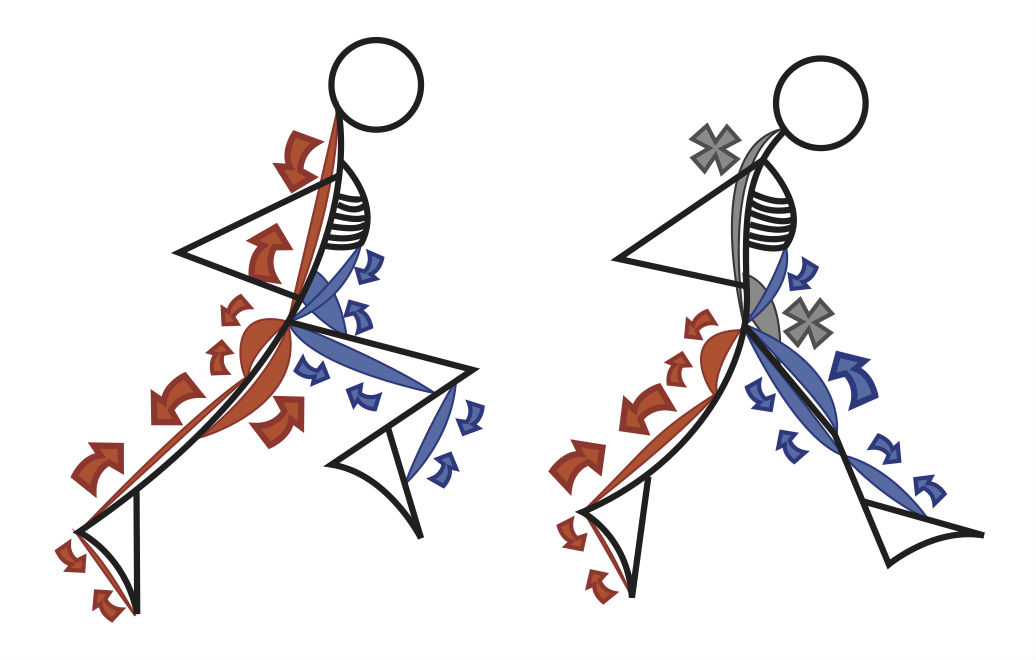
There may be a few runners out there for whom a true heel-strike doesn’t break this full-body arch. There may even be others who can land on their heels, under the center of gravity, without breaking this arch. But paradigmatically, the stride difference between forefoot-strikers (left) and heel-strikers (right) looks like this:
heelforefoot1

As mentioned before, a paradigmatic body geometry corresponds to a particular pattern of muscle use. In the above graphic, you can observe major differences between midfoot-striking and heel-striking in the neuromuscular paradigm of both the extensor muscles used during pushoff (red) and the flexor muscles used during the swing phase (blue). Of course these two types of body geometry load different tissues in different ways. That’s the point.

The most important differences are (1) the reduced iliopsoas function for the heel-striker (depicted by a grayed out X at the hip), (2) the reduced function of the upper back extensors (grayed-out X at the back), and the concentric activation of the quadriceps muscle for the heel-striker (blue arrow at the thigh).

The heel-strikers’s upper leg is in a bit of a predicament: during the swing phase, both the quadriceps (front thigh muscle, blue), and the hamstring (back thigh muscle, blue) are active at the same time. This is a problem because, when the leg is forwards of the hip, the hamstring flexes the knee, while the quadriceps extends it. This means that two muscles of the body which perform opposite functions are active at the same time, pulling in opposite directions. And this is happening as the leg is nearing the ground—during the landing phase—which means that two of the major muscles of the body are fighting each other, and they are doing so at the very moment that the body is about to slam into the ground.

This isn’t a problem for the midfoot-striker: the fact that the front knee is bent, and near the height of the hips, means that the quadriceps is largely inactive at that stage. Full quadriceps activation only occurs towards the end of the pushoff phase (front thigh muscle, red).

Because athletic power is generated through the creation of consistent and symmetric arches, any running body will always be the most powerful version of itself as a midfoot-striker. Furthermore, the body is designed around these principles: because load-bearing structure (the arch) is most consistent when the body is powerfully midfoot-striking, the body is at the peak of structural resilience when midfoot striking. Given that resilience is a hallmark of systemic integrity, this means that a systemic analysis of the body can only basically conclude that the human biomechanical system is operating at its “peak” when it is midfoot striking.

Similarly to the heel-strike, the midfoot-strike doesn’t refer to the part of the foot that hits the ground first. It refers to the constellation of stride components (such as the creation of a full body arch), that allows this part of the foot to hit the ground first.

This post shouldn’t be construed to mean that we should ONLY midfoot-strike. There may be plenty of reasons to heel-strike, such as rapid deceleration, and the opportunity to use the heel bone as a swivel, in order to turn quickly. However, for the purpose of producing safe and sustained forward motion, no type of stride will yield results that are as consistent or as powerful as those allowed by the midfoot-strike.
The human body as a system of suspension bridges: The geometric source of athletic power.

To say “stand up straight” is a bit of a misnomer; the body is made up of a series of curvatures.

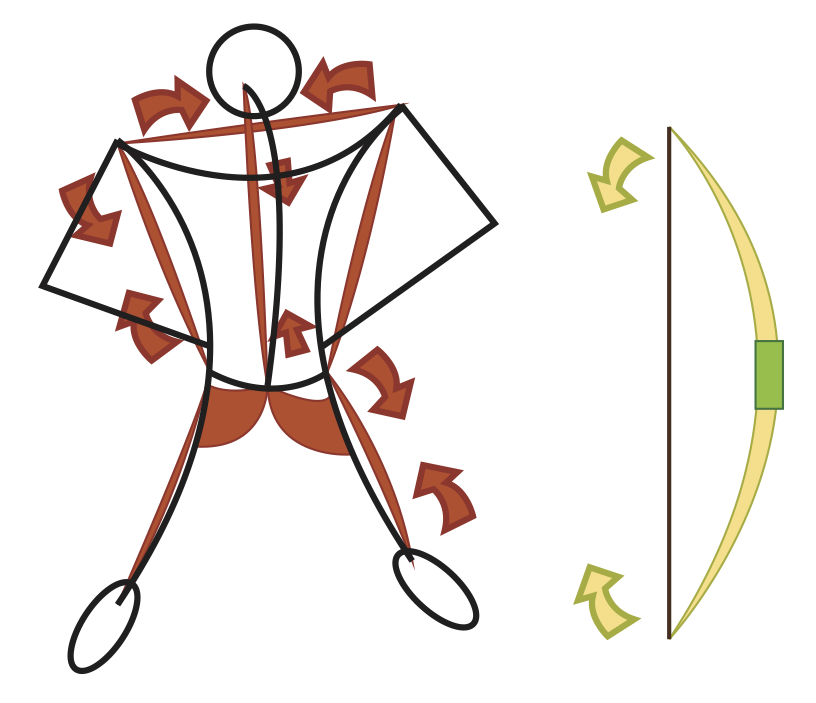
When you look from the side at someone standing up straight, you’ll see that their body actually follows a curve which begins at their heels and ends at the top of their head. Think of a hunting bow: when a bow is strung, the bowstring holds both ends of the bow together, allowing the structure to store a magnificent amount of potential energy, to be released when an arrow is loosed. The extensor muscles of the body (hamstrings, glutes, and back muscles) perform largely the same function as the bowstring:

bow 1

The quintessential proud or dominant posture is achieved by tensing the extensor muscles to align the majority of the bones in the body to create a series of arches, or bows. By maintaining tension in this way, the body creates a firm (yet dynamic) structure. This isn’t a spurious analysis: throughout the history of architecture, arches have been the quintessential support structure. For these same reasons, suspension bridges are built in high-wind and earthquake-prone areas: because using tense cables to support the structure not only maintains the bridge’s shape very well, but does so despite the power that wind or seismic events can exert on it. By contrast, a bridge that is completely rigid through and through would be far less resilient. 

Because the body is a moving system (as opposed to a rigid system), it creates these arches in order to more easily engage with the forces that routinely interact with the body, such as the force of gravity and the kinetic energy generated during exercise.

Continue reading The human body as a system of suspension bridges: The geometric source of athletic power.

Systemic paradigms and their repercussions: the athletic phenomenon of “heel-striking,” and its origins in scientific reductionism.

It would be misleading to say that the philosophical currents that drive society affect our behavior and influence events. It’s much more accurate to say that those philosophical currents largely determine our patterns of behavior and generate those events.

The widespread and damaging athletic phenomenon of heel-striking is no exception.

(By “heel-striking” I refer to the global set of gait characteristics which results in the runner putting their weight on the heel of the landing foot ahead of the center of mass).

Systems thinking proposes that our “mental models”—our belief systems about the world—create the very fabric of society, and therefore the patterns of behavior that emerge. The repercussions that our worldview has on our thought, our social structure, and our lives, are vast, and they are powerful.

Continue reading Systemic paradigms and their repercussions: the athletic phenomenon of “heel-striking,” and its origins in scientific reductionism.

The Tales of Forgotten Subsystems, part III: aerobic respiration, a.k.a The Krebs Cycle.

What if I told you that by running at a lower intensity, you could boost your running efficiency by 600%?

You’d think I was lying.

Well, I’m not. That’s exactly what happens when we run at the right intensity. When we’re burning sugars anaerobically, the sugar only gets partially processed by the cell, and out comes lactate. But when we burn them aerobically, that lactate goes through another process: The Krebs Cycle.

Continue reading The Tales of Forgotten Subsystems, part III: aerobic respiration, a.k.a The Krebs Cycle.

The benefits of developing a healthy, dialectic relationship with pain.

One way or another, most of us have an unhealthy relationship with pain. Either we’re scared of it, or we try to overcome it. In both situations, pain is the enemy. But our relationship with pain doesn’t have to be of enmity. If we understand it, it can become a great asset in training and in life.

This especially goes for runners: we’ve become socially conditioned to believe that running is just painful. According to society, when you run, pain is gonna happen anyway, and because running “is injurious”—it’s just that way—well, there’s no point in listening to it, to what it’s telling us about our bodies, and figuring out how to modify our running accordingly. Because running is injurious, our body will break at some point, so we might as well just wait until something happens and then go see the physical therapist.

But pain itself can help us guard against injury. We just have to get to know what it’s telling us.

Continue reading The benefits of developing a healthy, dialectic relationship with pain.

The irony of the “fitness” identity: a praise of CrossFit, and a critique of its founder.

CrossFit, in name and on paper, is an excellent form of exercise. CrossFitters achieve fitness through emphasizing the mobility and functionality of the body across many varieties of athletic skill. In my opinion, the most physiologically sound version of a human body is one in which its strengths and abilities are expressed alongside a capacity for sustained, safe, and healthy endurance running. CrossFit doesn’t emphasize the development of the “aerobic engine” necessary for that kind of endurance running. That may be my one complaint against the sport. That aside, CrossFit is as good as it gets.

As a runner, I live with the hopes of becoming fast, regardless of who’s next to me, or where I go in the world. Because of that dream, the training philosophy of CrossFit—and many of its exercises—have become a staple of my training. My simplest interpretation of the CrossFit philosophy is that a single-event athlete will be better at their best event if they are a multiple-event athlete. In other words, ability has to be cultivated across a breadth and depth of skills, for “fitness” to emerge. As the website says:

“By employing a constantly-varied approach to training, these functional movements at maximum intensity (relative to the physical and psychological tolerances of the participant), lead to dramatic gains in fitness.”

It’s there in the name: CrossFit.

Ever since hearing of CrossFit, I do more and more classic weight exercises such as the barbell squat—and have consistently made gains in speed, power, and endurance over “purer” runners. I’ve incorporated jumping rope as the ultimate plyometric and cognitive exercise: the amount of repetitions that you can put out during a jump-rope session do wonders in honing your body’s ability to exert force against the ground, and receive it safely.

CrossFit’s definition of “fitness” is the most useful I’ve ever heard of—or that CrossFit is aware of, too; it says it right there on the website. “Fitness” is defined as:

“Increased work capacity across broad time and modal domains. Capacity is the ability to do real work, which is measurable using the basic terms of physics (force, distance and time). Life is unpredictable (much more so than sport) so real world fitness must be broad and not specialized, both in terms of duration and type of effort (time and modal domains).”

This is a great definition. I can’t visualize a world where CrossFit practitioners would be anything but the supreme examples of health, if that philosophy (and this definition of fitness) were followed to the letter, and taken to their logical extreme. I’ll begin by breaking down their philosophy—(I’ll do the definition of “fitness” in a bit)—so you can see why:

Employing a constantly-varied approach to training. Taken broadly enough, this means that the concept of “training” can easily be expanded to encompass activities that aren’t typically known as “exercise.” Nutrition, for example. Developing the functional components of nutrition would be a boon to the athlete’s net power output. Seeking spiritual, social, and emotional health for their purely functional benefits, is perfectly encompassed under this philosophy.

I think back to Chris McDougall’s book, Born to Run, in which he quoted the kinds of advice that legendary track & field coach Joe Vigil would tell his athletes: “Do something nice for someone.”This is a varied  approach to training. And a coach like Vigil would only incorporate it because it helped take his athletes to another level of athletic achievement. (These kinds of “unorthodox” approaches are common across the 1% of the elite: Bruce Lee trained “breaking habits,” and when that became a habit, he would break that one too).

Let’s analyze the phrase “movements at maximum intensity, relative to the physical and psychological tolerances of the participant.” This phrase implies a systemic understanding, in which the athlete is not perceived to be a machine, but a person with a unique reality, a unique set of circumstances, that can influence their athletic output at any given time. This is a call to empathy for of the trainers, and a call to self knowledge for the athletes.

Let’s move on to the definition of fitness: “Increased work capacity across broad time and modal domain.” On the surface, this means that the athlete should have speed, power, and endurance.

But let’s look at the definition a little bit more deeply. Especially in conjunction with the phrase “relative to physical and phsychological tolerances,” I could easily argue that one such “broad time domain” is a lifetime. In other words, embedded within the very definition of “fitness,” as put forth by CrossFit, is the argument that health entails fitness: there must be health if the athlete will be “fit.” Under that definition, losing “fitness” because of a lack of health means that what seemed like fitness wasn’t fitness, but was instead a façade—a social performance of fitness that broke down under the assault of time.

Only in view of that impressive philosophy can this next part be so damn ironic. I recently read a New York Times article critiquing the obsession of Westerners with physical fitness. The article quoted extensively from an interview with Greg Glassman, CrossFit’s founder. The NYT article’s critique of the fitness craze centers around Glassman’s 2005 admission that CrossFit had become a breeding ground for an exercise-induced condition called rhabdomyolysis, which can lead to kidney failure. According to the New York Times article, Glassman viewed the rampant “exertional rhabdo” problem as part of CrossFit’s “dominance over traditional training protocols.”

This is absurd—and not only in reference to a “reasonable person’s” idea of fitness.

The idea that a dangerous kidney condition is a marker of fitness goes against CrossFit’s stated definition of fitness—the potential for increased work capacity across broad time and modal domains. Furthermore, persevering through exercise despite the onset of rhabdomyolysis is a serious breach of the idea that intensity should be measured relatively to the physical and psychological tolerances of the participant.

But wait! There’s more.

According to the NYT article, Glassman also wrote: “Until others join CrossFit athletes in preparing…the exertional rhabdo problem will be ours to shoulder alone.”

You just can’t make this stuff up.

Glassman’s writing reminds me of something I read in a book called The China Study, about the physiological effects of eating animal protein (specifically, of its contributions to cancer and heart disease). In that book, the authors quoted a physician saying that heart disease was the burden of man, and that only “the effeminate” would pursue other, healthier, avenues of eating to escape it.

In these two examples, these “experts” on health have structured their identity around the ill effects of their chosen activities! When the marker of being “a man” is heart disease, it becomes impossible for anyone subordinated to those social circumstances to seek a healthy lifestyle.

Similarly, if it is the presence of exertional rhabdo that makes CrossFit so “superior”—at least in the eyes of its founder—then the presence of rhabdo in the athlete quite naturally becomes the high watermark of achievement. In direct opposition to the stated philosophy and mission of his fitness empire, Glassman has set up a dangerous situation for his followers: if they haven’t suffered the ill effects of exercise, that means they haven’t been training hard enough!

The problem here isn’t CrossFit. It is the discrepancy between what CrossFit proposes on paper and what its founder touts as the “CrossFit identity.” This should serve as yet another reminder of the fact taht there is often an abyss between what a particular training regimen does for us, and what it is supposed to do. Often, the problem isn’t in how we follow it, but in how we don’t—or more specifically, how we overshoot.

If the reasons for which we overshoot are based on a set of social beliefs that we have created around us—that have long since been divorced of any knowledge of the world (or were never based on that knowledge in the first place)—we are treading dangerous waters. Often, we can’t even see them. Not when it counts. We might be able to laugh at those ironies over a couple of beers, but once in the gym, they will consume us and guide our efforts. If we have taken an identity upon ourselves, all of our exertions will be in service of that identity.

And if that identity centers around illness or overtraining, it doesn’t matter what athleticism we have cultivated as a short-term side-effect of our exertions. We will lose it.

We live and train in social systems. Often, those systems do no favors to the physical, psychological and biological systems on which our athletic output is predicated. Our identity—which is based largely on the demands of that social system—will shape our choice of exercises, the intensity, duration, and frequency with which we do them, and the efficiency of our rest and recovery. What’s on paper never reflects the reality of the situation. The social system, via our identity, informs the effectiveness of our athletic development. 

Let’s make sure that social system, and that identity (or lack thereof), is the right one.

UPDATE: For an answer to the NYT article critiquing “extreme fitness,” see this Outside Magazine article. I’d love to hear your thoughts and answers to any of these articles, and this blog post, in the comments.

Training starts with an idea. Make sure that idea is correct.

More and more of the newer science seems to fly in the face of conventional wisdom.

This trend brings into question everything that we know—and more importantly, everything that we think we know.

Sitting in the armchair, this isn’t a problem. If we theorize about the differences between barefoot and shod running, and never actually go out for a run, never actually pushing the system to observe its behaviors, theory seems like a great idea. It seems like all we need to do.

But we don’t do theory for its own sake. The point of theory is for it to help us in practice. So we go out and run, and if our mental model—our suppositions, assumptions, beliefs, and beliefs about our knowledge—is different from how the world actually works, the discrepancies between that mental model and the real world will begin to show up as pain on our knees.

One of the reasons I love running is because out on the road, mental models accelerate towards the ground at 32.2 ft/s2. The collision between our mental model and the ground is as close to truth as we lay athletes are ever going to get.

Writing this was brought on when I read a post by The Gait Guys, talking about achilles tendonitis, and possible solutions to it. Conventional wisdom would suggest that the way to reduce achilles tendonitis is by shortening the achilles tendon, a.k.a. raising the heel on the shoe.

Why? Simple. If you raise the heel of a shoe, you loosen the achilles, so it’s not carrying the weight of the body anymore. By all counts, that should do the trick.

(It doesn’t).

But that’s the problem. This solution was thought up in the armchair, and never tested in practice. Theoretically, it should work. But that’s because a theory is a mental model: a self-contained little idea of the world. Given the rules of that model, raising the heel is an excellent solution. Now, all that has to happen is for that model to coincide with the realities of the body.

In academic circles, those kinds of suppositions are known as “pipe dreams.”

The body isn’t just a series of simple machines put together. It is a complex entity, built from stacks and stacks of systems, each doing a different job. And the job of one of those systems is to regulate impact force by using touch receptors.

Because that subsystem—the central nervous system—is also at play, the behaviors of the body/system will be “unpredictable.” But it’s only unpredictable because the theoretical model doesn’t account for that subsystem.

When we account for this system, its actual behavior seems a lot more reasonable: in order to maintain tension on the achilles, the body raises the foot as the leg approaches the ground. However, this means that the leg can accelerate for a longer period of time, making the initial contact forces that much more powerful.

We need to understand the systems we’re playing with.

We need to go out and test them, and get a feel for their behavior. The phrase “push the envelope” comes from test pilots: every one of those pilots climbed into the cockpit fully aware of the mathematical model that predicted the flight capabilities of the airplane—also called the “flight envelope.” Pushing the envelope literally means taking the plane into unpredicted territory—literally pushing the aircraft beyond what the mathematical predictions say that it can take.

Dangerous? Yes. Necessary? Absolutely. The reason flying such a safe mode of transportation these days is because a few brave and knowledgeable people understood that there is a big discrepancy between the armchair and the road—between the predictive model and the actual system.

Let’s take these lessons and put them into our running. Let’s push our own running envelopes to see what sorts of behaviors our body exhibits—and then modify our training and adapt accordingly.